Book Review: The Silence In Between by Josie Ferguson – a remarkable historical novel about a family divided by the Berlin Wall

I’ve read quite a few books about World War II from the Allies’ point of view – the families caught up in the war, on either side of the Channel, the people who helped Jewish children escape at risk of their lives and the SOE recruits dropped behind enemy lines to help the Resistance or lead downed Allied airmen out of occupied territory. Loads about Bletchley Park too. But I haven’t come across nearly so many about what it was like from the German perspective.

While The Silence In Between describes what happens to ordinary people in East Berlin when the Wall went up, it also dips back to follow the lives of a mother and daughter during the war and the terrible treatment they received at the hands of Soviet forces in 1945. Events of both periods are firmly linked.

The book opens in 1961 with the Wall. Lisette has just had a baby, and while she is ready to take little Axel home, the hospital want to keep him in for a bit longer. She goes home to fetch some things for him and to spend the night with her husband and daughter, and that’s when the Wall goes up. Overnight, Lisette and Axel are separated. The situation is made more poignant by Lisette’s admission to herself that she loves Axel more than her daughter, teenage Elly. As the days and weeks pass with no means of contacting the hospital or any news of Axel, Lisette sinks into despair, losing her speech.

Elly’s life goes from carefree outings with friends to trying to manage her mother. She decides the only way to save her family is to bring Axel back herself. The Wall is patrolled by armed Soviet officers sent over from the USSR, ordered to shoot anyone attempting to cross the border. By chance Elly meets the one soldier who doesn’t shoot. She has a gift for hearing music in other people, and the music the soldier Andrei has tells her she can trust him. In the background is the awareness that there are people watching and reporting back, a spy in every apartment block. Secrecy is of the essence.

The story follows Elly’s plan to cross to West Berlin, which is told from Elly’s perspective, interwoven with Lisette’s narrative of her survival in Berlin during WWII. Lisette witnesses many terrible events, the barely acknowledged rounding up of the Jews; the pressure from nosy neighbour, Frau Weber, to meet her nephew, a Nazi officer; the lack of food; the fear of bombing, which becomes a reality as the war progresses. We learn why she never bonds with Elly, her worries for Julius, the boy she loves, fighting on the Eastern Front in a war he doesn’t agree with.

Throughout the book is music. Lisette is an accomplished pianist and gives lessons to a young girl who becomes like a sister. Elly has her own kind of musical synasthesia and a keyboard in her bedroom, which she loves to play, but for reasons she doesn’t understand, it only upsets her mother. If you check out Josie Ferguson’s website, there are pieces of music you can listen to that relate to some of the characters, composed by the author’s brother.

The Silence in Between is a gripping novel, beautifully written that had me constantly on edge. On the one hand I couldn’t wait to see what happened next, while also being almost too anxious to find out. I almost broke my rule about not reading the back of the book to see how it ended. But the book is much more than its story, and gives a good picture of what life was like on either side of the Wall, and the lot of women in Berlin during the war. Some of this makes for grim reading.

The Silence in Between is a brilliant debut, well-researched and gripping, offering a different view of the war as well as Berlin in 1961. Well recommended, it’s a five-star read from me.

Book Review: The Red Shore by William Shore – an atmospheric new mystery series set on the Devon coast

William Shaw’s a well-regarded author of detective fiction; you may already have come across his Breen & Tozer, and Alexandra Cupidi series. In The Red Shore we meet London detective, Eden Driscoll, who gets a phone call out of the blue from Devon and Cornwall Police informing him that his sister is missing and her son taken into care. His understanding boss tells Eden to take as much time as he needs to sort things out. Eden thinks he’ll be back in a day or two, he’s working on an important case after all.

Eden hasn’t seen his sister Apple in over a decade, not since he ran away from his family at the age of fifteen. He felt bad about leaving his mother with Apple when his father died. But parenting was never their strong point, Dad being an overbearing man, his mother acquiescing too readily with his ambitions for a nomadic hippy lifestyle. Because of all this, Eden has never wanted a family of his own, doesn’t see himself settling down at all, let alone being a dad. He cringes from the idea of being the guardian of his nine-year-old nephew, Finn, a boy he never knew existed.

All this is an interesting story in itself, but layered on top is the mystery of what has happened to Apple. Eden’s sister, was an experienced sailor who seems to have gone overboard from her boat, the Calliope. Even more unlikely is the idea that she would have locked Finn in the cabin. When Eden asks for a look at the boat, DS Mike Sweet is sceptical when Eden assumes the presence of two recently used wine glasses suggests another person may have been on board. Sweet’s a nice chap, but seems inclined to go for easy options – suicide or an accident being the most likely scenarios.

So tracing the Apple’s movements will take a different kind of investigating. Molly’s irritating but she’s the only one who takes Eden seriously. There’s also Bisi, the social worker who is hoping Eden will find it in himself to be a father to Finn. Uncle and nephew don’t hit it off at first, but as Eden makes more of an effort, the idea that he could parent the boy starts to be a possibility, just as the trouble he gets into over his investigations causes alarm bells to go off with social services. This creates some terrific tension and emotional pull for the story, which also weaves in scenes from Eden’s childhood.

On top of all this, you’ve got a fabulous setting. Apple’s cottage is right on the estuary of the seaside town of Teignmouth, with a living room that opens out onto a beach. You’ve got lots of boating going on, adventures at sea, and the special vibe seaside towns have, with busy cafés and pubs catering to tourists and weekenders. It all adds up to a very satisfying read, with a plot that has you racing through the pages as Eden’s discoveries take him towards increasing danger, not only personally, but also for Finn.

I was very happy to discover this book recently, a new series I imagine will appeal to readers of Ann Cleeves’s books. I can’t wait for the next book featuring Eden Driscoll to find out if he settles in to a new life on the Devon coast. The Burning Tide is due for release next July. The Red Shore is a four-star read from me.

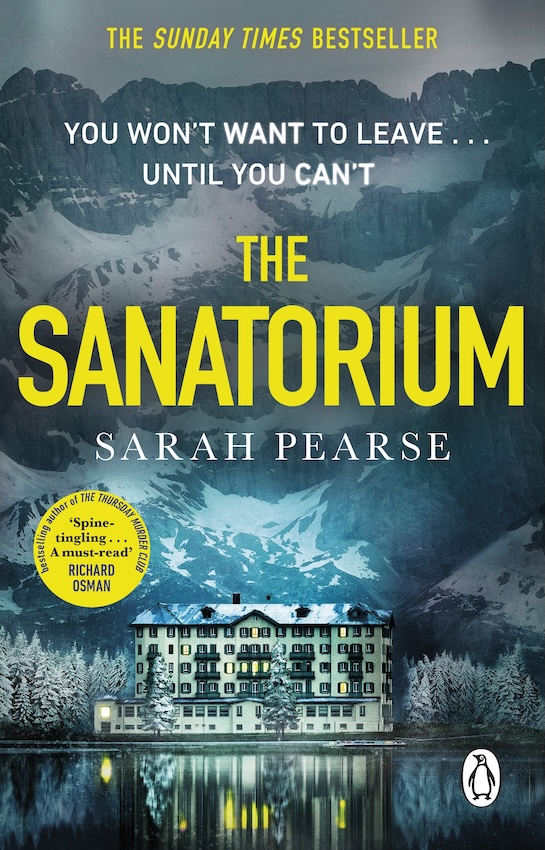
Book Review: The Sanatorium by Sarah Pearse – a gripping mystery-thriller set in the Swiss Alps

I like a good thriller set in an environment which hampers the investigation. There are plenty set in Scotland, but The Sanatorium might be the first I’ve read set in the Swiss Alps.

It’s January, so winter is well established, when Elin and her boyfriend, Will, arrive at a swanky hotel that was a former sanatorium for tuberculosis patients. They are there to help her brother celebrate his engagement to Laure, who works at the hotel, but before the other invitees arrive, the weather worsens, with avalanche warnings threatening the only road out.

Which is one problem. When Laure goes missing Elin starts digging. She’s a cop on extended leave after losing her mother to cancer and a particularly horrific case that left her traumatised. Elin’s also worried about her brother Isaac and has a score to settle. He was there when their young brother died, and because of their constant rivalry, of Isaac’s endless need to prove himself, Elin has often wondered if Isaac was being honest in his account of what happened all those years ago. So there’s that.

When weather conditions deteriorate to such an extent, the call goes out to evacuate the hotel, a body is found in the pool. Now that the last bus out has gone, the police can’t get in, so Elin is asked by the hotel owner, Lucas, to help. Despite her ongoing anxiety – she has panic attacks and flashbacks – Elin has to step up. She has been ignoring her boss’s frequent emails asking when she’s coming back to work, and trying not to think about Will’s wanting to make their relationship more permanent. So she’s got a lot going on in her personal life, too.

But the reader knows this is going to be Elin’s chance to prove her worth, without the support of her team, with a killer somewhere in the hotel, a missing woman and a dead body. The weather batters and threatens and the remaining guests and staff are unsettled. There’s also the mystery hovering in the background of what happened to Daniel, the hotel’s architect, who disappeared a couple of years before.

And then there’s the hotel itself. An austere architectural monstrosity, ground-breaking to some, like Will, who being an architect, is impressed. But Elin finds it unnerving. So much glass, and windows that don’t let you ignore the weather outside. But it’s the building’s former purpose that is really chilling. Laure shows Elin a storeroom before she disappears, which still houses some grim-looking equipment. Even the artwork that graces the hotel walls is a stark reminder that many people came here with incurable illnesses.

So there’s an awful lot here to build tension, inside the hotel and out, with Elin’s inner struggles and the case to worry about. I started this novel as an audiobook which is really well-performed by Gemma Whelan, who has to do French and German accents and pulls off the characterisation with aplomb. But it was such an engrossing story, I wanted to get my hands on a physical copy as well. I galloped through it all and found it overall a pretty good escapist read – four stars – with the promise of two more mysteries in the Elin Warner series to look forward to.

Book Review: Shadows of Winter Robins by Louise Wolhuter – a tense, dark, twisty story full of family secrets

Shadows of Winter Robins is psychological suspense with a big emphasis on the psychological. Our main character, Winter Robins, is in therapy for something she did that was at best misjudged, at worst a chargeable offence. The therapist encourages Winter to dig deep, and soon we’re transported to a council house in Harrogate, 1994, and Winter’s childhood. There’s a twin brother Four (he’s the fourth in his line to take the name Lewis), and loving parents, Nancy and Lew. But when Nancy dies, Lew falls apart, and though she tries, Gran is just too old to manage.

Lew writes to Nancy’s family in Western Australia and an uncle they’ve never met arrives to bring Winter and Four home with him. Although the children quickly enjoy time with their uncle, who has the nickname Dog, it’s a heart-breaking wrench, but the possibility of an idyllic childhood is obvious. Grandfather Harry is a successful artist and lives with their grandmother on the coast, off the beaten track. So there’s the beach to enjoy and fresh air and good food. Such a change from England. There’s also the housekeeper’s boy, Gabe, the same age as Winter, who is friendly too.

But there’s a darkness to Harry – he has a temper and is domineering, and rarely kind to the children, or his wife. His housekeeper is obviously more than a housekeeper and so there’s tension, while Dog is always in and out of trouble. Terrible things happen here, and the freedom the children enjoy is tempered by a loss of innocence.

The story follows Winter’s time at the beach house, before being sent to live with an aunt to attend school. These scenes weave in and out with the sessions two decades or so later with her therapist, as well as the discovery of what really happened at the beach house. Why did Dog have to leave in such a hurry? And why did the police arrive soon after? There’s an abundance of secrets and twists before you turn the last page and some shocking revelations, going back to the time Robins’s mother escaped to Europe with her best friend, Jan.

Louise Wolhuter has written a chilling but also gripping story that keeps you guessing until the end. There seem to be endless secrets that turn what we know on its head, again and again. It’s well written, too, with evocative prose, complex characterisation and an emotional pull. Underpinning the story is the notion of nature versus nurture, as Robin can’t help but worry about the kind of family she has been brought to live with, a family that can be cruel and morally dubious. The possibility of violence never seems far away.

Shadows of Winter Robins is a very clever thriller, but you might need a more cheerful read afterwards, as it left me with a chill down my spine. Even so I’ll be interested to see what the author comes up next. This one’s a four-star-read from me.

Book Review: The God of the Woods by Liz Moore – a stunning thriller about family secrets and lost children in the wilderness

I found myself unable to put down this mystery-thriller set at a summer camp in the Adirondacks during the 1970s. The God of the Woods begins when thirteen-year-old Barbara goes missing towards the end of camp. Barbara’s parents, fragile Alice and autocratic Peter, are part of the wealthy Van Laar dynasty who own the camp and pay the staff who run it. They thought camp would be a good idea for Barbara as she’s been showing concerning behaviour at school and dresses like a punk.

Fourteen years before, the Van Laar’s son Bear also went missing, thought murdered by a local man who seemed to have a strange obsession with the boy. His grief stricken parents idolised Bear, who was by all accounts a popular and cheerful boy, his death something Alice could never get over. Unfortunately the suspect was never tried in court as he died suddenly – the case closed, leaving questions unanswered.

When a search is organised to find Barbara, young state trooper Judyta Luptack is determined to do her darnedest not just at finding Barbara, but in also discovering what happened to Bear, whose body has never been recovered. She suspects the Van Laars are hiding something. There’s also the recent escape of a serial killer from prison, who had been in the area when Bear disappeared. Could he have taken Barbara too?

The story dips back and forth through time, to when Alice first met Peter Van Laar, and her struggles to be seen as a person worthy of more than producing a Van Laar heir. The story is told from various perspectives, including Louise, one of the young staff running the camp who is hiding a secret. There’s also Tracy, the awkward girl who became Barabara’s friend, sent to camp following her parents’ divorce.

The story, weaving its way through these characters’ lives, and the suddenly changing timeline takes a bit of getting used to. I found myself having to really concentrate to keep up. But the sudden revelations, the cliff-hanger chapter endings and the issues each character carries with them, to say nothing of fears for the young Van Laars, keeps you on the edge of your seat as you read.

Class, power and money seem to be at the centre of things with the Van Laars and their wealthy friends, their alcohol-fuelled parties and casual disregard for the locals, their determination to keep their good name – all of which makes them unlikable. Although you can’t but help feel sorry for Alice. Other families have problems too – Judyta’s conservative Polish family are reluctant to let her live away from home, which means a long commute every day. Louise is worried about her alcoholic mother and her inability to properly care for her twelve year old brother. There’s also TJ, who has taken on the burden of running the camp, trying to fill her highly-regarded father’s shoes.

The God of the Woods is very much a literary thriller – it is so well put together, its characters all so interesting and complex, the natural wilderness setting, so peaceful one minute, full of danger the next, an evocative backdrop. The 1970s era gives us a glimpse of changing attitudes, but there’s still the paternalist misogyny lingering in the police force and wider society. It all gives you a lot to think about as you whip through the pages to find out what has really happened. It’s a brilliant mystery and a four and a half-star read from me.

Book Review: Tenderfoot by Toni Jordan – a coming-of-age novel set in the world of greyhound racing

There has been a lot about the greyhound racing industry in the news lately, with information coming to light over the cruelty towards the dogs, the frequent euthanising of young animals. This novel couldn’t be more timely but I didn’t need a lot of prompting to pick it up, having immensely enjoyed Toni Jordan’s previous novels, Dinner with the Schnabels and Prettier if She Smiled More.

Tenderfoot by Toni Jordan, is a coming-of-age novel about 12-year-old Andie. Set in 1970s Queensland, Andie narrates the story, decades later, of the year her parents marriage ended and she lost her dad, and with him the four greyhounds that made up his business.

Andie loves those dogs, especially Tippy, but they are not pets. We are introduced to the nefarious world of greyhound racing, gambling and addiction. Jordan keeps what really happens to the dogs off centre stage, which is fortunate, so we never really know the specifics of what happens to Shep, Crumbs, Sally and Tippy who used to live in the basement – the how and the when. Anyone who has a fondness for dogs might still find this sobering reading, so be warned.

Through it all Andie is a brilliant character, determined to win back her dad, her friends and her dog, solve the mystery of what happened to Macavity, her former bestie’s cat. All this despite her difficult mother, Mum’s shady boyfriend Steve, and a world that seems to block her ambitions at every turn. Andie is a determined battler with an eternal optimism that she can make everything normal again.

Jordan balances the seriousness of what happens – a promising child of parents who constantly let her down, the greyhound and gambling business, the adults with their own demons – with humour that comes from children interacting with adults who aren’t as adult as they should be. The characters come to life through dialogue, something the author does really well – the caustic remarks and endless criticism from Andie’s Mum, the sly innuendo that bounces between her and Steve, the playground politics that Andie struggles with.

Jordan recreates the 1970s, down to the choice of sweets available at the corner store. You also get a scorching Queensland climate for plenty of atmosphere and a poor neighbourhood where gambling is for some the only hope. It all comes together well for a thought-provoking and moving read – five stars from me. I read the novel courtesy of Netgalley. Tenderfoot is due for release on 26 August.

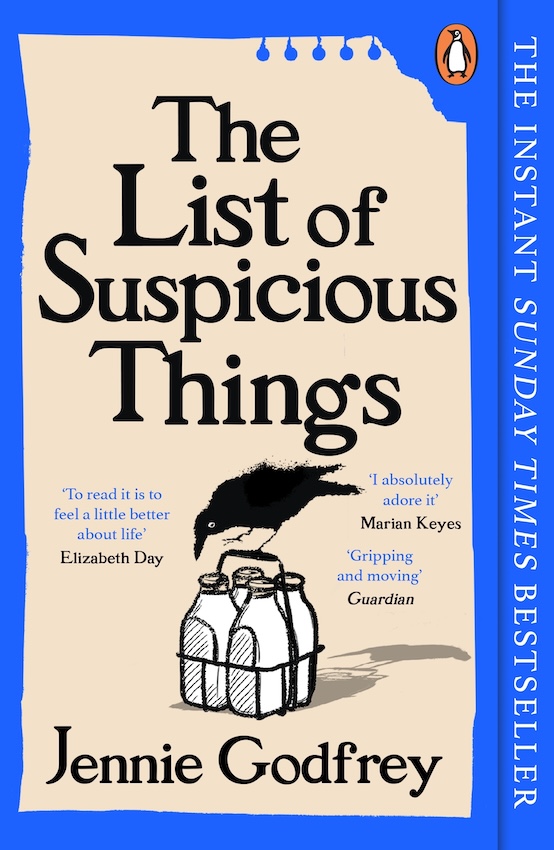
Book Review: The List of Suspicious Things by Jennie Godfrey – a story about friendship, growing up and a small town’s dark secrets

The List of Suspicious Things is a debut novel which takes you back to 1979. Thatcher has just been elected PM and the Yorkshire Ripper is at large, killing young women, while the police have few clues to his identity. In Miv’s Yorkshire town the mills have closed down, so things are already tough, and likely to get tougher. At home, Miv’s mother never speaks, Auntie Jean delivers food to the table and terse comments, while her dad seems a bit lost.

When the family thinks a move down south might be a good idea, Miv is desperate. At twelve, she’s bright but a bit socially gauche, partly due to her home life, so her friendship with Sharon is too precious to lose. She’ll do anything to save it so decides to investigate and catch the Yorkshire Ripper. She buys a notebook and makes lists, and with Sharon’s help, begins to look for suspicious characters close to home.

As names are added to the list, the reader is introduced to the people of the town, beginning with Mr Bashir who runs the corner shop. He’s one of the nicest adults Miv knows but he has dark eyes and a moustache, so makes the list. There’s a truck driver from her father’s work, people she knows from church and a teacher among others. Other people in the community include Helen at the library – because where else do you go for information in 1979?

Of course, the girls don’t catch the Ripper, but their investigations uncover some of the darker elements going on in the town – the racism, the misogyny, the prejudice against those who are a bit different. Miv learns one or two secrets that are a bit close to home, and finds herself caught up in some of the fallout. She’s a girl who is left too much to her own devices, there’s just too much going on at home for consistent parenting. But then in 1979, kids were often left to find their own entertainment and the town is their playground.

Through Miv you also see the struggles of the adults in the story. Sometimes the narrative shifts to Austin, Miv’s dad; Helen; or Mr Bashir, who each have personal sadness and secrets. The setting – the late ’70s is well realised. Mr Bashir is always singing along to his favourite Elton John songs, jeans go from bellbottoms to stovepipes and Sharon buys a glittery lipgloss to try. And it’s also very Yorkshire, though not posh Yorkshire – the kids go ‘laiking about’ and at least one character’s house has an outdoor loo.

While overall I enjoyed the book, I did feel at times that it was rather overloaded with issues. So many dark things happen with a lot to fall on Miv’s small shoulders. Still, The List of Suspicious Things is a quirky and interesting novel, easy to get lost in. I was reminded of Joanna Cannon’s The Trouble with Goats and Sheep – another novel about two young girls investigating – in this case a neighbour’s disappearance – also set in the ’70s, and which is well worth checking out. The List of Suspicious Things is a three-star read from me.

Book Review: The Treasures by Harriet Evans – an immersive family saga and the first of a trilogy

I was happy to put my hand up for this Netgalley offering as I’ve enjoyed several Harriet Evans’ novels before. She often centres her novels around an atmospheric house (Keepsake in The Butterfly Summer; Vanes in The Beloved Girls; Fane Hall in The Stargazers), which I’ve always found appealing. A bit like Manderley in Daphne du Maurier’s Rebecca.

Early on in The Treasures we hear mention of a house called Sevenstones. I imagined a grand old English manor, full of secrets and mystery. In actual fact Sevenstones has more of a cottage feel, a country bold-hole where various members of the cast of characters arrive when they need a break. For some, including Tom Raven’s parents, it was a chance to take a break from the war – World War II that is – and where relationships were forged.

But we first meet Tom as a young boy, living in a two-room cottage with his much loved Dad in Scotland. At the age of nine, he is uprooted by his Aunt Jenny, leaving the simple life behind for more opportunities in London and public schooling, even though his aunt and Uncle Henry really have no idea about children or even running a house without staff. We’re in the 1950s, and there are bomb craters everywhere, and children from the upper classes aren’t to mix with the lower orders, or so Tom’s told.

There’s also another grander house in this book – Valhalla, the American home of the Kynastons. Alice is growing up as best she can, with a father battling demons and debts owed on his orchards. When he takes his life, it seems Alice and her mother are to lose their home on the grounds of Valhalla. Wilder Kynaston was a good family friend and offers them a lifeline, but there’s a price to pay.

We’re well into 1960s by now, and as Jack and Alice grow up on opposite sides of the Atlantic, another war has arrived, and with it the rise of the protest movement, women’s lib and the chance of new freedoms and ways of thinking. The novel takes you through these changes as our two young characters’ stories are set to intersect. But family secrets lurk, throwing roadblocks in their way.

Harriet Evans captures the time really well, and the dilemmas faced by young women like Alice who are trying to forge a new path for themselves, only to find they’re still chivvying for the boyfriends they tie themselves to. The men of the establishment still hold all the power, while choices for women remain limited. But there are others too, like the fathers of both Alice and Jack, who have been left haunted by the past, plagued by guilt or disappointment, also unable to be the people they want to be.

I was curious that the book starts with a modern day setting and a character, Emma, who doesn’t appear again, discovering the ‘treasures’ of the title. These are little mementos Alice has been given by her father on each of her birthdays. But I now see that this novel is the first of a trilogy – I’ll be intrigued to see how the story continues to fill in the gaps in the books that follow. The Treasures is a rich, immersive read with terrific characters you empathise with.

The Treasures is due for release on 12 June. It’s a four-star read from me.

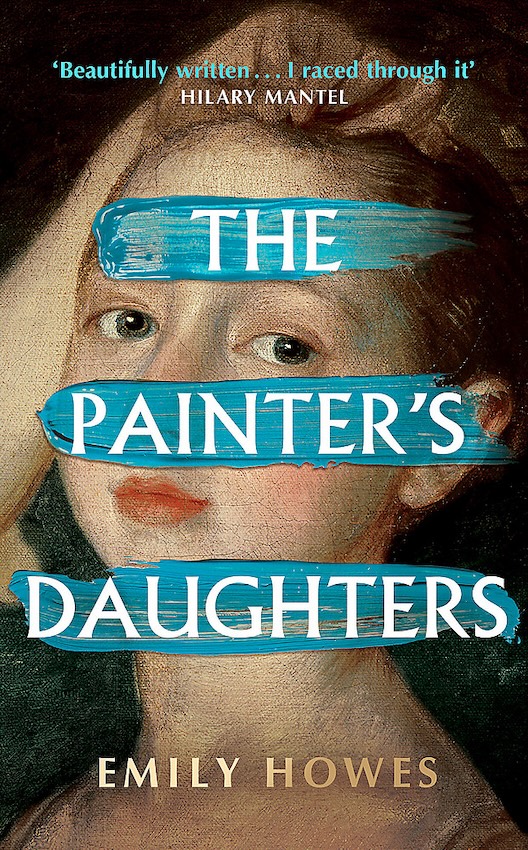
The Painter’s Daughters by Emily Howes – a stunning historical novel exploring the family of Thomas Gainsborough

I knew a little of the work of Thomas Gainsborough before I read this book, his striking portraits, the most famous of which is probably the Blue Boy, which frequently used to appear in tapestry kits. Such a pretty picture. But I remember looking at his portraits, marvelling at the light feathery brushstrokes, the use of colour, and how they seemed to capture the essence of the sitter. Then the way he might put them in a landscape setting rather than a fashionably lavish interior.

So it was interesting to learn that Gainsborough much preferred painting landscapes, was a great lover of the countryside near Ipswich where the book, The Painter’s Daughters begins. He wants his young girls to have a free and healthy country childhood just as he did. But his wife, Margaret, has other ideas. There’s no money in landscapes and the fashionable town of Bath is full of the kind of society that will want their portraits painted, and also where young Molly and Peggy might make a good marriage.

Emily Howes weaves a brilliant fiction around a well-researched collection of facts. Among them that Margaret was the illegitimate daughter of the Duke of Beaufort, although there also exists a document that suggests an even loftier parentage. Margaret knows about this and is desperate for the family to do well. She’s there in the background working on her husband’s accounts, calculating and chivvying.

Thomas is much more a bohemian character, carousing with friends, playing music and up all night. It’s a difficult household, so you can imagine how that might affect the young girls, particularly as early on, Molly appears to be mentally unstable. You would think fresh country air would be better than the sudden town environment in which young Molly and Peggy find themselves. In Bath they are kept inside, dressed in silks, the better to appear in the famous portraits painted by their father. These are his advertisements, as prominent visitors come to call.

The girls grow up, and Molly continues to be Molly, bright and seemingly well one minute, lost in a mental nightmare the next. Young Peggy adores her sister and promises to look after her, as she always has, trying to maintain a veneer of the normal in a polite society full of rules. Much of the narrative is from Peggy’s viewpoint, and she’s a constantly anxious child, watchful of her sister, but also desperate for the attention of her father.

Through the novel, is another story, that of Meg, Margaret’s mother, bullied by a brute of an innkeepr father. Meg slaves away, serving and cleaning, her life mapped out for her. When a German prince and his escort party descend on the inn, one of them dangerously ill from an infection, the men settle in until the invalid is fit to travel again. Meg catches the eye of the handsome heir to the throne.

The two stories, that of the sisters and Meg’s, make a rich contrast that brings 1700s England to life, warts and all. Both show a picture of the kinds of lives women led, with no power of their own, dependent on fathers and husbands for their livelihood. If they cannot make a good marriage, or keep their reputations intact, their futures are uncertain indeed.

This is such a satisfying read – fascinating with its descriptions of art and fashionable society, as well as the muck and mess of 18th century England. The struggle if you’re poor; the struggle to keep up appearances if you’re genteel. The book is full of images that stick in your mind from the feel of silk and lace and satin, to the stench of streets full of horse dung. A totally immersing story and so much my kind of book that it is, unsurprisingly, a five out of five read from me.

Book Review: The Berry Pickers by Amanda Peters – an emotional read about identity, guilt and the effects of childhood trauma

Amanda Peters won a cluster of awards, including a Carnegie Medal, for this novel. I’d also heard many recommendations from other readers, so have had this on my to-read list for some time. The Berry Pickers explores what happens when a young Mi’kmaq girl goes missing from the berry fields where her family are working. They are a family of five children, who with their parents travel from Nova Scotia to Maine every year to work in the berry fields to supplement their income.

Every year, they set up camp with other families, and there’s a strong sense of community as the pickers get to work. It’s the early 1960s when six-year-old Joe loses sight of his four-year-old sister Ruthie to look at something for a moment. When he returns, she is gone. An extensive search over the days and weeks that follow yields no clues while the police are reluctant to get involved; there’s even a suggestion that the family were careless. You can’t help feeling they would have been far more helpful for a local family, or a white family.

Joe grows up with this tragedy on his conscience, as well as the loss of his older brother Charlie in a fairground altercation. This sets in place a rage that will affect him for much of his life. When we meet him at the start of the book, Joe is dying of cancer. Now in his fifties, he still does not know what happened to his little sister. Is it too late now for him to find out?

The narrative flips between Joe’s story and that of Norma, a young girl growing up in a middle-class white home. Norma is disturbed by strange dreams and questions about why she is so much darker-skinned than her parents. Her mother, Lenore, is very loving, but over protective and watchful, not letting Norma out to play except in the back garden, hidden from view. It’s a strange, suffocating childhood, which has long-reaching effects on Norma and her adult life.

The plot follows the two main characters through the years – Joe trying to deal with his rage and Norma still questioning her identity, but unable to talk to her emotionally fragile mother about it. Both stories are immensely sad and this makes for quite an emotional read. There’s also the racism constantly directed at Joe and his family, particularly in the years following the loss of Ruthie and Charlie. The authorities are swift to criticise but offer no justice.

Which isn’t to say that the book is didactic or preachy. The storytelling through its two main characters brings the reader into their worlds, raising ideas about culture, motherhood, childhood trauma as well as grief and forgiveness, simply but effectively. It’s a terrific read, powerful and gripping. A four-star-and-a-half-star read from me.