Book Review: The White Hare by Jane Johnson – a haunting country house mystery with a touch of magic

We’re back in Cornwall for another novel set in the 1950s and I was in my happy place listening to this as an audiobook. I often hunt out these evocative country house stories.

The White Hare begins with a family of three arriving to take on a run-down country house with the aim of turning it into a guest-house. Somewhere comfortably-off urbanites might sojourn for a change of pace and some gentle pampering. This is Magda’s idea. In her fifties, Magda is an imperious, demanding and determined woman who won’t take no for an answer.

Her daughter, Mila, passively just does what her mother tells her, hoping to build a home for her and young Janey. But although she has strong feelings, she keeps them in check, because she owes her mother her salvation. A chance for a new start, having been duped by a bigamous husband and left with a five-year-old daughter. Remember, it’s the mid 1950s, when a woman’s reputation was everything.

The house is of course a mess, but in the barn they also discover an unwelcome guest. Jack, the interloper, says he hadn’t meant to trespass; he was just exploring the nearby countryside and would soon be on his way. But Janey has warmed to Jack, and when Jack reveals he can fix their car, and is handy with a hammer and nails, he becomes the women’s saviour when they face one crisis after another.

The locals don’t take kindly to strangers. It is said the house is haunted and when Mila mentions seeing a white hare on the road the day they arrived, all sorts of strange legends start to emerge. Then there’s Jack. He and Mila soon warm to each other, but Jack seems to be harbouring secrets. There’s also a creepy vicar, but fortunately for Mila, friendship and support are on hand from a local healer and her artist girlfriend.

The story follows Magda and Mila’s rocky relationship as they struggle to bring the house into a reasonable state of repair ahead of a lavish New Year’s Eve party Magda hopes will entice acceptance from the locals. The folklore of the area won’t leave Mila alone, and there are odd discoveries that hint at a tragedy involving the previous owners of the house.

To make things even more creepy, Janey seems to have discovered a way of communicating with an otherworldly presence through her toy rabbit. The story builds to a dramatic ending where the real and unreal converge and the present reveals, and can finally bury, past wrongs. The characters of Magda, Mila and Janey are interestingly developed – there’s nothing like adversity to bring people together.

I loved the story – the perfect sort of audiobook, narrated brilliantly by Danielle Cohen – intriguing and full of mystery with a bit Cornish history thrown in. Listening to a book like this takes me back to those old fireside tales that begin with, ‘let me tell you a story’. If you like books by Katherine Webb and Kate Morton, you’re sure to enjoy The White Hare, a four star read from me.

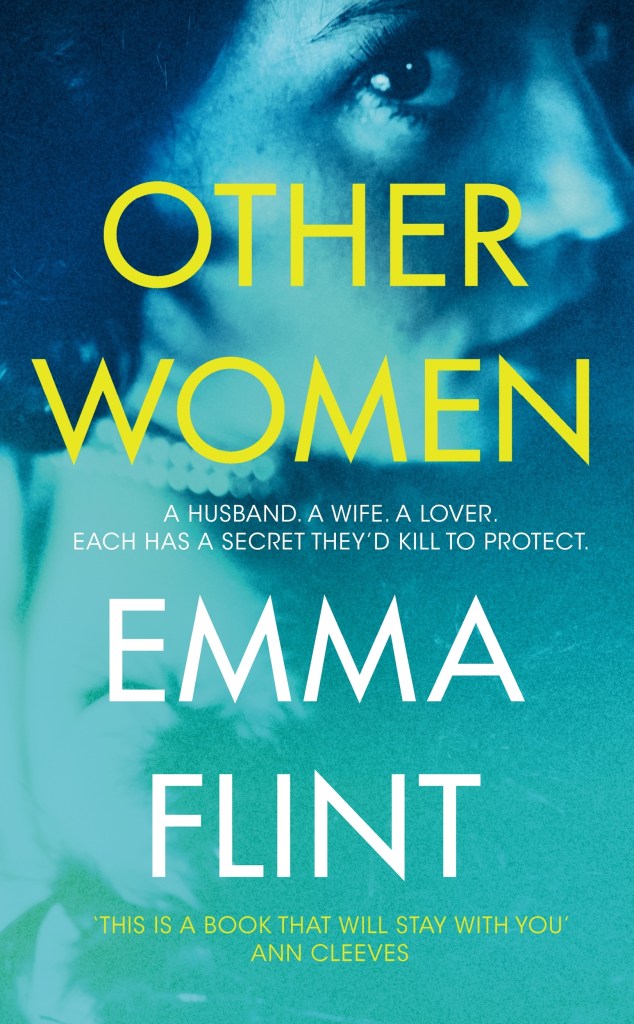
Book Review: Other Women by Emma Flint – a compelling crime story based on true events

I really had no idea what to expect from this novel when I picked it up – the description on the cover – “A husband, a wife, a lover. Each has a secret they’d kill to protect” is more beguiling than informative. Which is a bit of clever marketing probably. But it doesn’t really matter as I was soon caught up in the story which is told from the perspectives of two women.

First we have Bea, who is a working woman in the 1920s, living in a ladies’ club in Bloomsbury. She’s good at her office job and has worked her way up to have some responsibility. At thirty-seven, she feels she’s missed out on marriage and a family, but is happy with her life. She is independent and can afford to treat herself now and then. Her life is sharply compared with that of her somewhat self-satisfied sister Jane, who has married well and is a little sneering of her sister’s London lifestyle.

But at work, everything changes when a new salesman joins the team, the handsome and very charming Tom Ryan. The other girls gossip and flirt with Tom, while Bea keeps her head down and tries to ignore him. But she can’t deny the power of his personality. We follow the affair that develops, how Tom singles out Bea; their shared love of literature and self-improvement. Bea discovers another side to her that she’d mostly ignored, her capacity to love and be loved.

The story interweaves Bea’s story with that of Kate some months later as Kate deals with her husband’s arrest and the court case that follows. She is repeatedly questioned by the police about particular dates and the whereabouts of Tom, while trying to maintain a home for her daughter, and a veneer of respectability. She worries that her landlady will loose patience and they’ll be out on the streets.

I am his wife.
I am only his wife.
This is all I know how to say. To the policemen who come to the house, who take me to the police station, who ask me questions, I say over and over, ‘I don’t understand. I am only his wife.’
And they both look at me – the fat one with the moustache and the thin one with the coarse ginger hair – they look at me as though I am a child they are disappointed in.

Kate is also employed by Morley’s in the office, but at another branch. She needs her work to keep her small family afloat but how to do this with all the police activity, the newspaper interest. Kindly policeman, Inspector Wilde, is a quietly probing interrogator, patient and biding his time.

The court case that develops is based on true events. Emma Flint captures the fascination it engenders in the press and those who crowd onto the the public benches, the prejudices against the victim and the sympathy for the plaintiff. How the case unfolds is a brilliant piece of story-telling, particularly Kate’s role in the revelation of what happened, her feelings as a wife and mother balanced against her need to do the right thing.

Other Women is a haunting novel that brings to life the characters of two women who have been connected by a terrible event. It captures the post-war years and a time when Britain was still recovering from the tragic loss of a so many young men, and what this meant for women in the years following. The writing is exquisite – very atmospheric, evocative and empathetic.

As I began to read the early chapters, I wasn’t sure whether I was going to enjoy Other Women, but Emma Flint makes it all so compelling and believable and I know the novel will haunt me for days and weeks to come. Flint’s a master storyteller and writes with conviction and power. Her earlier book, Little Deaths picked up quite a few nominations for book prizes, and I imagine Other Women might well do the same. It gets four and a half stars from me.

Book Review: Good Riddance by Elinor Lipman – a witty New York comedy full of the unexpected

I’m often drawn to these sorts of New York comedies. I like the smart and snappy dialogue, the invigorating big city atmosphere – the apartments and the quirky characters who are always eating out or talking about eating out. I really enjoyed Elinor Lipman’s On Turpentine Lane, so was keen to snap this one up too. Both novels showcase this author as a writer of very original storylines.

In Good Riddance, the story follows Daphne Maritch, studying to be a chocolatier after a failed marriage and a recent move to a new apartment. It’s not long since her mother died, bequeathing Daphne, among other things, a 1968 Pickering High School yearbook. June Maritch was just a few years older than her students that year and had attended all the class of ’68 reunions, as well as annotating her yearbook with snarky comments about her former pupils.

Daphne doesn’t see any reason to keep the yearbook, and consigns it to the dumpster, where it is discovered by her neighbour, a budding documentary film maker. Geneva Wisenkorn sees all kinds of potential from interviewing the old classmates, showing them the yearbook and speculating about their teacher.

Suddenly Daphne rethinks her hasty ditching of the evidence. She doesn’t want her mother seen in a poor light and doesn’t trust her neighbour not to make her family look ridiculous. Her father was for many years principal at Pickering after all. Throw in a politician with a scandalous secret that also affects Daphne and suddenly she’s feels desperate to shut down the doco and reclaim the yearbook.

There’s a romantic twist to the story in the form of Jeremy, the young actor across the hall, who becomes Daphne’s co-conspirator. And things are complicated by Daphne’s father moving to New York. He plans to see a bit of life in the city he’s always dreamt of. When her dad takes on a dog-walking job, he has a chance to meet all kinds of women.

Lipman throws in loads of fun situations, including Daphne’s tagging along with Geneva to a reunion, a wedding, a funeral and a dramatic situation requiring Daphne to administer first aid. There’s a load of humorous dialogue and the characters butt heads and wind each other up spectacularly. It’s a fun read all round, but I have to say Daphne isn’t for me a particularly appealing character. She can be rather shouty and shrill. Maybe she needs more chocolate.

But on the whole, Good Riddance is an amusing read and Lipman’s writing crackles on the page. I whizzed through the book and will certainly read more by this author. Good Riddance is a three star read from me.

Book Review: The Last Party by Clare Mackintosh – a new promising new detective series in a moody North Wales setting

I saw Clare Mackintosh’s name connected with fellow suspense/mystery author Lisa Jewell, and being a fan of Jewell, decided she should be worth a shot. Like Jewell, Mackintosh has written a bunch of twisty mysteries, but The Last Party is the first in a series featuring Welsh detective Ffion Morgan. I like being in at the start of a promising crime series, and was soon glad I’d picked this up.

The mystery starts with the discovery of a dead body by swimmers braving a New Year’s dip. We’re in the remote village of Cwm Coed on the shore of a lake which borders England. Across the water is a luxury resort called The Shore, built by a couple of investors as holiday homes for the wealthy. These incomers don’t support the village shops, they zip around the lake on jet skies and are just generally obnoxious. So it isn’t surprising that the corpse turns out to be one of the investors, a Rhys Lloyd.

With a name like that you’d assume the victim’s Welsh. And he is – a local made good in the sense he’s become a successful star of stage and screen, and knows how to turn on the charm. His mother still owns the hardware store in the village, and it was his father’s land that he and his partner Jonny Charlton have turned into The Shore. Their New Year’s Eve party was supposed to bring everybody together and appease the villagers, but it all ends in murder. The story soon throws up a fair few suspects – it turns out Rhys is struggling to pay off creditors and his charm hides a darker persona.

DC Ffion Morgan is on the spot – she’s local, still living with her mother and sister in Cwm Coed, but for all that she’s something of a lone ranger. She drives an old Triumph at tearaway speeds over the winding rural roads and has a burning secret. She’s also shocked to discover that her one-night stand from the night before is the English cop assigned to assist on the case.

DC Leo Bradey is an intelligent and promising police officer from Cheshire, with a whole lot of baggage. His ex-wife is going out of her way to exclude Leo from being a parent to their young son, whom he adores, and his boss makes him the butt of all his tasteless jokes. Working with Ffion doesn’t get off to a great start either, but they slowly form a team. They soon discover that hardly anybody doesn’t have a motive for killing Rhys Lloyd.

The Last Party is a much better than average murder mystery. Clare Mackintosh is a former police officer herself so the story has a ring of authenticity. However, there’s a lot more than police work here. Family dynamics, old scores and the effects of burying damaging secrets all add to a character-driven, atmospheric read, the evocative setting adding a ton of interest.

As well as the dangers of the lake, there’s snow to contend with and the story builds to a life-and-death climax that has you on the edge of your seat. This is helped by a plot that switches back and forwards in time and between characters, mostly Leo and Ffion but also the key players and suspects. I was fair racing through the chapters to see what happened next. And then there are the twists.

For a diverting crime read, The Last Party doesn’t put a foot wrong and introduces a fabulous pair of detectives I’ll be happy to meet again. I’ll happily give it four stars. A Game of Lies, the next Ffion Morgan mystery, is due to be released later this year.

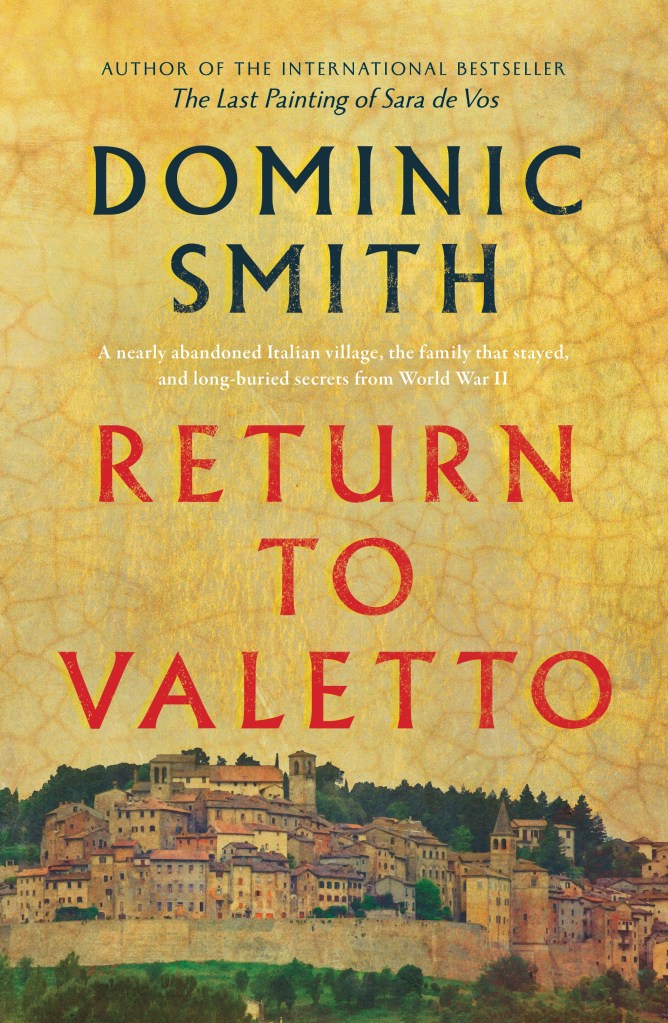
Book Review: Return to Valetto by Dominic Smith – back to Italy with a gorgeous evocation of place and atmosphere

Well, yes I know this book is about a lot more than its setting. There’s a man’s lingering grief for his late wife. A family of elderly women and a secret they never got to grips with from World War II. There’s some parent-child dynamics and a potential love affair. And all of it comes together in a captivating story that maybe takes a little while to get going, but once you get in, has you nicely hooked.

But when I look back on this book in months and maybe even years to come, I know it will be the setting that I’ll think about first. Valetto is Dominic Smith’s invented town in Umbria, which sits on a pedestal of volcanic rock. Much of the old town has fallen down into surrounding valleys, a 1971 earthquake urging many of its inhabitants to relocate. It has become a kind turreted and terracotta island, connected to the surrounding landscape by a footbridge.

Hugh is an American historian who specialises in the study of abandoned towns – there’s hundreds of them dotted around Italy and what better place to begin than Valetto, the childhood home of his mother and where even today his grandmother and three aunts still live. The Serafino women, all widows, are a big chunk of the population which has dwindled to just 10. In a few weeks it is to be his grandmother’s 100th birthday and a party has been planned.

A spanner in the works is the woman who has taken possession of Hugh’s cottage on the Serafino property, supposedly given to her mother for services rendered when Hugh’s grandfather, Aldo, was a resistance fighter during the war. Elissa Tomassi is adamant that the cottage is legally hers, just as Hugh’s aunts are convinced she’s a squatter with no legal tenure. Hugh is sure there can be a way to keep everyone happy and is caught in the middle. But he has to get to the bottom of what happened during the war and discovers not one but two family mysteries to solve.

The past will take Hugh back to Elissa’s home town in the north of Italy to find out what Aldo did in the closing years of the war. He’ll also discover a link between his mother and the Elissa’s that is a trickier memory to unlock and will reveal a crime that has been swept under the carpet. The story builds to a powerful and moving conclusion that has you glued to the final chapters as past deeds are dealt with.

What could be done with the wreckage of the past? As a historian I’d always believed that studying the past could reveal hidden meanings and patterns, that motifs lurked in the underbrush, but now I saw the neap tide of history washing up flotsam on an empty beach.

I enjoyed Return to Valetto enormously, not only for the setting which seems to be a big part of every scene. The late autumn mist across the valley that comes and goes and adds even more mystery. The large old villa that is the Serafino home with its cavernous rooms and crumbling frescoes. There’s the old family restaurant established by his grandmother, where you can see abandoned place settings and dusty menus from a night in 1971. (Oh, did I forget to mention this books is also a hymn to Italian regional cuisine?)

And the characters are a joy. The three aunts, each with their own peculiar ways and at times difficult interactions with each other. I have a particular fondness for books about aunts, going back to P G Wodehouse’s Bertie Wooster stories, and here Iris, Rose and Violet are brilliant. The grandmother with her iron determination to host an unforgettable birthday celebration with an ever-growing guest list and a despairing cook. Both Hugh and Elissa have daughters that make an appearance, so it’s an inter-generational tale as well.

I can’t help feeling Dominic Smith had a wonderful time researching and writing this book as his love for history, particularly social history, as well as all things Italian shines through. This is the second novel by this author I have read and recall that Bright and Distant Shores was one of my top reads for the year it came out. I’ve heard lots of good things about The Last Painting of Sarah de Vos as well. Return to Valetto gets the full five stars from me.

By the way, the fictional town of Valetto is inspired by Civita di Bagnoregio in Lazio – in case you want to visit, either in person or via the Internet.

Book Review: The Lincoln Highway by Amor Towles – the rocky road to adulthood in 1950s America

The latest novel from Amor Towles, author of A Gentleman in Moscow which I simply adored, is quite a different kind of book. Perhaps Towles needed a change from setting a novel almost entirely within the confines of a hotel – albeit a fairly grand one.

This time he’s taken us on a kind of road trip. And instead of a man of experience and taste as our main character, we’ve got several friends around eighteen years old, young men who met at Salina, a correctional facility for youth. It’s 1954 America – a conservative period full of opportunity. But these are lost boys, lacking parental love and guidance, having to overcome a misstep on their path to adulthood if they have a chance of making a life for themselves. We see them as they set out to do this in different and at times conflicting ways.

First up is Emmett, whose father died while he was away, leaving a farm in hock to the bank, awaiting a mortgagee sale. His younger brother, Billy, only eight, has been cared for by the neighbours, a farmer and his kindly, maternal daughter Sally. She has a soft spot for Emmett, but can only show this by cleaning the boys’ house and bringing them lovingly cooked meals. Otherwise, she’s usually giving Emmett a piece of her mind or stony silences.

After Emmett has been returned to his family home by the warden, Duchess and Woolly, two escapees from Salina, surprise Emmett, having stowed away in the trunk of the warden’s car. Duchess has been worried about sensitive, childlike Woolly, who has been struggling. So Duchess, an impulsive charmer, has taken matters into his own hands, seen an opportunity to save his friend, and get his hands on enough money to set them all up in life.

Sensible Emmett is appalled, having promised to take Billy to California in search of their mother and build a new life with the small stash of savings his father has left him. So many side-trips, diversions and interruptions hamper Emmett’s best of intentions and the four of them end up heading for New York one way or another.

Billy’s one consolation all the time he has been missing his mother, his brother’s time in Salina, his father’s passing and the loss of their home, has been a compendium of epic journeys by the heroes of literature – Achilles, Jason and Theseus for example – one for every letter of the alphabet. That and a handful of postcards written by the boys’ mother showing her progress west. And the best way to get there according to Billy is the Lincoln Highway.

I learned a lot of interesting things in this book. How to ride the empty cargo wagons on a freight train while avoiding being clocked by the guards. A trick with a cork and an empty wine bottle. How if you plan to stowaway in the trunk of a car, put teaspoon in your pocket so you can pop the lid when you want to get out.

The funny thing about a picture, thought Woolly, the funny thing about a picture is that while it knows everything that’s happened up until the moment it’s been taken, it knows absotively nothing about what will happen next. And yet, once the picture has been framed and hung on a wall, what you see when you look at it closely are all the things that were about to happen. All the un-things. The things that were unanticipated. And unintended. And unreversible.

Echoes of Billy’s compendium appear among the characters – not only the journey the boys take to New York, but in the helpful cargo train rider, Ulysses, who rescues Billy from a thief posing as a preacher. As you can see the novel has a picaresque quality about it, and that reminds you of stories like Don Quixote and Candide with the varied people the boys meet, the kind and the duplicitous, and the continued reversals of fortune.

And then you have the allusions to the tragic heroes like Macbeth who have a fatal flaw that can so easily lead them into disaster. Each of the boys has his own character fault that led him astray and on to Salina, and which they each must master if they want to avoid disaster. So the characters are affected not only by external events of fate or coincidence, but by those of their own making, their desires and needs.

There is so much going on in The Lincoln Highway I am sure I need to read it again to get the most of it. But again, Towles is such a delightful writer that every sentence is a joy. Situations that have the reader sighing an “Oh, no!” are nicely balanced with humorous ones and the story is paced and developed perfectly to its conclusion. I possibly didn’t like it quite as much as A Gentleman in Moscow, but it’s still a four and a half read from me, and I can’t wait to see what Towles comes up with next.

Book Review: Paper Cup by Karen Campbell – walking in the shoes of a character at odds with the world

It can’t be easy to write from the point of view of a homeless person, particularly one like Kelly. She’s around fifty, an alcoholic whose thoughts never seem to stray far from where she’s going to get the next drink. You might think this makes Paper Cup uncomfortable reading too. And sometimes it is. But far outweighing all that is Kelly’s story and her telling of it. It helps that there’s a bunch of interesting and amusing characters around Kelly and the argo of Glasgow adds a touch of Billy Connelly. You might wonder if Glaswegians ever take themselves seriously.

Paper Cup is a kind of road novel, beginning during a Glasgow evening when a bride-to-be on her hen night makes a connection with the person dossing on a nearby bench. Fed up with the indignities of her evening, bride Susan flings down the bag of pound coins she’s earned for kisses from strangers but accidentally loses her engagement ring. Susan will be heading back to Galloway for her wedding a week away, and she’ll be aghast to discover her ring’s missing.

Kelly has been running from the past, a past that began in Galloway and has caused her to cut ties with her father and sister. What happened ruined Kelly’s life, setting her on a path of self-destruction and she’s been running from it all ever since, losing herself in alcohol. Suddenly, over twenty years later, there’s a reason to go back, and she has a week to get there. Along the way Kelly will meet people who help her, though many avoid her – she smells after all. And in her unlikely way, she’ll help others too, even saving a life and rescuing a dog. Kelly unwittingly becomes the unlikeliest of heroes and very readable.

She abhors it, this strange adolescent fury she feels. And this sharp recall of past events that keeps bowfing out on her – she doesny want that either. What is her mind playing at, opening doors and shaking out corners?
Just leave it well alone, Kelly.
Well, I’m trying, Kelly, I really am, but it seems we are running away with ourselves.

While it’s a kind of redemption story Paper Cup is also packed with humour. The way Kelly just brazen things out, getting away with all sorts, to feed and clothe herself – but then when you have nothing but what you carry with you, sometimes it’s the only way. She finds herself joining a kind of pilgrimage of sacred sites around the coast. She’ll learn about a leper colony and about two women condemned as witches for not adhering to the local faith. History repeats in its casting off of those who don’t fit in.

The novel is also reasonably pacy. With her deadline of one week to reach Susan before her wedding, there are moments when you feel Kelly hasn’t a hope of making it on time. And her wild disregard for rules throws her up against forces that want to stop her, including her own demons. Meanwhile she’s caught the attention of the news media who want to tell her story. You desperately want to give Kelly a hand and fortunately, eventually, someone does.

Paper Cup is a brilliant, heart-felt read, the writing is stunning and it will have you thinking. The next time you come across a homeless person, you might feel inclined to throw a coin into their paper cup. Or maybe you won’t. Either way, you might think about what has happened to them to bring them to the streets. This novel is one of my top reads for the year and gets a well-earned five out of five stars from me.

Book Review: Where the Crawdads Sing by Delia Owens – a mystery that brings a marshy wilderness to life

I may be the last person I know to read this novel, but with the movie causing a lot of chat – both positive and negative, I thought it was about time.

Where the Crawdads Sing is one of those novels that sweeps you away. You can’t help but get lost in the world of Kya, abandoned by her family, by anyone she takes a shine to, but just gets on with the hand she’s dealt. The story starts in the early 1950s when Kya’s six, living with her family in a shack among marshes on the North Carolina coast. Her father’s a violent drunk with PTSD from his war service and has fallen out with his own once-grand family as well as his in-laws.

Kya’s mother is the first to leave and you struggle to understand how she could walk out on her family, particularly young Kya. But she’s a victim of so much abuse, it’s all she can do to get herself to safety. Soon Kya’s brothers and sisters leave too – they’re just old enough to make a life for themselves, but it’s a shame no one thought about their little sister. Meanwhile Kya, who teaches herself how to cook and keep herself alive, avoids the worst of her father’s mood swings, until he too leaves.

Kya has avoided school. Her single day in the classroom a rude awakening to prejudice and bullying. Still just a kid, she has learnt to navigate the marshes in her dad’s old boat. She discovers that the elderly black man who sells fuel, also sells fresh mussels so Kya finds a way to support herself. Thank goodness for old Jumpin’ and his kindly wife who look out for Kya, offering used clothing and affection.

And thank goodness for Tate, the boy a few years older, who teaches Kya to read and write. This opens doors for Kya and she is obviously very smart, soon recording the wildlife in her marsh not just with her collections of feathers and shells, the self-taught watercolours, but now with written descriptions too. But Tate is off to university and his life is set to take him in a different direction.

The story jumps forwards to 1969 with a murder investigation when the body of popular motor mechanic Chase Andrews is found at the bottom of a defunct fire tower. Did he fall or was he pushed? Sherriff Ed Jackson finds no fingerprints and enough to suggest foul play and soon his attention turns to the Marsh Girl. The old prejudices against Kya have never left and she becomes an easy scapegoat.

The murder investigation propels the story along, while weaving in Kya’s backstory, her growing up and her relationships with two young men. This is interesting enough, but what really makes the book special is the way Delia Owens brings the marsh to life – the watery passageways, the plants that grow there and the wildlife. This is described vividly in Kya’s distinctive voice which helps you see the world through her eyes.

“Crawdads” is an engrossing read and the character of young Kya as she learns to make a life for herself both heartbreaking and fascinating. The court case against Kya is gripping too, although I did find the plot lagged a little in the middle. And I couldn’t help thinking of Hardy’s Tess of the D’Urbervilles, which kind of skewed my reading of this novel. Perhaps this earlier work was an inspiration for Owen’s book or it may have just been me. I guess it’s true that every reader reads a different book. “Crawdads” gets three and a half out of five stars from me.

Book Review: The Way It Is Now by Garry Disher – old crimes surface in Aussie Noir mystery

I remember when Jane Harper’s stunning novel The Dry hit the shelves and suddenly we all wanted to read more Australian crime, or Aussie Noir as we soon called it. And all the while it seems Australian author Garry Disher has been producing reliably readable and award winning crime thrillers for years. I’d heard of him of course, but this I am ashamed to admit is the first Garry Disher novel I’ve read. At the end of which I could only shake my head and ask myself, what took me so long?

The Way It Is Now is Disher’s latest stand-alone novel. It’s about Charlie Deravin, a police officer on disciplinary leave who has nothing better to do or anywhere else to go but the old family beach house on Menlo Beach. While there’s plenty of surfing and Christmas to think of – his daughter’s visit is something to look forward to – there are reminders of the past at every turn.

The son of a cop, Charlie grew up in a society where the friends who came to family barbecues were other cops. And some of them are still around. But the most haunting thing for Charlie is the disappearance of his mother when he was a rookie policeman part of the team looking for a boy missing from a school camp. Assumed drowned, the child disappeared the same day as Charlie’s mother, a high school teacher who’d just popped home unexpectedly. Her car was found abandoned with evidence of a struggle. Newly separated, many people pointed the finger at Charlie’s dad.

The story weaves Charlie’s memories of the past with his ongoing relationship with his brother who hasn’t spoken to his father since, and his father now ailing but still receiving poison pen letters. There’s also the case Charlie has been suspended from, which caused him to fall out with his boss, but also brought a new love into his life. Anna was a whistle-blower in a case of jury tampering and someone’s trying to silence her. So nothing’s going well for Charlie. As Charlie uncovers the past, two dead bodies are found at a construction site and the police see even more links to Charlie’s dad. But Charlie has seen the toll the unsolved mystery has taken on his father and believes in his innocence. The book becomes a race to prove his innocence while the old man begins to fade.

While the plot is complex and interesting enough, humming along with plenty of suspense, Disher really excels with his characters. Charlie is likeable enough but flawed – the disappearance of his mother niggling in his mind for twenty years. This has put a strain on his marriage to say nothing of his work in Vice. There’re the old-school cops that he bumps onto at the beach, particularly Mark Valente who was like a second father to young Charlie and epitomises the old-boys club of local cops. Minor characters are no less interesting

While Valente seems a benign presence, he evokes a sense of not rocking the boat and keeping the past in its place. Charlie’s brother Liam loathes the man for his homophobic attitudes. Misogeny also lurks throughout the book – his mother’s nervousness around her lodger, the nasty rape case that was Charlie’s downfall, the attitudes to police wives. Disher brings it all to life in a way that seems authentic and adds a tone of menace.

I enjoyed The Way It Is Now as an audiobook, which was superbly read by Henry Nixon and made me feel I was at the beach on Australia’s Victoria coast. Disher evokes the Australian landscape well, so I’m going to see where else he takes me. This books gets a four out of five from me.

Book Review: It All Comes Down to This by Therese Anne Fowler – a compelling sisterly drama

Stories about sisters seem to pop up in all kinds of literature. They’re in those fairy stories I loved as a kid (Cinderella, The Twelve Dancing Princesses, Snow White and Rose Red), several Jane Austen novels, to say nothing of King Lear which we read in high school. What is it that we like about sister stories so much? Is it because you get to see a family from several different angles? Whatever the reason, I absolutely devoured It All Comes Down to This.

The book starts out in New York – another plus for me – where Marti Geller is getting her affairs in order. She has only a couple of weeks to live and is remarkably calm about it; the hospice people are wonderful. She has written in her will that the family cottage in Maine is to be sold and the proceeds divided among her three daughters. This creates a mixture of responses from the sisters, particularly as she has chosen her son-in-law as her executor.

Beck is appalled at the idea of the sale. The cottage has been their vacation home for decades, even if no one’s been there in a while. Her sisters could use the money, but Beck is looking for a bolt-hole. With her children grown-up she wants to finally write that novel. She’s an accomplished journalist, but the novel has been in the back of her mind for years. It doesn’t help that her husband Paul is an editor for a publishing company that has nurtured award winning novelists. Having him peering over her shoulder just stifles any creative juices. Secretly, Beck wonders if Paul might be gay.

Middle sister Claire is recently divorced, having admitted to her husband after too many drinks at a party, that he wasn’t the love of her life. She still carries a torch for someone else. As a girl, Claire struggled to compete with assertive Beck or pretty younger sister Sophie, the family darling, so she worked hard at school. Now Clare’s a paediatric heart surgeon, still with a huge student loan to pay off. The divorce has been another financial burden and she’s got a young son to think of. Selling the cottage in Maine would be a godsend.

While her older sisters married early and settled into family life, Sophie is single at thirty-six and trying to live the dream, or at least what her Instagram followers think is the dream. She works for an art gallery in New York, using her bubbly personality to seal deals with up and coming artists and their buyers. This involves travel and looking the part and being at all the right parties. She has maxed out all her credit cards and lives out of two suitcases, house-sitting to put a roof over her head, while everyone thinks she has a flat of her own which she sublets. Sophie could definitely use a hefty cash injection.

The narrative cycles between these three women as well as Paul, who has a burning secret of his own and C J Reynolds the cottage’s prospective buyer. C J is interesting in that he’s just served a term in prison for shooting at his father. Another character with family baggage. He settles into a friend’s lavish home on Maine with the idea of buying in the area and is surprised to have to share the house with two other unusual house guests: an elderly patrician woman and her newly orphaned grandson. This creates some wonderful scenes as the three learn to get along with each other.

The story burbles along between all of the above characters and while they are likeable enough, the author doesn’t shirk from showing us their faults and foibles. The story is paced nicely as Beck does her darnedest to hang on to the cottage and the lengths she will go to. Claire’s story is more of an emotional one while Sophie gets in a tighter and tighter spot as her financial house of cards looks set to crumble.

So, as I said, I simply plowed through the book, thoroughly entertained and curious about how it would work out for all five characters. But to tell the truth the ending fell a little flat for me. Was it a bit too fanciful, a bit rushed? Or was it that when it came down to it, I found the sisters just a bit foolish, annoyingly so even, and not quite likeable enough. So this one’s a three and a half out of five from me. I’ll still hunt out more books by this author though.