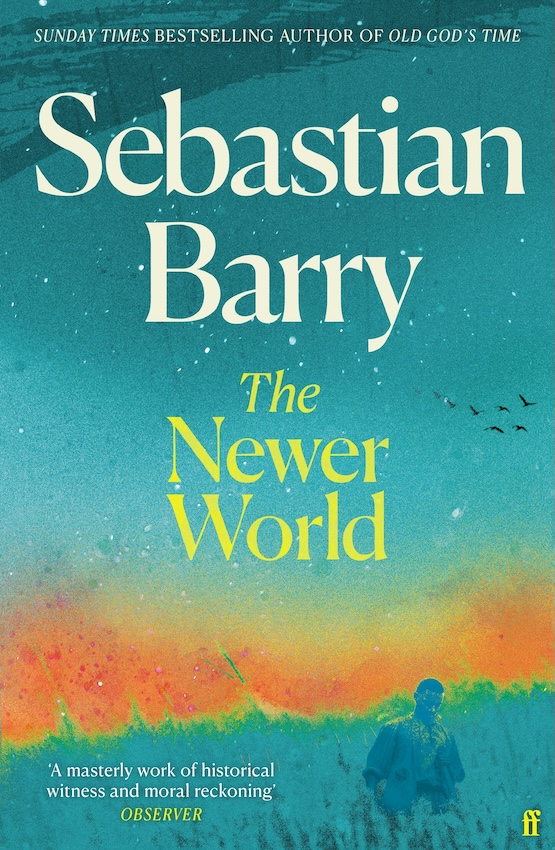
Book Review: The Newer World by Sebastian Barry – life beyond the American Civil War for a man born into slavery

Sebastian Barry is one of those writers who can create such perfect sentences you pause in your need to find out what happens next just to enjoy them again. So I was happy to throw my hat in the ring for his new book, The Newer World, when it was offered on Netgalley.

The story kind of follows on from Barry’s earlier books set in America around the time of the Civil War (Days Without End and A Thousand Moons). Characters from those books cross paths with our main character in this one – Tennyson Bouguereau, a man born into slavery. We’re in rural Tennessee, where Tennyson grows up with his twin sister Rosalee, losing his parents in one act of brutality after another. The Civil War and the end of slavery brings hope of freedom, but there are many in the area who supported the Confederate cause and don’t see the freed slaves as anymore deserving of a decent life than before.

The farm where Tennyson and Rosalee work is owned by the Magan family, who only just make a living from their land. But at least they are more kindly than other landowners. Luther Magan even allows the children to be educated and passes on a patch of land to the twins when he dies. His son Elija (Lige) however signs up for the Union during the war, which marks the Magans out among their neighbours. The war seems to bring out the worst in them, and when Tennyson defends the Magans property and his new friends (Lige has opened his home to Cole, McNulty and Winona, from the earlier books), he must leave abruptly, or risk being lynched.

So begins a tale of new beginnings and abrupt departures as Tennyson attempts to make a life for himself. A sympathetic lawyer named Briscoe helps him on his way and Tennyson makes the journey to Nashville where his singing voice lands him an opportunity to join a touring choir. A new friend, George, helps him adapt to his new life. As a reader you realise how basic a slave’s life could be as Tennyson learns about cleanliness and to dress in a suit, his old rags thrown away.

Still, it seems that whatever Tennyson learns and however much he adapts, freedom doesn’t equal acceptance in a white dominated society, and danger and injustice hover around him. But you can’t help feeling hopeful, particularly when he falls in love and is appreciated for his singing voice. Nothing is plain sailing, though, and Tennyson must make a terrible choice, between love and the obligations of friendship.

Barry does an amazing job of recreating the period and the people, his main character feels truly authentic and his struggles really tug on your heart. He’s also a witness to an America putting its colonial stamp on its land which is truly illuminating. For all he endures, he’s a survivor and by the end of the book, you can’t help but feel that there might be another story for Tennyson, and another book. I’d certainly be keen to see how his story continues. Another masterly work from Sebastian Barry, The Newer World is a five-star read from me.

The Newer World can certainly be read as a stand-alone novel and is due for publication on 10 September. With thanks to Netgalley and Faber & Faber, in return for an honest review.

Book Review: The Berry Pickers by Amanda Peters – an emotional read about identity, guilt and the effects of childhood trauma

Amanda Peters won a cluster of awards, including a Carnegie Medal, for this novel. I’d also heard many recommendations from other readers, so have had this on my to-read list for some time. The Berry Pickers explores what happens when a young Mi’kmaq girl goes missing from the berry fields where her family are working. They are a family of five children, who with their parents travel from Nova Scotia to Maine every year to work in the berry fields to supplement their income.

Every year, they set up camp with other families, and there’s a strong sense of community as the pickers get to work. It’s the early 1960s when six-year-old Joe loses sight of his four-year-old sister Ruthie to look at something for a moment. When he returns, she is gone. An extensive search over the days and weeks that follow yields no clues while the police are reluctant to get involved; there’s even a suggestion that the family were careless. You can’t help feeling they would have been far more helpful for a local family, or a white family.

Joe grows up with this tragedy on his conscience, as well as the loss of his older brother Charlie in a fairground altercation. This sets in place a rage that will affect him for much of his life. When we meet him at the start of the book, Joe is dying of cancer. Now in his fifties, he still does not know what happened to his little sister. Is it too late now for him to find out?

The narrative flips between Joe’s story and that of Norma, a young girl growing up in a middle-class white home. Norma is disturbed by strange dreams and questions about why she is so much darker-skinned than her parents. Her mother, Lenore, is very loving, but over protective and watchful, not letting Norma out to play except in the back garden, hidden from view. It’s a strange, suffocating childhood, which has long-reaching effects on Norma and her adult life.

The plot follows the two main characters through the years – Joe trying to deal with his rage and Norma still questioning her identity, but unable to talk to her emotionally fragile mother about it. Both stories are immensely sad and this makes for quite an emotional read. There’s also the racism constantly directed at Joe and his family, particularly in the years following the loss of Ruthie and Charlie. The authorities are swift to criticise but offer no justice.

Which isn’t to say that the book is didactic or preachy. The storytelling through its two main characters brings the reader into their worlds, raising ideas about culture, motherhood, childhood trauma as well as grief and forgiveness, simply but effectively. It’s a terrific read, powerful and gripping. A four-star-and-a-half-star read from me.

Book Review: Alternate Side by Anna Quindlen

There is something about a New York novel – and Alternate Side could be the quintessential New York novel – that always seems to appeal. Maybe it’s because New York is one of those cities that people dream of calling home (like Paris or London, for that matter) – the culture, the food, the parties the opportunities…

And so it is for Nora Nolan, who turns up in New York after college, and here meets Charlie. Alternate Side is partly the story of their marriage, and their finest achievements as a couple – their twins, Rachel and Oliver. And then there’s their house. The Nolans live on a quiet block of infinitely expensive Victorian houses, with a dead-end which makes it even more of an enclave.

They attend parties and barbecues with their neighbours, watch each other’s children grow up, use the same handyman: Puerto Rican Ricky from the Bronx. They all have nannies and housekeepers – for the Nolans, it’s Charity from Jamaica. And to give Nora credit, she does sometimes feel conflicted that all the people she knows have immigrant hired help, black or hispanic, who come from poor neighbourhoods.

Their children, their dogs, and housing prices: the holy trinity of conversation for New Yorkers of a certain sort. For the men, there were also golf courses and wine lists to be discussed; for the women, dermatologists.”

The story begins with Charlie beaming with glee, having finally been offered a space in the street’s only parking lot – an empty section which once contained a house and now has room for a select half dozen cars. As you can imagine, these spaces are highly sought after. When a violent incident occurs, involving Ricky and one of the Nolans’ more insufferable neighbours, things are never quite the same for anybody. Suddenly the gaps between the haves and the have-nots are obvious to all, not just Nora, as issues of racism and entitlement in connection with the block make the news.

Alternate Side is about keeping up appearances, as well as that old adage, be careful what you wish for, you might just get it. Everything seems to fall into Nora’s lap – her job setting up a jewellery museum (only in New York, right?) is one of a string of interesting work opportunities that always seem to come her way. Her marriage: Charlie appeared just at the right time when Nora was suffering from a broken heart. What is it Nora really wants? That is the question.

“People go through life thinking they’re making decisions, when they’re really just making plans, which is not the same thing at all.”

The story though is very much in the telling. Anna Quindlen writes with both wit and wisdom and I found myself chuckling at the snappy dialogue and Nora’s wry outlook, her interactions with Phil, the panhandler who takes up space on the path outside the jewellery museum, the obnoxious notes distributed by neighbour George about rules on use of the parking lot. There is so much to enjoy here as well as a story to make you think – and all set in New York. I loved it. A four and a half out of five from me.