Book Review: The Wakes by Dianne Yarwood – a thoughtful, contemporary read about life, death and catering

So we’re back in ‘feel-good fiction’ territory with a novel mostly about Clare, whose husband has had a kind of conniption and decided to leave their marriage. She becomes unhinged by this and takes some long service leave, and this coincides with her meeting a new neighbour, Louisa, who has plans for a catering business centred on funerals. Clare is persuaded to help out – she’s always been a dab hand in the kitchen and her chicken sandwiches are to die for – ha, ha!

Louisa is a larger-than-life character – tall and funny as well as kind. She’s soon in and out of Clare’s kitchen when Clare needs a friend. An accident that has left her face bruised and her front teeth chipped has confined Clare to her home. We find out that Louisa’s bouncy, chatty manner hides a secret heartache.

The story flips to Chris and his own marriage break-up – a relationship that has turned sour when he and his wife found they were unable to conceive. He thinks back to his relationship with Beth when he was in London – was she his one great love? He determines to find out if she is still in Australia – he has a box of her things he’d like to return. Chris is also no stranger to death, being an ER doctor, and it is this that brings about his first meeting with Clare at the caterers’ very first wake.

Clare worked at a very fast pace. It wasn’t until people began streaming through the doors that Louisa admitted how uncomfortable she felt around crowds. Somehow, stupidly, she’d thought mourners would be different. Quieter, less of a strain on her sensibilities. But not so. The opposite, really – all those families. She disappeared into the kitchen as the room filled up. I’ll hold the fort in there, she said with a look of concern and apology. And so Clare moved around the room in something approaching a run: she hovered by groups, raced off to the kitchen, came back, checked on what people had, offered plates and darted off again.

The Wakes makes you aware of the idea that “in the midst of life we are in death” in that it is the passing of loved ones and the proximity of death that makes the characters feel aware of the wonders of life. That we only have one and we must seize the day. But there’s also a lot about the complexities of friendship. Chris’s great friend is Max, who is dying; there are other friends – particularly Paul, who was also in London during the Beth era.

Paul has his own chapters, too, and his role in the story is important as a catalyst for what happens. Paul’s a kind of counterpart for Louisa in that he’s always quick with the ready wit and can rattle off a vast selection of pop culture references at any given opportunity. But Paul’s life is an empty shell. We are not really supposed to like. him – he works in advertising – but I couldn’t help feeling sorry for him. Chris, as an ER doctor, is obviously more worthy.

Perhaps it was these moral undertones that put me off the book a little. That and the funerals. It is difficult to balance the weight of grief with that of the hopeful resolutions that we wish for the characters. Sometimes it just got a bit too much. Or was it just that I liked the more light-hearted scenes better? Perhaps if I’d just lost someone dear to me, I’d have found the book more relatable. The Wakes is a three-star read from me.

Book Review: The Keeper of Stories by Sally Page – a big-hearted novel about letting go

I’d forgotten why this book was on my list – probably a glowing review somewhere (thank-you, if that was you), but was soon ensconced in the story. I quickly discovered a novel packed with quirky characters and gentle humour – two key ingredients for a pleasant, feel-good read.

The Keeper of Stories takes us to the English university city of Cambridge, where Janice cleans people’s houses and discreetly collects people’s stories. This isn’t for any inclination towards blackmail; it’s just a kind of hobby. Many of these stories come from clients: the famous opera singer who has come from humble beginnings, charming but frail Carrie-Louise, and recently widowed Fiona and her boy Adam who are still grieving. Everyone knows Janice is the best cleaner in Cambridge, but not everything’s plain sailing.

For a start there’s her husband Mike, who is a serial job-quitter, never keeping the same employment for more than a month or two. To make things worse he always leaves on a sour note. He belittles Janice for her humble work even though it’s her earnings that keep a roof over their head, and his insistence on sending their son Simon to boarding school has caused a rift between mother and son.

When two of her more difficult clients, Mrs YeahYeahYeah and her husband Mr NoNoNotNow ask her to clean for the husband’s autocratic mother, Mrs P, it might just be the straw that breaks the camel’s back for Janice. Yet she forms an unlikely alliance over stories with Mrs P. Catching the bus – Mike nearly always has the couple’s car – her attention is caught by one of the drivers who reminds her of a geography teacher.

“How many stories do you think that there are in the world? Seven? Eight? I can’t remember how many. I read in a magazine somewhere that there are only a certain number of stories ever told.”
  Mrs B sits quietly, watching her.
  Janice sighs. “You and I both know what’s coming, don’t we? It’s a predictable story. It has been played out in hovels and palaces around the world since the beginning of time. There are no new stories, Mrs. B.”
  “But this is your story, Janice, and I believe you need to tell it.”
  “Do I? Will it make any difference? I can’t change the ending.”
  “That’s where I think you’re wrong.”

Mrs P’s has determinedly unsettling ways, trading stories, including that of the scandalous Becky, a courtesan from Paris and her rise in society, in her attempts to hear Janice’s story. For we soon realise that Janice’s collecting of stories is her way of avoiding her own, a story that she feels is too dreadful to tell. Through all this, Mrs P also has a battle on her hands to stay in her university flat, while her son wants to throw her out. Janice is soon doing her bit to help.

There’s plenty of humour and whimsy in Janice’s interactions with her clients while the story builds in drama as it seems likely for Janice that change is in the air. This will not be without pain, but Janice has her friends to help her through, as well as Decius, the sweary dog that Janice walks for Mrs YeahYeahYeah, and who patently thinks Janice should be his owner.

We’re in classic ‘second chances’ territory here, and it all comes together nicely for a big-hearted read. The writing is witty enough to avoid being sentimental – often a danger with this type of book. Keen readers will enjoy the references to literature, while the characters are varied are and interesting. Look out for Page’s new novel, The Book of Beginnings, which will be out later this year. The Keeper of Stories is a four star read from me.

Book Review: Thirst for Salt by Madelaine Lucas – a story of melancholy and nostalgia told through the senses

I confess I had a couple of goes at this novel, which I’d heard such good things about. And it’s not as if it gets off to a slow start. I was soon swept up into the narrator’s story – a woman in her late thirties reminiscing about a relationship from over ten years before, and the man, Jude, whom she’s never quite forgotten.

I imagined some kind of reconciliation, a meeting of some kind. What would they say to each other? How would they feel about each other now? Would such a meeting rekindle old feelings? Would there be new revelations about what really happened?

But that’s not what happens. Thirst For Salt is a journey back to a year in the life of the narrator – do we ever learn her name? – viewed from the point of view of her older self. It’s a journey filled with nostalgia, melancholy and yearning.

Our narrator meets Jude at the beach where she and her mother have rented a cottage for a summer holiday. He’s an older man of 42, compared with the young woman’s 24. She swims a lot on her own and this attracts Jude’s concern – all kinds of creatures lurk in the water, he tells her, and there are no lifeguards at this beach. Sharkbait, he calls her.

The cool shock of the blue. Movement, water, salt, light, heat. I began every day that way, my first week at Sailors Beach. Rising up with the waves and kicking down into the depths, into those sudden cold patches where the sun didn’t reach. Patterns of light on the surface, shadows passing above, water darkening. The fear, sometimes, of something brushing past my leg – a tangle of kelp or a lone gull landing beside me. Rocks seemed to quiver on the silty bed below, and once, I caught sight of a silver ray.


Parallel to their story, is the narrator’s relationship with her mother, who was just 24 when her daughter was born, a relationship that’s almost sisterly. Her mother has always lived a Bohemian kind of life, her long separated father, an itinerant, so learning how a long-term relationship works isn’t easy. By contrast, Jude seems a more solid, settled kind of guy. He’s a man of steady habits, with his own routines. He’s even living in the old family beach house built by his father.

The novel is an intimate portrayal of a relationship that reminded me a little of Sally Rooney’s Normal People. It is also a story that evolves through all the senses – the feeling of the sea on skin, the sights and sounds of the beach, of nature, both summer and winter. There’s taste and scent as well, in the old things Jude has in his house, the meals they prepare together. And the writing is just gorgeous.

As I said, I put this book aside after the first third or so, a little frustrated at the lack of obvious plot. But I still wanted to know how it ended and found myself picking it up again as an audiobook, which in this case was read by the author. It seemed to work and Madelaine Lucas gives a nuanced and engaging performance, capturing perfectly the feelings of loss and sadness that haunt the pages. I’m glad I persevered; Thirst for Salt is a four star read from me.

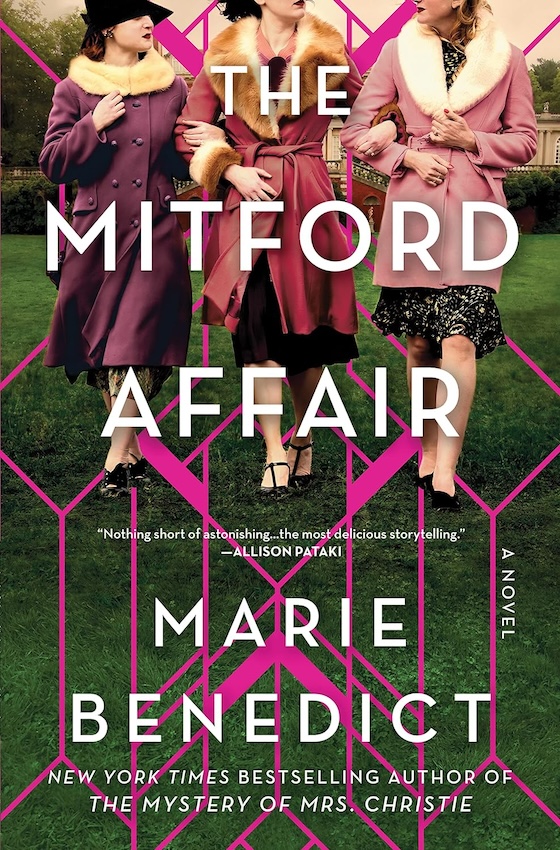
Book Review: The Mitford Affair by Marie Benedict – a novel about an extraordinary set of sisters and the politics that divided them

I’ve been fascinated by the Mitfords ever since I saw a British TV adaptation of Nancy Mitford’s Love in a Cold Climate which aired in the 1980s. Nancy was a witty novelist who moved in literary circles during the 1930s and ’40s, rubbing shoulders with Evelyn Waugh and his ilk. She mined her family and the upper classes for material for her books, which are still very readable today. Nancy had five sisters and one brother, and with eccentric parents, each sibling seemed to be more extraordinary or oddball than the next.

These are the characters that people Marie Benedict’s novel The Mitford Affair, which concentrates on the years 1932 to 1941, with the rise of fascism in Europe and the opening chapters of World War II. Told from the viewpoints of sisters Nancy, Diana and Unity, you couldn’t ask for more varied characters, each with a very distinctive narrative voice. As the years pass, Nancy watches in horror as Diana goes to ever more extremes to promote the politics of her lover Oswald Mosley, and as Unity heads off to Germany to become a kind of Hitler acolyte. As war becomes inevitable, Nancy has to decide if her loyalty lies with family or her country.

As a reader, you feel very much on the side of Nancy, who seems to be the voice of reason among her sisters. She’s also dealing with a lot personally, in particular a problematic marriage and ever more desperate attempts to bear a child. Meanwhile Diana has ditched an adoring, wealthy and titled husband for a man who is already married and the voice of fascism in Britain. She devotes her energies to his cause even when Mosley declares he cannot offer her marriage or any kind of respectability.

Then there’s Unity. Always the least liked in her family – the only daughter to be sent to school so her mother didn’t have to put up with her – you get the feeling that today, Unity would be diagnosed with a mental condition, possibly as bipolar or a spectrum disorder. Much younger than Nancy or Diana, she’s only in her late teens when we meet her, her half of her bedroom festooned with pictures of Hitler and Mussolini, as opposed to Jessica who on her side of the room has etched the hammer and sickle into the window.

After the Olympia Hall rally and the violence of the Blackshirts inflicted at the slightest provocation, undoubtedly on Mosley’s orders, I could no longer even pretend to be in the same political ranks as my sisters. Did we not live in a society where free speech was guaranteed? Could Mosley not bear the slightest critique of BUF and his rule. The strutting, posturing, flag-waving, and shows of bravado I’d chuckled at privately now seem menacing rather than humorous, and I felt an urge to unmask Mosley and his dangerous army as hooligans through my writing. I also began to wonder if I could use my writing as a way to awaken my sisters from this madness.

Unity’s adoration for Hitler is like any ordinary girl’s crush on a matinee idol, but such is her fervour, that she talks her mother into sending her to a finishing school in Munich and staking out a café popular with Hitler himself. She’s a difficult character to be with, but Benedict captures her intensity with sympathy, despite her anti-semitism and support for a cruel totalitarian regime. Hers is the saddest story of the three, and you can’t help feeling that with affection from her family, and some half-decent parenting, Unity could have had a brighter future. But that’s not to be.

This is one of those books that is so much more extraordinary for being based on real events and real people. I found myself often heading to the internet for more background, and it’s all there. The Mitford Affair is an enthralling read, although not an easy one, considering what Diana and Unity were prepared to do for a political cause that would lead to such terrible events in Europe. But I couldn’t help feeling that the writing could have been sharper – there are some rather convoluted sentences, and a few Americanisms slip through now and then. As a study of how political fanaticism can take someone over, though, it does the trick. It’s a three star read from me.

Book Review: Prettier if She Smiled More by Toni Jordan – another hilarious round with the Schnabels

I hadn’t realised until I started it, that Toni Jordan’s latest novel features a bunch of the same characters we met in Dinner with the Schnabels – one of my favourite reads from 2022. In Prettier if She Smiled More, we follow the story of Kylie Schnabel who at the start of the book is about to experience three disasters that upend her life – all before Wednesday. By the end of the week, nothing will be the same.

Kylie Schnabel, if you remember, is the oldest sibling, daughter of Schnabel matriarch Gloria. She works as a pharmacist and likes to think she has everything under control. She’s very serious and is a stickler for detail, hardworking and a little abrupt. She’s been working at the same small suburban pharmacy since she graduated, living frugally and planning her life around one day buying the shop from her genial boss Tim who’s approaching retirement.

Life’s all going to plan, until one day it isn’t. Kylie gets to work on Monday to discover that Tim is selling his shop to a chain of pharmacies, a big business conglomerate all set to modernise and refurb. Gail from Pharmacy King insists Kylie reapply for her job – just a formality, and even though Kylie has a work ethic second to none and has won a Young Pharmacist of the Year award, the reader knows it’s going to be tricky. Kylie’s sometimes grim, no-nonsense manner is going to be a problem.

Then there’s Colin, Kylie’s partner, who is supposedly away at a business conference but activity on his Fitbit suggests he’s getting up to some extra-curricular hanky-panky. Kylie suddenly sees unpatchable cracks in their relationship. When Gloria breaks her ankle and needs full-time care, Kylie finds herself back at her childhood home, dealing with a mother who doesn’t want to be looked after and somehow ends up baby-sitting Caesar, a tiny Pomeranian.

There are plenty of funny moments, and Kylie’s internal monologue is always entertaining – she’s such a force of nature. But coming home where the decor is still stuck in the 1980s and there are so many reminders of her childhood, suddenly the past comes back with a wallop. Why has Kylie’s bedroom been turned into a sewing room, while her siblings, Tansy and Nick’s rooms are still intact, just as they left them? Then there’s her parent’s acrimonious divorce and memories of her childhood anguish, of being the eldest and having to be the sensible one when her mother was in pieces.

‘Your … father, is this?’ Ramona said, picking up one of the photos. ‘Is very handsome, but familiar somehow?…
  …In those years before Photoshop, what could be done about David, who was in the centre of many of the said photos and who Gloria wished dead several times a day in a variety of painful ways? Facing the grinning face of her ex-husband every day in her own home was untenable.
  Gloria’s solution had been to cut out a range of Kevin Costner heads of varying sizes from different magazines and glue them over similarly sized David heads. Now the family photos lined up on the mantel were of Gloria and Kevin, standing proudly behind their children, young Kylie, Tansy and Nick.

There’s a lot for Kylie to deal with, all in one week, including a tennis open day for Gloria, who is a children’s tennis coach. There’s finding a nurse who will want to stay with her mother so that she can get back to work when Gloria has other ideas. Kylie’s brother Nick talks her into going on a date with one of his mates. And on top of everything, Kylie has agreed to host the family lunch on Sunday. As the pressure mounts, something has to give.

Prettier if She Smiled More is a smart and often hilarious second-chances kind of novel. The format is similar to Dinner with the Schnabels, with one character having a lot to get done as the days of a single week slip by and each day heralds more problems. The final chapter brings everything to a head and somehow everything gets fixed, but in a way Kylie, the meticulous over-planner, would never have predicted a week earlier. I loved it and wouldn’t say no to another Schnabel novel if Toni Jordan feels so inclined. This one’s gets an easy five out of five stars from me.

Book Review: The Patient by Jane Shemilt – a creepily suspenseful novel with two picturesque settings

I felt sorry for Rachel from the first page of Jane Shemilt’s latest novel. Rachel’s a respected GP, and lives in the picturesque town of Salisbury with her teacher husband. But things are distant between them – a spark has died and life’s a bit dreary. And then there’s the daughter – Lizzie, who scarcely talks to Rachel, harbouring a grudge about the lack of quality time Rachel was able to give Lizzie growing up.

But that’s not the problem. The problem is Rachel has stepped over the line with a patient and now her world’s in chaos. She wasn’t even supposed to be working when a suicidal patient turned up at the medical centre. Rachel recently lost a patient to suicide, so gives Luc plenty of time, listening as he pours out his heart. When Rachel discovers Luc is a new neighbour, having renovated the old house she remembers belonging to a childhood friend, she also meets his glamorous American wife, Ophelia, and her charming brother and Ophelia’s little boy. The perfect family – or are they?

Luc has a everything, it seems, but he and Rachel are drawn to each other but, as we all know, doctors aren’t supposed to embark on relationships with their patients – especially vulnerable ones with a mental illness. We meet Rachel as she’s recollecting everything that happened in the months preceding – her lawyer has told her to write it all down while she’s in custody. As a reader we realise that Luc has gone off the rails, that a terrible crime has been committed and somehow Rachel’s involved.

The plot see-saws in time, back and forth, filling in the gaps – Rachel’s fear she’s being followed, her tricky relationship with a woman at work, an obsessive patient, her escape to a conference in France and her affair with Luc. It seems nobody’s on her side – apart from her dear neighbour Victoria, but she’s away on photo shoots a lot or off caring for a dying mother.

As the narrator, Rachel is the perfect character for a story like this. She’s intelligent, obviously, but very trusting, so the plot delivers plenty of surprises as facts rise to the surface. As a reader you are in the position of constantly yelling, look out behind you! And why is she so vague about whether or not she locked up her house? She really needs to be more careful. But she also seems to know her stuff as a doctor – you can tell Jane Shemilt’s own work as a GP inspired her story.

The setting is gorgeous. As well as Salisbury it takes you to the South of France, and the countryside around Arles, where Van Gogh painted his sunflowers. Luc’s mental illness is a kind of echo of Van Gogh’s. But inside of a prison cell is not so nice, particularly when you’re on the cusp of losing everything.

The Patient is a well put-together, nicely written addition to psychological thriller genre. There are plenty of surprises and the before and after timeframe maintains suspense nicely. I enjoyed the novel as an audiobook, read by Hilary McLean, who gave the character of Rachel just the right tone. It’s very easy to binge on psychological thrillers like these, they can be so compelling, particularly the good ones. The Patient is a four star read from me.

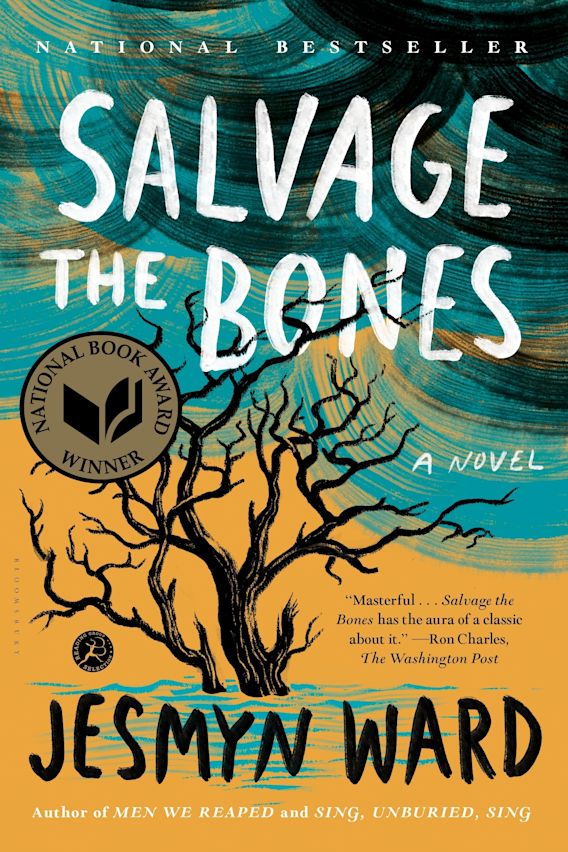
Book Review: Salvage the Bones by Jesmyn Ward – a struggling family, a desperate girl and a hurricane

It’s so easy to go for a book that’s a nice relaxing read and totally forget the wider world. But this time I took up Salvage the Bones with the idea that this might be a fairly gritty read and, well, yes it was. But it is just so instantly immersing and the storytelling so engaging that once I’d picked it up, I really didn’t have much say in the matter.

The story follows a poor African-American family living in Mississippi in the days leading up to Hurricane Katrina. This family has such a lot to deal with. Told from the point of view of fifteen-year-old Esch, we’re soon in her world – a house on the outskirts of town which she shares with older brothers Skeetah and Randall, a much younger brother, Junior, and their alcohol-dependent father.

Daddy is very hurricane-aware and weather warnings impel him to get his house in order – the bottled water and extra supplies, gathering the timber to board up the windows, but his children have other things on their minds. Randall has hopes of going to basketball camp – he’s got potential, and if he can perform well at an upcoming game, he can earn some sponsorship. Skeetah is more entrepreneurial; his pit bull is due to give birth to puppies and China being such a good fighter, he thinks he can sell the pups for a good price.

Junior has been cared for since day one by his older siblings and is a bit of a loose cannon, though very much loved. And that’s the thing. There is such a lot of love in this family between the siblings, but without a lot of parental guidance things pretty soon go haywire. And no one is more desperate than Esch – in love with one of her brother’s friends who is blatantly using her, and pregnant. But Esch is also a reader, dipping into a book of mythology from school, especially drawn to the story of Jason and empathising with the ill-used princess Medea.

After Mama died, Daddy said, What are you crying for? Stop crying. Crying ain’t going to change anything. We never stopped crying. We just did it quieter. We hid it. I learned how to cry so that almost no tears leaked out of my eyes, so that I swallowed the hot salty water of them and felt them running down my throat. This was the only thing that we could do. I swallow and squint through the tears, and I run.

The plot is really compelling as the siblings resort to all kinds of escapades to help fulfil their ambitions, or to just get by. It’s a very different world, there’s danger and lawlessness, and the story doesn’t shy away from the violence inherent in these kids’ lives, and of their acceptance of it as a kind of normal. But there’s also camaraderie and loyalty, a tight-knit community that sticks together. Plenty to keep a story going as it is, but on top of everything else, there’s a hurricane coming.

The story builds up to a dramatic climax – the weather event we are expecting makes its presence felt and it’s truly life and death. Earlier in the year, in my neck of the woods, we also experienced a cyclone (that’s what we call hurricanes here), and as I was reading this was well aware of the kinds of situations that people can find themselves in if they don’t get out in time, or if things get a lot worse than predicted.

I raced through this book, particularly the final chapters, engrossed in Esch’s world, but also dazzled by the writing. Jesmyn Ward won a National Book Award for this novel, a prize she’s won again for Sing, Unburied, Sing, and she’s brilliant, confronting, but also immensely readable. I’ll be putting Ward on my must-read list and give this book five stars out of five.

Book Review: The Bookbinder of Jericho by Pip Williams – a war-at-home story set among Oxford’s printing presses

Pip William’s first novel, the inordinately successful The Dictionary of Lost Words was always going to be a tough act to follow. But when The Bookbinder of Jericho came my way I was soon swept up in Peggy’s story – the work she does at the Oxford’s Clarendon Press in the bindery’s folding room with other women. It’s a segregated working environment, the women collating the pages from the printing room, folding them ready for stitching and binding, a man’s job. Just as it’s men who are always the machine operators and compositors, mechanics and readers.

Oxford itself is also segregated along class lines. Peggy and twin sister Maude live on a canal boat, still missing their mother who died several years before. The are ‘town’, the ordinary working folk who live outside the walls that separate the academic inhabitants of Oxford – or ‘gown’. But we’re on the brink of World War I, and things are set to change.

Peggy can’t help trying to read the books they are folding; she’s smart and yearns for a higher education. Her mother was also a reader, and their canal boat is crammed with books and parts of books that didn’t made the grade, But her sister needs her, or so she thinks, and Peggy sticks by her side. Maude is a little fey, her fingers always busy folding even in her spare time, her conversation a parroting of the phrases of others. The arrival of Belgian refugees, and in particularly Lotte, a grief-stricken woman who joins them at the folding bench, shakes up Peggy’s relationship with her sister, challenging her excuses for avoiding change.

I’d been walking past Somerville all my life, imagining what it was like for the women on the other side of the wall. Now, here I was, a little bit of Jericho littering an Oxford quad. I remembered when I first thought of being one of them – I’d been listening when I shouldn’t have been. She’d be well suited to the Oxford High School, my teacher had said. I know that, Ma had replied, but she won’t leave Maude. My teacher persisted. I think she’s bright enough for college. Ma sighed, It’s not always enough, though, is it? I’d thought of the income I could start earning at the Press, the difference it would make. I’d stopped listening

Other characters breeze through the book and rock Peggy’s world. There’s Gwen, the upper class girl she meets when the two volunteer to read to wounded soldiers. Gwen is ‘gown’, but finds Peggy’s world fascinating. Peggy can’t be sure if her friendship’s genuine or is she just a pet project? Then there’s Bastiaan, the badly scarred Belgian soldier Peggy is drawn to during her hospital visits. He would definitely be ‘gown’ if he were at home, studying architecture, but war has a levelling effect and the two meet as equals.

Tilda is the girls’ mother’s great friend, a flamboyant actress who becomes a VAD at the front, her letters revealing the horrific realities of life in the field hospital at Etaples. There’s Rosie in the canal boat ‘next door’, whose son Jack marches off to war with so many of the boys from the Press. We also momentarily meet Vera Brittain (Testament of Youth) when Peggy attends a function for the refugees at Somerville – the women’s college Peggy eyes with longing.

As Peggy’s views of things are challenged by her new acquaintances, the war grinds on, news of horrific battles and casualty lists filtering back to Oxford. The book is divided into parts which roughly equate to a year in the war, and a book from the presses. In the background there’s another battle going on – the battle for women’s rights, the suffrage movement on hold for the duration. This enlivens the conversations Peggy has with Gwen, but it’s hard for Peggy not to feel bitter. The vote for women when it comes will only be for women over thirty and landowning ones at that – the vote by no means universal.

As the plot goes, The Bookbinder of Jericho isn’t exactly riveting reading. Like Peggy’s life, all the action seems to be happening to someone else, somewhere else. Peggy seems to be in a kind of holding pen, waiting. As a reader I found myself waiting too. What makes the book interesting is the world Pip Williams has created. The little enclave in the printing presses of Oxford is well researched and described in detail. Lovingly so. Then there’s Peggy and Maude’s canal boat and life on the water. Everything tucked into corners to make the most of the space. The frugality of their world – apart from paper, which is everywhere.

So The Bookbinder of Jericho gets top marks for characterisation and world building, for bringing history to life. But I did find myself rushing through it to get to ‘the good bits’ rather than savouring it. There’s still a lot to like and even more to think about so I’ll probably read this author again. This novel’s gets three and a half out of five stars from me.

Book Review: The War Pianist by Mandy Robotham – wartime danger across the airwaves

This is one of those wartime novels featuring a heroine who is just an ordinary girl toughing it out against Hitler. She probably never wanted to get involved in the Resistance or working as a spy for SOE, but something has triggered her desire to get involved. There will be a couple of military aircraft from the era on the front cover, discretely in a corner so you know it’s a war story. A ton of books like this have been written lately, and they can be a fun read, but how do you tell which are the good ones?

I’d really enjoyed the audiobook version of The Resistance Girl by Mandy Robotham, which took me to the war in Norway. It had engaging characters, a really nasty malefactor, a bit of romance, plenty of suspenseful dodging of the enemy, and the promise of a happy ending. But I learned a lot about the war in Norway and how it affected people, the heroic ways they fought back. The story didn’t shy away from some of the horrific events of the war but describes them off-stage so nothing’s ever too harrowing for the reader.

And it’s much the same here with The War Pianist. Marnie works at the BBC in London helping to prepare radio scripts for airing. Her parents have decamped to Scotland and apart from cousin Susie who is wondering about leaving London too, her only family is Gilbert, her adored grandfather, still running his tailoring business near Trafalgar Square. But after a bombing raid by the Luftwaffe, Marnie is horrified to discover the shop has been levelled and her grandfather is dead.

Reeling with grief, Marnie goes back to the shop one day in search of a memento of her beloved relative only to find hidden away in a basement cupboard, a radio set for transmitting. Gilbert was a man with a secret, and Marnie worries that he might have been a spy. As she carries the radio away with her she is brought to a halt by an ARP warden who turns out to be someone else keeping a secret. Willem is a Dutch Resistance fighter in London to help shore up support from Britain on the behest of Queen Wilhelmina.

Willem persuades Marnie to take over from Gilbert, sending coded messages to Corrie, Willem’s fellow Resistance fighter in Amsterdam. Marnie knows all about radios from her work at the BBC, and she and her grandfather used to play games in Morse Code when she was young. So Marnie, fired up with rage against Hitler because of the Blitz and her grief, is the perfect recruit to step into Gilbert’s shoes. But she has to be careful, as there are reports of fifth columnists supporting the enemy at large, who are watching and listening. Who can she trust?

When the inevitable sirens stir the BBC’s populace into the basement that evening, something in her – she doesn’t know what – is drawn in the opposite direction, up onto the roof of Broadcasting House. Climbing out into a sky already glowing orange and a wind warmed by fiery destruction, she stands aghast. It’s as if Hitler has taken a match to a box of fireworks and simply sprinkled the contents across London – the red tracer fire of ack-ack guns meeting mandarin sparks from a fresh explosion, tiny pockets of green-blue glow like fireflies amid the rubble as the gas mains are hit below. A rainbow of destruction that’s both vivid and grotesque.

The story weaves Marnie’s story in with Corrie’s in Amsterdam, where things are a lot more desperate under the Nazi Occupation. It’s only 1940 and the resistance is in its early stages while reprisals and food shortages are the order of the day. There are reports of devastation in other cities like Rotterdam and fear is widespread. But Corrie continues with her radio, messages kept as brief as possible to avoid her site of transmission being pinpointed by the enemy.

The story takes Marnie across to Amsterdam where the plot ramps up a lot. Here the evil Nazi officer, Lothar Selig, is keen to make his mark – he also turns up in The Resistance Girl – when one of the Willem’s team disappears. There’s an emotional connection, so this gives the story a bit more punch. Marnie is also torn emotionally, but will do anything to help and her radio skills become crucial. The story builds to a taut ending and it’s a satisfying read, without ever being too grim centre stage.

I confess I didn’t enjoy this quite as much as The Resistance Girl, although it’s still a pacy read and interesting for the most part. The romantic element seemed a bit forced, maybe because the character of Willem is not particularly well developed. I might give Robotham another go, or if I’m in the mood for a good wartime story, I’ll head back to Pam Jenoff or Kate Quinn, who are pretty solid in this genre. The War Pianist gets three out of four stars from me.

Book Review: Lucy by the Sea by Elizabeth Strout – a memoir-like novel that relives those dark early days of Covid

If you’re an Elizabeth Strout fan like I am, you’ll have come across Lucy Barton before. She’s an easier character to like than Olive Kitteridge, the character of the eponymous novel which earned Strout a Pullitzer Prize. Lucy is a novelist who has come from a very humble beginning in a small town. So she tends to turn her author’s eye on the world – watching people’s interactions and thinking.

Lucy’s upbringing and her relationship with her mother are the subject of the first book, My Name Is Lucy Barton. Her hometown, Amgash is the subject of the stories in Anything Is Possible, and is where Lucy returns to visit her siblings who are still there, after her long absence in the city. Oh, William is Lucy’s story again, and concerns her relationship with William, her first husband. And this continues in Lucy by the Sea, which is also what some people might call a “Covid novel”.

And I found this a bit difficult to start with. William is a scientist, and as he watches the news about the virus decides it’s time to leave New York. He wants Lucy to leave too and persuades her to pack a suitcase and go with him to the small seaside town of Crosby in Maine. They’re only going for a few weeks. He also insists their two daughters, Becka and Chrissy to move out of the city too – although Becka resists. William’s the only one who can see what’s coming.

The novel takes you back to those terrible early days – the deaths, and the lockdowns, the personal distancing and the fear. We see it all through Lucy’s eyes and being a writer, she’s observant and sensitive. New York was hard hit and news footage on TV is must-see viewing for William. When they venture out to go shopping the locals give them the cold shoulder and one day they find an angry sign on their car telling them to go back to New York.

A strange compatibility was taking place gradually between William and me. I had even forgotten about how I used to have to go down to the water and swear because he wasn’t listening to me when we had supper. I mean, we were essentially stuck together, and we sort of adapted to it.

Thank heavens for Bob Burgess, the genial lawyer (and also a main character in The Burgess Boys, which I also highly recommend). Bob makes them welcome, finds them some Maine licence plates and becomes a good friend of Lucy’s. The story takes us through the months that follow, the couple’s fears for their daughters, William’s attempt to reconnect with his lost sister, their settling in at Crosby as well as shifts in their own relationship. There is more sadness than joy, but there is still hope by the last pages.

For quite a way through this novel I felt a lot more uncomfortable as I read than I usually do with Strout’s fiction. And this is because she brings to life that terrible time as Covid first took hold and also the political events that followed – the divisions in society shown on the TV, and so on. But somewhere towards the end, I felt the wisdom of the book and I went from wanting to rush through the book to get it finished to taking my time and enjoying it.

Much is made of Lucy having come from poverty. Strout has made this an asset, even if it troubles Lucy, as it means she can talk to just about anybody. I love her openness and truthfulness. Her attempts to understand people from other walks of life and across the political spectrum. I wish more authors did this. And William is forced in this book to confront again the terrible way he treated Lucy years before. It seems the Covid crisis makes everyone focus on what really matters in their lives.

Lucy by the Sea is well worth the read, even if you wonder what else can be written about this character. It is a thoughtful novel, and makes you think. And the writing is so natural, it really seems like your inside someone’s head. But if you’re not ready to relive that awful time, give it another year or two. It’s a four-star read from me.