Book Review: Mr Campion’s Christmas by Mike Ripley – a fun, seasonal read with both thrills and period charm

Mike Ripley is the author of the Fitzroy Maclean Angel crime series featuring an enigmatic bandleader as its sleuth. Then about ten years ago he picked up where Margery Allingham left off and has written another twelve novels in her Albert Campion series. I feel as if I’m rather late to the party having never read any of the Campion books, which Allingham began way back in 1929, a kind of spoof, supposedly, of Dorothy Sayers’ Lord Peter Wimsey novels.

Having just read Mr Campion’s Christmas I feel I have a bit of catching up to do. The story begins with a bus journey from London, leaving the Victoria Coach Station a couple of days after Christmas. It’s 1962, a year that went down in history not only for the Cuban Missile Crisis, but also a severe season of blizzards that particularly rocked East Anglia. The coach is heading for Walsingham, a Norfolk village famous for its shrines and as such a destination for pilgrims.

Walsingham is also near an RAF airbase, so there are three genial American airman on board, as well as a small collection of odd characters: Hereward Henderson, a history buff and general bore, Miss Pounder, a reserved middle-aged woman, Reverend Breck who is planning to retire in Walsingham, and Fred De Vries, a Dutch art dealer who guards his luggage with his life. It’s a nerve-wracking journey for Graham Fisk, the driver, as snow turns to blizzard, so he’s only too happy to hand over the driving to one of the airmen. But even Oscar can’t keep the bus straight in such horrific conditions and the coach collides with one of the gate posts of a country house named Carterers.

Yes, it’s the home of Albert Campion, his wife Lady Amanda and their son Rupert, just home from his first term at a University in America. The three are hunkering down as the snow falls, along with Campion’s side-kick Magersfontein Lugg, a large man with a few rough edges. The hot meals keep coming thanks to Mrs Thursby, the housekeeper, and the family have also rescued Lloyd Thursby, Mrs Thursby’s deaf father-in-law who has a passion for watching westerns on the TV.

Suddenly the Campions are playing hosts to the stranded coach party and sleeping arrangements have to be sorted. But what starts out as Yule-tide hospitality turns into a hostage situation plus a murder, and it’s a return to the old days for Campion and Lugg who must save the day. It’s a classic kind of thriller, made entertaining and fresh by the quirky characters of the household as well as those from the coach. Most of this group seem to be harbouring a secret, just to make things complicated.

Of course the telephone loses connection so there’s no chance of rescue, and the Campions must rescue themselves, although help comes from an unexpected quarter. Lady Amanda is a modern woman, with a career in the aeronautical industry, and also gets to show her mettle. Just as all seems lost, Campion devises an oddball plan that is very entertaining as well as reasonably nail-biting. Campion hides his skill at handling tricky situations behind a facade of batty eccentricity, that’s a little P G Wodehouse, while his brain is in overdrive looking for windows of opportunity. There are codewords and his number one weapon, the size and heft of Lugg, is eventually deployed.

Bubbling through it all is a steady stream of wit, humorous incidents and smart writing that makes this update of an old favourite nicely readable for a modern audience. But you’re still happily in 1962 and the classic crime writing of this era – the perfect light, diverting escapade for Christmas. Mr Campion’s Christmas is a four-star read from me.

Book Review: 33 Place Brugman by Alice Austin – an engrossing read set in WWII Brussells

Some stories are so much about the setting that it is like a main character. This is the case for 33 Place Brugman, an apartment building in Brussels whose residents are adjusting to life during World War II. As we know, German forces invaded Belgium in 1940 and began an occupation that would last another four years. In this novel, we are treated to a glimpse of normal life before that, and how that changed with the Occupation. The fear and the pressure to conform, to dob people in or risk your life, or else to take courage and resist – to say nothing of food shortages and loss of work.

On the fourth floor of Number 33 are two families: Francois Sauvin, an architect and his daughter Charlotte, and their neighbours the Raphaëls. Leo Raphaël is an art dealer who lives with his wife Sophia, and their children, Esther and Julian. Losing his wife in childbirth, has left Francois to raise his daughter alone, but he’s been lucky to have support from the Raphaëls, particularly Sophia, who has her nanny help out with Charlotte’s care so that Francois can work and sleep.

The children all grow up together, and the two families dine together regularly. So when the Raphaëls disappear one night, without word to anybody, it’s a bolt from the blue. They are a Jewish family, and with stories about Nazi atrocities and the likelihood of another war, the Raphaëls have been lucky to get out when they could.

The Raphaëls leave in the middle of the night, and they leave everything behind.
The sofas and chairs and beds and lamps and heavy carpets and the dining table. The films we made are in a box together with the projector, a set of oil paints, and a blank canvas. On it is a note that reads, For Charlotte. I gasp, the air coming in tight and sharp. I might have thought I was dreaming, but for that note. When I see it, I know the Raphaëls are truly gone.
In their wake, rumours swirl through the building. The Raphaëls haven’t left everything. They took their silver. And the paintings? The paintings simply disappear.

The novel follows the first years of the war and how it affects both the Raphaëls and those that remain at Number 33 – not just Francois and Charlotte, but also Masha, the Russian emigré who lives in the attic, making a living as a seamstress. There’s an elderly widowed Colonel with his dog Zipper, and nosy and unlikeable Miss Hobert – both live below the Sauvins. Next floor down are the DeBaerres whose son Dirk is an old school friend of Julian’s. Each has a part to play in the story as each has to examine their conscience and decide what is the right thing to do.

And this is what the story is so good at. It throws unheard of challenges at its characters, who are complex enough for their decisions to be difficult ones. To keep in the good books of your oppressor, to look out for your neighbour, or to fight back? How to feed your family and to keep them safe.

The novel is also a love story. Firstly, there’s Charlotte, who meets Philippe at art school, where she’s talented and able to see the world in a different way, being quite colourblind. But then there’s Julian, who has always loved Charlotte, which worries his mother. The story also brings in the work of the French Resistance in Paris, through the nefarious Harry, a friend of the Colonel, as well as the war in the air, with Julian signing up for the RAF. This gives the novel plenty of strands, and adds some excitement to balance out the quietly tense periods of the plot, as pressure slowly builds.

For me, 33 Place Brugman was an engaging novel and I was soon swept up in the lives of Charlotte, Julian and their families. It’s quite nail-biting at times, when the reader knows more about the danger around the corner than the characters. The story is also threaded with philosophy, particularly that of Wittgenstein, who is discussed quite a lot – but not knowing a lot about him, I found these references somewhat beguiling. The writing is beautiful though; the characters come to life on the page, as do the settings.

I would have loved to learn what happens to the characters by the end of the war, as the story finishes even before D-Day. An epilogue, maybe? But overall I really enjoyed this original view of the war, and its splendidly evoked setting – so it’s four-stars from me. 33 Place Brugman is to be published on 11 March, 2025 . This advance copy was provided by Netgalley in return for an honest review.

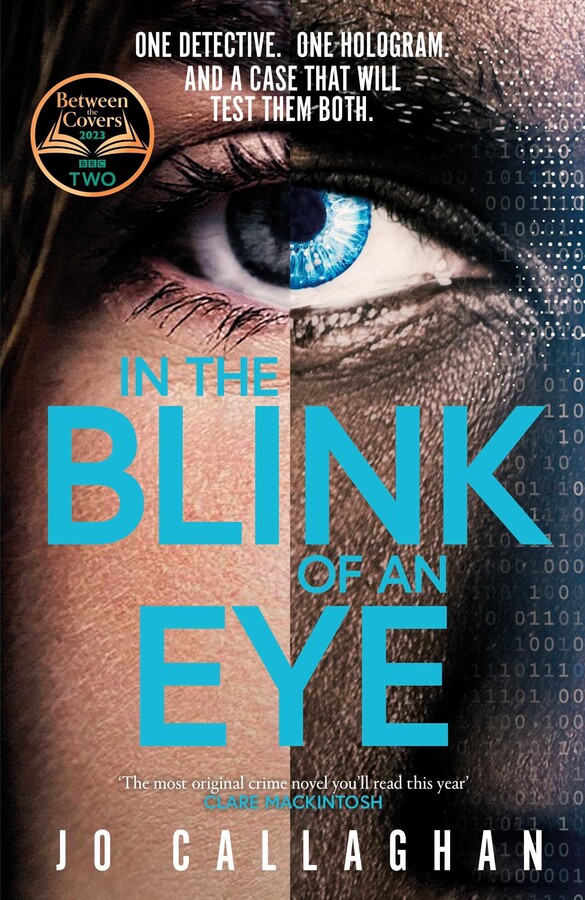
Book Review: In the Blink of an Eye by Jo Callaghan – a police pairing that breaks the mould

I always like to check out the Theakston’s Old Peculier Crime Novel of the Year awards – the shortlists are full of my favourite mystery authors (Elly Griffiths, Ruth Ware, Abir Mukherjee, and that’s just for starters). This year’s winner was Jo Callaghan’s debut novel, In the Blink of an Eye, which breaks new ground in that there’s a new police officer on the team, and it’s AI. The premise of this novel was just too good to ignore.

DCS Kat Frank has been away from the Warwickshire police on bereavement leave, and her husband’s death is still a bit raw. Her son, Cam, who has just completed his A Levels, has been having therapy, his anxiety over losing a second parent who has a dangerous job never far from his thoughts. So Kat has requested a safe option for her return to work, something less on the frontline. Her boss and mentor Chief Constable McLeish has a surprise in store. He’s signed Kat up to run a missing person’s cold case team that also will be trialling AIDEs (Artificially Intelligent Detecting Entities).

Kat is not happy. She’s an intuitive cop who follows her gut. You can’t solve cases with an algorithm, she declares. Meanwhile the scientist who has designed the AIDE, Professor Okonedo, with her own axe to grind, is sceptical of Kat’s skills and of the police in general. Reluctantly Kat agrees to the trial, taking on ambitious DI Rayan Hassan and shrinking violet, yet empathetic, DS Debbie Browne. Okonedo introduces AIDE Lock, a bracelet-type band that you can talk to like Siri, and which can whip up facts, statistics and probabilities in seconds. In holographic form, it’s remarkably like a person.

With hundreds of cold cases to chose from, Lock determines that recently missing young males will be more easily found. But Lock and Kat disagree over which. Kat’s preferred case is Tyrone Walters, a high-achieving young black man from a deprived area. Lock prefers Will Robinson, a young white male not much older from a wealthy home. According to Locke, statistics suggest the Robinson case would be easier to solve because he’s white. Kat is appalled as this racial bias and has a feeling that Tyrone has been a victim of foul play..

Ultimately, Hassan suggests the trial review both cases, and Professor Okonedo assures Kat that Lock can “perform the functions of many officers in just a fraction of the time”. This makes Kat only bristle more, but she reluctantly agrees. If only the team realised that what starts out as a test, a case chosen by statistics versus one chosen by gut feeling, will converge into a single case that is still active.

Picking up her briefcase, Kat paused at the door. She needed to leave her new team with something more motivational than her obvious irritation. ‘Remember, less than one per cent of missing people turn up dead, so we still have a good chance of finding both boys alive.’

‘Just to clarify, that figure represents one per cent of all the missing,’ said Lock’s voice from her wrist. ‘Only four per cent of adults are still missing one week after being reported, which is the category that Tyrone and Will fall within. So, in actual fact, there is a twenty-five percent chance that both boys are already dead.’

This really was an edge of the seat read, as woven into the narrative are scenes from the point of view of someone who has been kidnapped, drugged and immobilised. The clock is ticking and we can only hope that Kat and Lock will sort out their differences enough to solve the crime and save the missing lads. While Kat is learning how to manage Lock and use its obvious skills – downloading data, scanning social media for clues, extrapolating info, etc. – Lock is learning too. And it needs to, particularly with reading body language and developing social skills.

This makes the book really interesting as it takes time before Kat and Lock gel enough to be useful together. For a lot of the time they’re the angry cop and the irritatingly rational cop. Slowly, Kat’s team start to come into their own: Hassan in spite of his confident manner has a softer side and stuff going on at home, while Browne has a big problem to deal with, but fortunately Kat has enough patience to bring her out. Although mostly Kat is on edge, drinks too much and tends to fly off the handle.

It will be interesting to see how Kat and her officers, as well as Lock, evolve over the course of this series – there’s already a second book, Leave No Trace, plus a third to be published in April next year. Quite the feast. Whatever your thoughts on AI, In the Blink of an Eye illuminates it in real-world scenarios. Jo Callaghan has done a lot of research on the subject and how she imagines AI in a policing environment is fascinating. It’s a four-star read from me, and I can’t wait for the TV series. It would be a cracker.

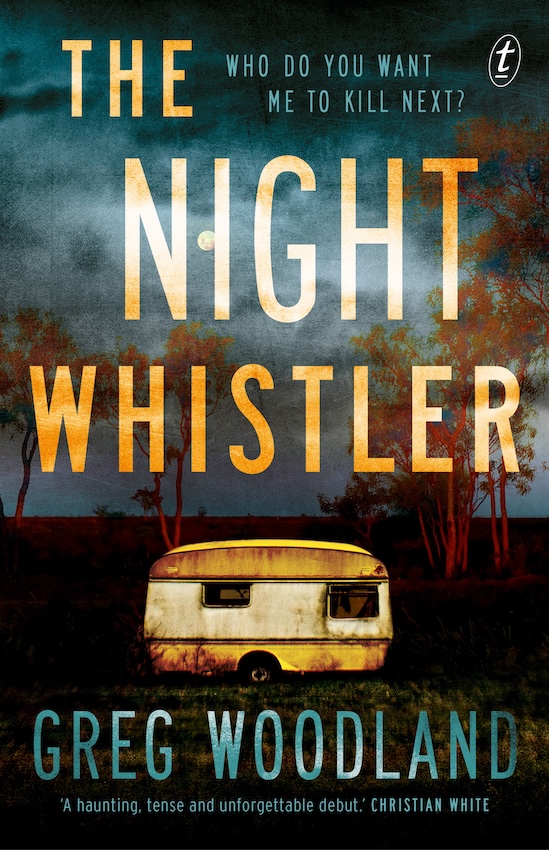
Book Review: The Night Whistler by Greg Woodland – a new cop in a small town that’s simmering with secrets

Readers of these posts will know that Aussie Noir is one of my favourite sub-genres. Having recently read Greg Woodland’s debut crime novel, I am pleased to have discovered what looks like a promising new series. The Night Whistler has all that readers have come to enjoy about Aussie Noir: an evocative, rural Australian setting; small town secrets; and a cop that’s up against it. Set in the 1960s, the story evocatively conjures up the era – the music, the social order plus the edgy restlessness of a long, hot summer.

Mick Goodenough (pronounced like “no-good” backwards, as opposed to “good enough”) has been sent to Moorabool, a smug little town that’s something of a culture shock. A former Sydney detective, he’s been busted down to the rank of Probationary Constable after a case went horribly wrong. Falling foul of his superiors and with a drinking problem that has cost him his marriage, Mick has hit rock bottom but, fortunately, it seems, you can’t keep a good cop down.

The narrative alternates between Mick’s story and that of twelve-year-old Hal, similarly a new kid in town, along with little brother Evan. The two boys are investigating a creek near their house when they come across the body of a mutilated dog. The boys are understandably upset, but go on to give the animal something of a burial, little knowing that the dog is one of a string of such killings that the police won’t take seriously. That is until Mick Goodenough recognises the traits of a perpetrator that will likely take a more serious turn. When the dead dog turns out to be Mick’s, it only spurs him on.

While there’s a killer just getting up steam, Mick is having to deal with arrogant Sergeant Bradley who is wary of Mick’s city cop ways, and lords it over his team. This includes a fellow Probationary Constable who sucks up to Bradley and world-weary Senior Constable Bligh, who becomes an unexpected ally. Meanwhile Mick is desperate to see his teenage daughter again, if only his ex-wife will agree to send her down on the train.

Hal’s father is the bright new spark at Prime Foods, which is why the family have moved to Moorabool. He’s got a fancy new car and wandering eyes. At the Prime Foods Christmas Picnic, we see a microcosm of the town, the braying and overbearing Mayor Dianne Curio, and her bombastic husband, as well as the racism carelessly handed out to Jenna, a young Aboriginal woman who is friendly to Hal and his mother.

Finding the dead dog sets Hal on a mission to uncover the killer – he’s been reading Sherlock Holmes. He gets a hand from young Allie, an Aboriginal girl who teases him relentlessly but shows him how to fish for yabbies in the creek. The two make a great pairing, but obviously they are soon going to be out of their depth. Worse still, Hal’s mother begins getting nuisance calls from someone whistling “Are you lonesome tonight” and making threats. Sergeant Bradley ignores her call for help, even when Mick suggests this isn’t just a snowdropper.

Greg Woodland quickly creates a simmering sense of menace as the story builds towards a gripping ending. But there’s also plenty of banter between Hal and his brother and with Ally, between the kids and their parents and other adults that adds some humour and light relief. Then there’s all the pressure on Mick: the pressure not to probe too much in a town where it pays not to ask too many questions.

For a debut novel, The Night Whistler is expertly constructed, the characters well drawn and interesting, while bringing the setting, both time and place, to life. But we shouldn’t be surprised. Greg Woodward is an experienced screenwriter with a bunch of award-winning films under his belt. The second book featuring Hal and Mick, The Carnival Is Over, is already on my ever-growing list of must-reads. The Night Whistler, excellently narrated by Nic English in audiobook format, is a four-star read from me.

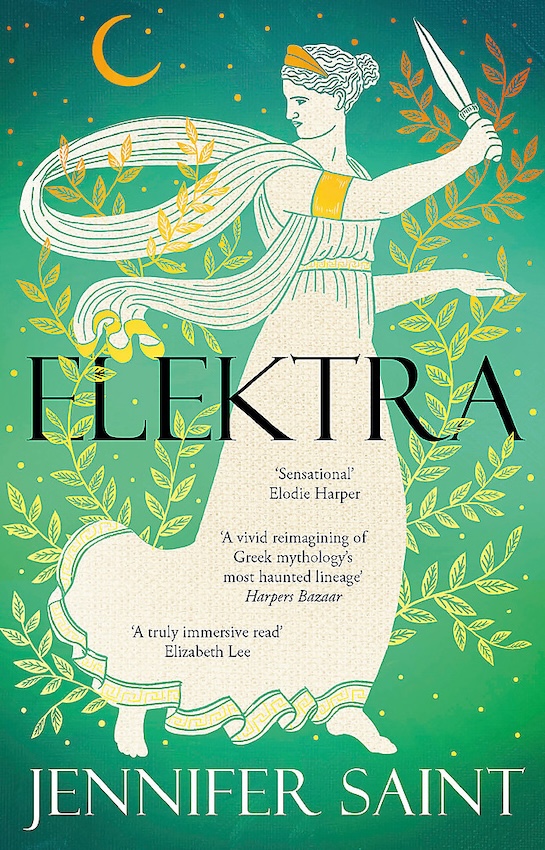
Elektra by Jennifer Saint – a retelling of the Sophocles tragedy for a modern audience

These retellings of stories from Ancient Greek classics can be oddly compelling. The latest to hit my bedside table is Jennifer Saint’s Elektra, a new version of the tragedy by Sophocles. If you haven’t met her before, the eponymous heroine is the youngest daughter of Agamemnon and Clytemnestra. You’ll remember Agamemnon as the leader of the Greek fleet that waged war on Troy – the thousand ships that sought revenge on Paris for making off with Helen – the world’s most beautiful woman, and also Agamemnon’s sister-in-law.

The story starts off with Helen choosing her husband. All the suitors have gathered at the court of her father, the king of Sparta, where she chooses the adoring Menelaus, a second son who will let her stay in Sparta to help rule her father’s kingdom. At the same choosing party is Helen’s sister Clytemnestra. She is impressed by the two brothers from the House of Atreus, particularly the powerful energy emanating from Menelaus’s brother, Agamemnon. After the marriage of Helen, the brothers set sail for the home they have lost to the uncle who’d murdered their father, and with the Spartan fleet behind them, enact vengeance.

It is this house that Clytemnestra marries into, and discovers the terrible curse on the House of Atreaus, one that just won’t leave them alone. It involves murder of innocents, fratricide and revenge – an on-going intergenerational battle for the throne. Things may have settled down after Agamemnon took back his kingdom – if only Paris hadn’t stolen Helen and spirited her away to Troy. You know how it goes.

Jennifer Saint tells the story from the point of view of three women: Clytemnestra, her daughter Elektra and Cassandra, a daughter of Trojan King Priam. Clytemnestra witnesses her husband sacrifice their eldest daughter Iphigenia so that the gods will grant him a wind to take his fleet to Troy. In her grief, she vows to kill Agamemnon on his return, but that’s another ten years away, and her grim decision takes over her life.

Elektra is a child when her father sails off to vanquish the Trojans, and misses him terribly. She is fierce, loyal and ignored by her mother. Clytemnestra’s intentions will set in motion a vengeance of her own. In Cassandra we have the story from the Trojan point of view. Badly treated by Apollo, Cassandra is cursed with a gift to predict the future, but to have her warnings disbelieved. Everyone therefore thinks she is mad – even when she predicts the fall of Troy and sees what’s hidden in the Trojan horse. Taken as a war prize by Agamemnon himself, her story will connect with that of Clytemnestra.

It surprises me just how readable and compelling this novel is given the content. Jennifer Saint does a brilliant job of envisaging the war, the plotting and scheming, the cruel indifference of the gods. One terrible deed just seems to lead to the next, and the characters have few redeeming features. So much bitterness and fury. All three women are trying to make a stand in some way, to determine their future, to make changes – difficult in a world run by power-hungry men and unreliable gods. Humming in the background is the question: if we leave one evil deed unpunished, do we not show contempt for the victim, for human kind and also for the gods?

The ending is brutal, but allows for a small glimmer of hope that the curse has finally come to an end – but who knows? Perhaps that’s another story. Elektra is another excellent addition to the genre, well-researched, intense and atmospheric. A terrific read for anyone who wants to immerse themselves in classical legends – four-stars from me.

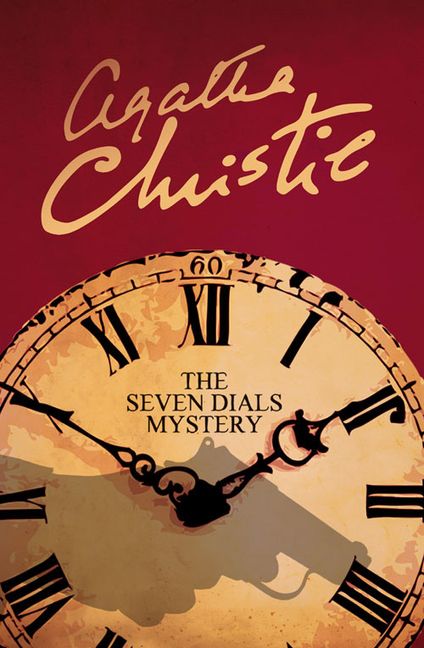
Book Review: The Seven Dials Mystery by Agatha Christie – a Golden Age thriller soon to be adapted by Netflix

I was intrigued to learn that Netflix had picked up The Seven Dials Mystery for the small screen and not remembering a lot about it, hunted it out among my collection of dusty old Agatha Christie paperbacks. First published in the 1920s, the opening scenes make it sound a little like a P G Wodehouse novel.

We’re in an English country mansion known as Chimneys which has been rented out for the summer by a wealthy industrialist, Sir Oswald Coote, and his wife Lady Coote. For some reason there are a bunch of young people staying that don’t seem to be anything to do with the Cootes, a typical Wodehouse type of house party.

When Gerry Wade becomes increasingly tardy about coming down for breakfast, much to Lady Coote’s growing discomfort, Jimmy Thesiger and his friends decide to teach him a lesson. They go into town to buy a collection of alarm clocks. The plan is to sneak them into his room to rouse him the next morning at the ungodly hour of 6:30. Only even that doesn’t seem to work, particularly when it is discovered that Gerry, far from sleeping through the cacophony of eight alarm clocks going off, is dead.

Chimneys is the home of Lord Caterham and his daughter Lady Eileen (Bundle) Brent. Bundle is also the heroine of a previous book, The Secret of Chimneys, and is always on the go in her Hispano-Suiza. Being a fearless young woman with time on her hands, she is easily bored. Before long Jimmy teams up with Bundle to solve the crime. Unlike his friends who have jobs in London, Jimmy’s a man of leisure; his valet Stevens has the same aplomb and consideration for Jimmy’s every comfort you might expect of Jeeves.

Bundle made a grimace.
“Why need people die in my room?” she asked with some indignation.
“That’s just what I’ve been saying,” said Lord Caterham, in triumph. “Inconsiderate. Everybody’s damned inconsiderate nowadays.”
“Not that I mind,” said Bundle valiantly. “Why should I?”
“I should,” said her father. “I should mind very much. I should dream things, you know – spectral hands and clanking chains.”
“Well,” said Bundle. “Great Aunt Louisa died in your bed. I wonder you don’t see her spook hovering over you.”
“I do sometimes,” said Lord Caterham, shuddering. “Especially after lobster.”
“Well, thank heaven I’m not superstitious,” declared Bundle.

Bundle’s and Jimmy’s friend Bill Eversleigh works in the Foreign Office, as did the victim, Gerry Wade. A second victim directs the investigation to Seven Dials, once a seedy part of London, now the name of a nefarious night-club and headquarters of a sinister sounding gang. With a second murder victim it is easy to assume it’s all something to do with a spy network of sorts, and the pace cranks up as our amateur sleuths team up with Gerry Wade’s step-sister, who’s a lot sharper than she looks, and follow clue after clue.

But Agatha Christie is a master of surprises, and there will be more than one shock for the reader before the end of the book. Of course, the killer is unmasked, in typical Christie style, and in spite of references to hangman’s nooses, there’s also a touch of romance in the air.

The Seven Dials Mystery really immerses the reader in a very different era of crime fiction and for some a book like this will seem terribly old fashioned. But with the huge array of cosy mysteries on the market, many set in similar periods, you can see why the Queen of Crime’s books are still big sellers. They are a lovely kind of escapism and the dialogue is full of fun, lending itself well to screen adaptations. And then there’s the settings, the costumes, that car! I shall look forward to the Netflix adaptation – in the right hands the story should come to life beautifully. This book scores three and a half stars from me.

Book Review: Body of Lies by Sarah Bailey – a riveting crime novel packed with surprises

I’d given up hope of another Detective Gemma Woodstock novel so was ecstatic to see this one come out earlier this year. If we’re talking Aussie Noir detectives, I might have to put Woodstock ahead of Jane Harper’s Aaron Falk (The Dry; Forces of Nature; Exiles), Woodstock scoring points for instinct, putting two and two together, feistiness and courage. If only she could get her life together.

But in Body of Lies, it seems Woodstock is at last doing well on the home-front. She has recently returned to her hometown of Smithson – she’d escaped it after the first book, lived dangerously for a time in Melbourne, but with a new relationship going well, she has come back to her old job. Gemma wants to be a good mother to her son, and has a new baby, but with the help of Mac, the man best pal Candy says is a saint, it all looks fairly promising.

Gemma’s still on maternity leave – Scarlett is just nine-months old – when she becomes caught up in a crime. Her dad’s had a health scare, so Gemma is at the hospital when the lights go out and a body is stolen from the morgue. But even before that, we’d had a white-knuckle scene with a car being chased off the road – the somewhat inebriated witness says it’s murder and so do the forensics. A murder and a stolen body before page 20!

Gemma is like a bloodhound, her detective nose is twitching and she wants in on the case. Jonesy, her old boss, is keen to have her help, as they’re short-staffed. But she’ll have to answer to DS Everett who finds Gemma pushy and inclined to do her own thing. Gemma finds Everett lacking in imagination and reluctant to share information. They’re going to have to work as a team but for a chunk of the book that seems unlikely to happen.

I’m halfway through Monday’s points when I smell Everett, a woody cologne that doesn’t fit with the musty aroma of the office. He stands in the doorway in an expensive suit, and not for the first time I wonder what led him to leave Melbourne and take a role in Smithson. It’s rare that a senior detective relocates to a small town mid-career. Smithson has become more of a drawcard in recent years, but in my experience, city cops only give up their plum metro roles when a problematic personality is being off-loaded or – like in my situation – when someone wants a fresh start due to personal reasons.

The body stolen from the morgue has yet to be identified, and that is surprisingly difficult in a town where everybody knows everybody. Before long the plot is complicated by the discovery of a newborn baby in a park by the lake, and then there’s another murder. Are the crimes all connected? Meanwhile Gemma is making a hash of juggling work and home life. Mac is busy on his own cases, and Gemma can’t help feeling there’s something he’s not telling her.

I always enjoy Gemma Woodstock as she’s such a determined police officer, as well as a thorn in the side to those in authority. She takes a lot of risks and stirs up a lot more trouble for herself, so you know that she’s going to put herself in harm’s way at least a couple of times before the end of the book. And so it is here, the plot racing away with some revelations you would never guess at and a thrilling, action-packed ending. Her relationships with new colleagues take some surprising and interesting turns too, making for a well-rounded and satisfying storyline.

This will probably be the final book in the series, which is perhaps a shame, although it would be nice for Gemma if life settled down a little for once. I’ve enjoyed her way of thinking, her banter with Candy the journalist and the avuncular Jonesy. But I’m sure Sarah Bailey has more exciting stories up her sleeve; perhaps she has a new detective waiting in the wings. Body of Lies is a four-star read from me.

Book Review: The Good Liars by Anita Frank – a haunting novel where old sins cast long shadows

It is interesting how claustrophobic a large country house can seem in a nicely gothic suspense novel like this. In spite of extensive grounds and views that take in woods and a river, the country house at the heart of Anita Frank’s latest novel, The Good Liars, is taut with post-war misery, its inhabitants hemmed in by events of the past.

We catch up with the Stilwell family in 1920. There’s Maurice Stilwell, who is mentally damaged by his time in the trenches. He lives at the atmospherically named Darkacre Hall with his beautiful and somewhat petulant wife, Ida, and his younger brother Leonard. There’s also Maurice’s great friend, Victor, manly and debonair, who was once in love with Ida, but with Maurice’s family money, was always going to be the losing suitor.

Unlike Maurice, Leonard is sound of mind, but a physical wreck, and this is why Sarah is taken on as his nurse, a great relief to Ida, as it has been nigh on impossible to find staff willing to stay at Darkacre Hall. It is soon clear that Ida has earned the hatred of the locals because of her actions in the early stages of the war, handing out white feathers to young men who needn’t have signed up, either because of their age or occupation. Many felt compelled to enlist and some lost their lives.

It’s a chilly, gloomy house, that Sarah has come to but being a good sort, she soon mucks in, not only helping Leonard but taking on a lot of the housekeeping. You can’t help wondering if she’s too good to be true, but she’s kindly and observant which helps the story along.

Sarah is beginning to find the dark wood that dominates the Hall horribly oppressive. The incessant panelling and ancient furniture greedily absorb all glimmers of light. Everything around her appears drab and morose. Even the silverware on the table – the candlesticks, the cruet set, the cutlery – is tarnished, and though the electric lights of the low-hanging brass candelabra above them are lit, two of the bulbs have blown, meaning that, beyond the immediate table, the features of the room are concealed in dense shadow, in which anyone – or anything – might lurk without fear of detection. She finds it a most unsettling thought.

Into this setting comes a police inspector who is looking into a cold case – the disappearance of a teenage boy in the summer of 1914. There’s been a letter apparently, and new information to suggest the boy was in the Darkacre Hall grounds when he went missing. A Sergeant Verity is sent to ask further questions, and this throws the household into a spin. Maurice becomes agitated, and Leonard even more miserable.

The reader is soon aware that there are secrets everyone is hiding, events from before and during the war that have never been accounted for. While everyone else quivers and frets, Victor, the man of action, makes a bold decision. Meanwhile Sarah has a sense that there is a ghostly presence at the Hall, which adds to the atmosphere. Can the aptly named Verity get to the bottom of things?

Anita Frank builds tension expertly, switching the point of view between characters who huddle in corners, or take drastic steps. As well as a major weather event that keeps everyone even more housebound, there are one or two surprises you probably won’t see coming. And while you get caught up in the story, desperate to know how it plays out, you’re treated to some excellent writing too.

While this may not be the cheeriest novel – the dark events of a terrible war haunt every moment for the characters, in more ways than one – it is all put together really well. I will be happy to look out for more by Anita Frank – The Good Liars is a four-star read from me.

Book Review: Cutters End by Margaret Hickey – a gripping new Aussie Noir series with a troubled cop

It’s hard not to pick up a book with a cover showing a dry Aussie outback setting. Those small towns in the rural backwaters of Australia just seem to seethe with all kinds of tension. Broken hearts and lost dreams, the struggle with a harsh environment wearing people down, young people abandoning home for the cities. You can’t help wondering if the author will be the next Jane Harper (author of The Dry).

With Cutters End, we’re in opal mining country, an industry on its last legs, the kind of place you pass through on the Stuart Highway heading north to Alice Springs. It’s also the place where a local hero and father met an unexplained death, discovered trapped beneath his vehicle and apparently burned to death. Back in 1990 this was explained as an accident at the inquest, but Suzanne Miller, a TV host with a flagging career, says it’s time for a reinvestigation. Michael Denby saved her and her mother from floodwaters when she was a small child and he deserves better.

DS Mark Ariti, similarly with a flagging career, is on leave when his superior officer discovers that he knew one of the witnesses at the time – one Ingrid Mathers who Mark dated at high school. Mark’s bumped up to Acting Inspector and sent to re-interview Ingrid and to see if he can jog her memory about the days around New Year 1990 when she was hitchhiking with her friend Joanne. But Ingrid’s not very forthcoming, although the reader has the inkling that she’s got a secret or two.

Mark catches up with Joanne, now living the high life in Sydney, similarly reticent. Why don’t the two women talk to each other any more? More clues pull Mark back to Cutters End, and the Mendamo Roadhouse, once owned by creepy Gerald, where Ingrid hitched a ride with somebody called Ron or Don. He bounces ideas off his new sidekick, DC Jagdeep Kaur, and picks up gossip at the three rather disappointing pubs in Cutters End.

Finally, Cutters End. The Stuart Highway a blade cutting through the centre of town, railway line alongside it like a rival sibling. Two main streets, a petrol station, the town hall, council offices, a supermarket, dingy motel, a primary school and, in the back streets, houses with sad facades and secret interiors.
The opal mining boom was bust, had been for decades, and although the welcome sign read ‘Cutters End, a town on the move!’ Mark doubted it. This town, like many across the country, had the look of a dying dog waiting to be shot. But still, he knew too well that dogs don’t die easy – those pleading eyes, that sense of loyalty and long history. The faded pride of what they once were.

When the woman at the service station where you get the best coffee in town tells Mark to find out about the two missing girls, the story goes in an interesting new direction. More than a couple of young women seem to have disappeared from the area, all of them hitching a ride and chancing their luck with whoever picks them up. Did they just move on and then take off overseas without letting anyone know? Build a better life? Or is there a more sinister explanation?

The story is peppered with interesting local characters: John Baber, the kindly ex-school teacher turned van driver who local businesses rely on for deliveries; mentally damaged Foobie who takes inappropriate pictures of people and becomes a source of useful information; Sergeant Darryl Wickman, the town’s long-serving police officer who has a way with the townspeople and a wise-cracking relationship with Jagdeep.

But it’s the undercurrent of evil so typical in these stories that has you on edge. The ugly circumstances of Denby’s death, the casual misogyny and disregard for vulnerable young women, the tight-lipped attitudes of the locals. Mark is struggling to make headway in all directions, either with his case or in his marriage, and like so many cops in these sorts of novels, never seems able to say the right thing.

There are evocative reminders of the time, not only the terrible haircuts and ugly sweaters, but also the real-life backpacker murders in New South Wales and the serial killer Ivan Milat. These crimes happened around the same time that our fictional Denby was killed. They conjure up all kinds of thoughts and feelings around how we protect our young people from predatory behaviour, about violence against women and whether anything much has changed for the better.

Cutters End is the first in a series about troubled cop, Mark Ariti. It’s a terrific read if you enjoy authors like Jane Harper, Garry Disher, Chris Hammer and Sarah Bailey, and a welcome addition to the genre. There are a couple more to look forward to (Stone Town and Broken Bay) with The Creeper out later this year. Can’t wait. Cutters End is a four star read from me.

Book Review: Zero Days by Ruth Ware – a compulsive thriller from a master of the genre

I always enjoy reading about an interesting new business or career I’ve not come across before – the processes, the clients, the marketing. In Ruth Ware’s latest book Zero Days we’ve got a couple of business penetration security specialists – husband and wife team Gabe Medway and Jacintha (Jack) Cross. Their business, Crossways Security, tests out security both inside and out for their customers. Gabe, an expert hacker does the computer side of things, leaving Jack, pint-sized but super fit, to break in at night, testing alarms, locks and security procedures. They make a great team.

The story begins with Jack entering a client’s premises, from climbing a six foot wall, through to avoiding CCTV cameras, sneaking through doors, disabling alarms and evading the security personnel. Gabe is constantly in her ear, helping her find safe corners and exit points. She has a few close calls but ultimately gets out unscathed, a bit like a character from a Mission Impossible movie.

But heading back to her car, she bumps into the head of security which means a trip to the police station where she tries to contact her client. The minutes tick by, and it’s the small hours before she gets home, only to find that Gabe has been murdered. Shock and anguish delay her call to the police leaving some hours not accounted for when she is later interviewed by the senior investigating officer, DS Malik. Her sister Helena implores her to get a lawyer – spouses are always the first suspect in a murder, they have the means and opportunity; all the police need is to find a motive.

Aside from the grief and shock Jack is experiencing, an email informing her of a life insurance policy to the value of a million pounds adds to her woes. And the way that Malik seems to be homing in on her during a voluntary visit to the station causes alarm bells. Suddenly it seems that the police have chosen their perpetrator, and if they lock up Jack, no one is ever going to find out who the real killer is, the same person who is framing her. With a few more security sidesteps, Jack exits the police station and goes on the run.

Inside the station it was noisy and smelled of cleaning fluid and used coffee cups. As I waited in line to speak to the officer behind the front desk, I couldn’t help scoping the place out as if I were on a job. Two exits – one to the street, unmanned; one to the interior of the station, no lock as far as I could see. There was probably an activation button under the desk. One fixed CCTV camera in the corner with a huge blind spot that covered most of the right-hand wall – not a very good design for a police station. The odd thing was that I had no memory of any of it from before. Shock had wiped half the night’s events from my brain – which felt strange, but no stranger than mechanically assessing the building’s risk profile in a world in which Gabe no longer existed.

The book is set for the most part over seven days, as Jack disguises herself, evades capture, copes with injury and tries to piece together what it was that Gabe was doing that got him killed. She has a bit of help from Helena, a busy mother of two, as well as Cole, Gabe’s best friend who was like a brother to the victim, and like Jack is devastated by the murder. At the heart of it all is some cyber crime that went a little over my head but makes for an interestingly different storyline. There are a lot more Mission Impossible type action scenes as Jack gets closer to the truth.

Zero Days was such a compulsive read, I was thankful for a weekend of cold, rainy weather. I inhaled this book, having to remind myself to eat. The writing is sharp and immediate, the tension non-stop, with first-person narration that makes you imagine yourself in Jack’s shoes. You can’t but wonder what would you would do in similar circumstances; how you would cope. The novel must surely add to Ruth Ware’s reputation as the Queen of Just One More Chapter. Zero Days is a four-and-a-half star read from me.