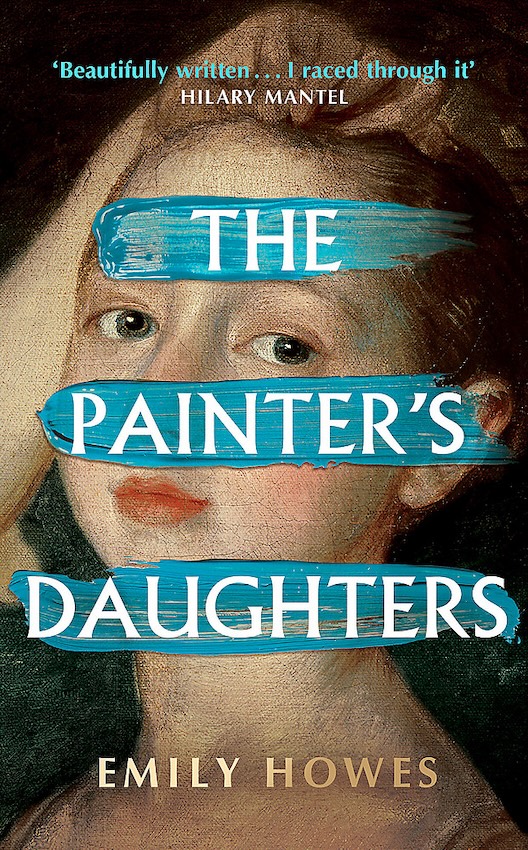
I knew a little of the work of Thomas Gainsborough before I read this book, his striking portraits, the most famous of which is probably the Blue Boy, which frequently used to appear in tapestry kits. Such a pretty picture. But I remember looking at his portraits, marvelling at the light feathery brushstrokes, the use of colour, and how they seemed to capture the essence of the sitter. Then the way he might put them in a landscape setting rather than a fashionably lavish interior.
So it was interesting to learn that Gainsborough much preferred painting landscapes, was a great lover of the countryside near Ipswich where the book, The Painter’s Daughters begins. He wants his young girls to have a free and healthy country childhood just as he did. But his wife, Margaret, has other ideas. There’s no money in landscapes and the fashionable town of Bath is full of the kind of society that will want their portraits painted, and also where young Molly and Peggy might make a good marriage.
Emily Howes weaves a brilliant fiction around a well-researched collection of facts. Among them that Margaret was the illegitimate daughter of the Duke of Beaufort, although there also exists a document that suggests an even loftier parentage. Margaret knows about this and is desperate for the family to do well. She’s there in the background working on her husband’s accounts, calculating and chivvying.
Thomas is much more a bohemian character, carousing with friends, playing music and up all night. It’s a difficult household, so you can imagine how that might affect the young girls, particularly as early on, Molly appears to be mentally unstable. You would think fresh country air would be better than the sudden town environment in which young Molly and Peggy find themselves. In Bath they are kept inside, dressed in silks, the better to appear in the famous portraits painted by their father. These are his advertisements, as prominent visitors come to call.
She is not playing or laughing any more. She is eyeing me, breathing hard in and out, and her hairbrush hangs limp in her hand. She is just Molly, I think, urgently. She is just Molly. I take a step towards her, when suddenly she draws back her hairbrush and throws it hard at a mirror. There is a crack like a bullet and shards explode across the hallway.
‘Molly, why did you do that?’ I say in the seconds before the adults come, hot tears rising. ‘Why did you do that?’ My voice sounds small and shaky. ‘You are so stupid.’ As the feet thunder up the stairs towards us to pull us from the shattered mess, I want to shout out, ‘It was not me, it was Molly, it was Molly, it was all Molly.’ But I know that if I do that we will only be separated for the day, and there is nothing worse in the world. It is like a bit of me has been cut off.
The girls grow up, and Molly continues to be Molly, bright and seemingly well one minute, lost in a mental nightmare the next. Young Peggy adores her sister and promises to look after her, as she always has, trying to maintain a veneer of the normal in a polite society full of rules. Much of the narrative is from Peggy’s viewpoint, and she’s a constantly anxious child, watchful of her sister, but also desperate for the attention of her father.
Through the novel, is another story, that of Meg, Margaret’s mother, bullied by a brute of an innkeepr father. Meg slaves away, serving and cleaning, her life mapped out for her. When a German prince and his escort party descend on the inn, one of them dangerously ill from an infection, the men settle in until the invalid is fit to travel again. Meg catches the eye of the handsome heir to the throne.
The two stories, that of the sisters and Meg’s, make a rich contrast that brings 1700s England to life, warts and all. Both show a picture of the kinds of lives women led, with no power of their own, dependent on fathers and husbands for their livelihood. If they cannot make a good marriage, or keep their reputations intact, their futures are uncertain indeed.
This is such a satisfying read – fascinating with its descriptions of art and fashionable society, as well as the muck and mess of 18th century England. The struggle if you’re poor; the struggle to keep up appearances if you’re genteel. The book is full of images that stick in your mind from the feel of silk and lace and satin, to the stench of streets full of horse dung. A totally immersing story and so much my kind of book that it is, unsurprisingly, a five out of five read from me.

 Judith McKinnon
This sounds like a great book Judith! Is it a recent release?
LikeLiked by 1 person
Fairly recent – it came out in 2024
LikeLiked by 1 person
I’ve had this for a while without reading it. That needs to change.
LikeLiked by 1 person