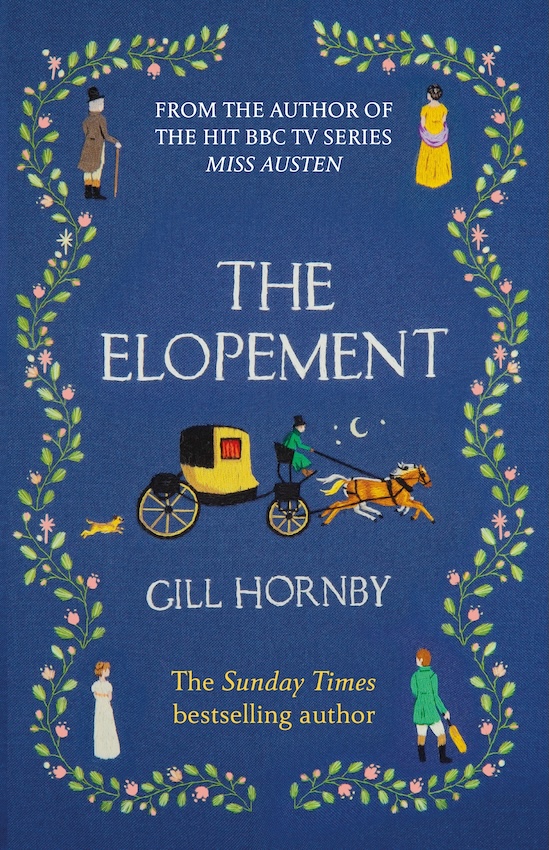
I’d already enjoyed Gill Hornby’s earlier book, Miss Austen, a novel about Cassandra, Jane Austen’s sister. But there’s obviously a lot more to tell, for the Austen’s are an interesting bunch. The Elopement is the third book about the family by Hornby, picking up their story with Fanny Knight, Jane Austen’s favourite niece, and Mary Dorothea, Fanny’s step-daughter.
This is a story of country life among the gentry in the early 1800s, large families and the rocky path to love. It begins with Fanny, in her late twenties, feeling as if she has missed the marriage boat, having spent many years mothering her younger brothers and sisters. When she is courted by an older neighbour, the politically ambitious Sir Edward Knatchbull, she accepts his hand.
Married life at Hatch, the Knatchbull manor house, includes five motherless children but somehow Fanny never quite takes a shine to the Knatchbull offspring, particularly the eldest, Mary Dorothea, the only girl. The boys get sent off to school from a young age, so are barely there. Fanny and Sir Edward contrive to have Mary educated with Fanny’s younger siblings at Godmersham Park, where Mary Dorothea becomes a firm favourite.
The story flips mostly between the two female characters: Fanny’s marriage to the pompous, devout and domineering Sir Edward, with whom she finds contentment, her avoidance of maternal responsibility for his children, her own struggles to be a mother; and Mary Dorothea, who seems like two – people quietly inoffensive with Fanny, and fun-loving and gossipy with Fanny’s sisters, particularly Cassie. As Mary and Cassie grow up, they bloom and go to balls – there’s a hint of a Jane Austen novel here, with suitors appearing in the wings. But no one is ever good enough to please everybody, particularly parents.
Sir Edward finds the young male Knights flippant and too fun-loving, particularly the eldest, Ned. So of course, Mary finds them charming, Ned in particular. The story follows the problems of making a match agreed on by the girls’ families. Not just Mary and Cassie but also Marianne, who ends up stepping in as a mother figure for her younger siblings after Fanny’s marriage.
Of course, when hunting or killing or hitting a thing, Ned moved like quicksilver. In the world beyond sport, though, he knew no sense of urgency and was rarely disturbed. Yet here he was, eschewing all greetings – Fanny prayed Sir Edward would opt, just on this one occasion to not take offence – and – what was this? – spluttering about yet another drama of Marianne’s making.
‘A proposal?’ Fanny fell back into the depths of the worn leather sofa. ‘A proposal from whom, might one ask?’
It was to her eternal credit that Fanny’s first thought was given not to Godermersham’s domestic arrangements and her own convenience, but that the gentleman’s identity did, in fact, take priority.
‘Billington,’ she repeated, once informed. ‘Billington?‘ Now she was thoroughly mystified. ‘But, Ned dearest,’ she explained in her patient voice, ‘we have no knowledge of any Mr Billington.’ As if that put an end to the matter.
It all gets a bit fraught for the young couple at the centre of the story, Sir Edward remaining intransigent, while Fanny is caught in the middle. A dutiful wife, she’s also strangely unaware of the secret trysts going on under her nose. You want to like Fanny, who means well, but it’s hard to see in her the niece of Jane Austen. She must have been brought up on the famous stories, and the recurring theme of the difficult path to love. Couldn’t she have a little more sympathy? More mettle?
I enjoyed The Elopement, but although the story is full of drama and conflict, the plot is a little slow-moving at times, sticking closely, it would seem, to events noted in Fanny’s collection of diaries. But you do get a good sense of the time, particularly of a woman’s lot; whether as wife, unmarried and useful relative, or as a mother. Hornby notes that giving birth was like Russian roulette, with dying in childbirth a distinct possibility even after a number of healthy births. The Austen’s were particularly fecund, producing endless large families – ample opportunity for losing a mother.
With the recent Jane Austen commemorations – 250 years since Jane Austen’s birth on 16 December – it was a good time to revisit her world. I enjoyed meeting Cassandra Austen again, still stepping in with wisdom and caregiving, an ageing mother at home, nieces requiring guidance, to say nothing of visits to the deserving poor. Gill Hornby does a brilliant job of capturing the tone of an Austen novel, and the book has the ring of authenticity, reflecting solid research. I’ve still Godmersham Park to read by Hornby, and wonder if there will be more Austen stories to look forward to after that. The Elopement is a four-star read from me.

 Judith McKinnon
I want to read this. Thanks for your post.
LikeLiked by 1 person