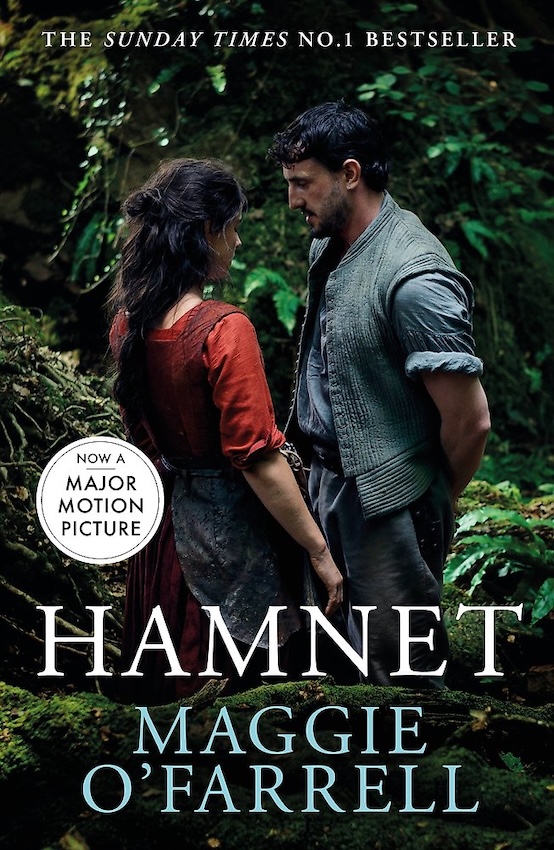
Maggie O’Farrell’s one of my favourite authors, but for some reason I forgot to read Hamnet. Then the movie came out and reminded me. To be fair, I wasn’t sure I would enjoy a story which involves the death of a child. And yes, there’s suffering as well as grief here. But O’Farrell also fills the book with so much life and sensation, vividly bringing you into the English countryside, the period, and the small town where Agnes/Anne and William Shakespeare live.
The first and biggest chunk of the book is a dual timeframe story which tells you how William Shakespeare meets Agnes Hathaway, when he is sent to tutor her young half-brothers. They are both extraordinary people and can see that in each other as soon as they meet. Agnes, because who wouldn’t notice a tall, striking woman carrying a falcon; and William, because Agnes can see into people with a kind of extra-intuition, and observes in the bored eighteen year old, the huge imagination and talent that will make his name.
The story flips between their love story and over a decade later when young Hamnet and his twin sister Judith are in the yard together. Judith starts to feel ill and goes inside to lie down. The twins live with their older sister and mother in a narrow house sharing a yard with Agnes’s in-laws. They are in and out of each other’s houses. But when Judith falls ill, her mother is at her brother’s farm, tending her bees. The other women, his grandmother and aunt are out, and his grandfather ill-tempered and volatile, leaving Hamnet running desperately into the street to find help.
She grows up feeling wrong, out of place, too dark, too tall, too unruly, too opinionated, too silent, too strange. She grows up with the awareness that she is merely tolerated, an irritant, useless, that she does not deserve love, that she will need to change herself substantially, crush herself down if she is to be married. She grows up, too, with the memory of what it meant to be properly loved, for what you are, not what you ought to be.
There is just enough of this recollection alive, she hopes, to enable her to recognise it if she meets it again. And if she does, she won’t hesitate. She will seize it with both hands, as a means of escape, a means of survival. She won’t listen to the protestations of others, their objections, their reasoning. This will be her chance, her way through the narrow hole at the heart of the stone, and nothing will stand in her way.
In a few scenes, Maggie O’Farrell shows us how their family works, the town they live in, the period, and the surrounding countryside. It’s all so vivid and full of the young boy’s energy, his desperation. By the time the women return, Judith is gravely ill, and there are the tell-tale signs of the plague. Time passes slowly and fast at the same time. Hamnet’s waiting for help, then slipping into sleep next to his twin, but everyone else around them is too busy to notice where the children are, only cross they haven’t done their chores.
We all know what happens, it’s on the back cover even if you’ve forgotten the history. But it’s still nerve-wracking reading. ‘Go upstairs,’ you want to tell the grown-ups. ‘Check on your children.’ In the meantime we have the alternate chapters describing Agnes and William’s marriage, William’s ongoing restlessness, his father’s endless displeasure with him, the plans to go to London. There are peripheral characters too. Agnes’s sensible brother and bitter step-mother, the story of Agnes’s own mother, long dead, but who had an affinity with nature, and the healing skills that Agnes herself has inherited.
It’s in the last section of the book that things really come together. We are not waiting for help this time, but for William to return home, urgently sent for to see for the last time his dying child. The passing years, William’s continued absences. How it all comes together is brilliantly done and the ending is stunning. Again you have the immediacy in how O’Farrell brings you into the lives of her characters. We feel what they feel, the sensations coupled with their own internal monologue are so well crafted.
Hamnet is such a beautifully put together story, and the ending so brilliantly done that you finish the book well satisfied. This alone is worth the five stars I’m giving this book. I’m also pleased to report that Maggie O’Farrell has a new book, Land, due out in June.

 Judith McKinnon