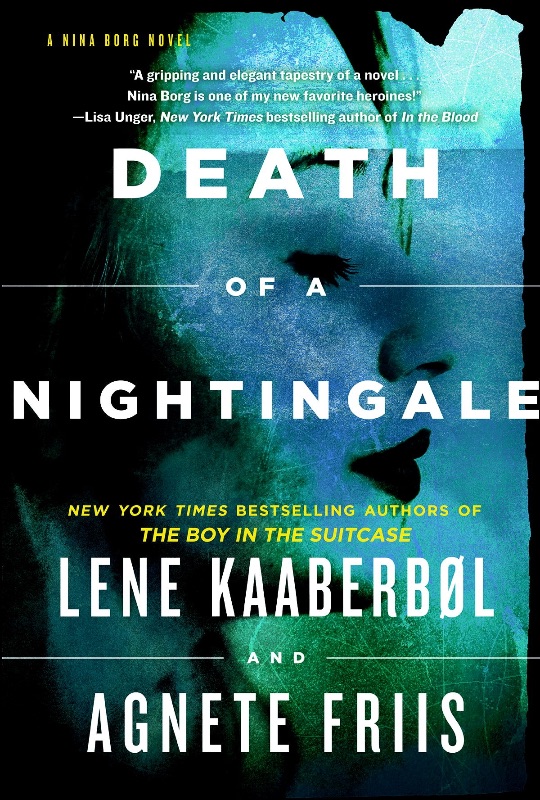
Book Review: Death of a Nightingale by Lane Kaaberbol and Agnete Friis

This novel is the third in the Nina Borg series which began with The Boy in the Suitcase. It’s also the only one I have read. Oh, no, nags the little voice in my head – you should read them all in order! Stilling the little voice, I was soon engrossed in this engaging example of Danish noir.

Nina Borg is a nurse who has worked in some dangerous places in her role with the Red Cross. Now she’s working at a Copenhagen refugee camp, where she feels driven to save those who have fled some horrific situations in their countries of birth. Her tendency to disregard her own personal safety has meant that now she’s cut off from her husband and children and living in a dreary flat. There’s a large digital clock on the wall which triggers thoughts about what her children might be doing at any time in the day.

Nina is one of those characters you want to shout at. She’s always going it alone. ‘Call the police!’ you want to scream. ‘Get some help.’ You can see how her commitment to wanting to help people drives her. But being a maverick sleuth can be lonely. Sometimes she brings home a Swedish doctor colleague for the night, who’s also a bit lonely, but this only makes her seem even more solitary. Already, she’s an interesting main character before we even get to the story.

Flip to Natasha – a runaway from Ukraine, wanted by police at home in connection with the death of her husband, and now in Copenhagen for the death of her fiancé who is a bit of a thug with an eye for her young daughter. It’s not surprising Natasha lashed out. But somehow now he’s dead. Natasha is desperate and being on the run in a Danish winter notches up the tension. Nina is concerned because Natasha’s daughter, Rina, is very sick and isn’t doing well away from her mother. Will Natasha risk everything to see her daughter? The authorities are alert to her possible return, but somebody else is too – somebody who might wish her dead.

There’s a police officer on the case who teams up with Nina when Rina’s safety is compromised. The story also switches back to 1930’s USSR where two young girls live in a village, battling hunger and the difficulty of being a good Soviet citizen. The book captures the period following the great famine when families struggled to feed their children, and hoarding food was an offence that would see you off to the gulags, or worse.

So Death of a Nightingale has plenty of threads in a complex storyline, peopled with a large cast of characters and some interesting twists. How the grim backstory has left its mark on Natasha and her countrymen keeps the reader guessing, and isn’t made clear until the end. But before we get remotely close to that revelation, there’s plenty of action and dicing with death.

I’m glad I picked this one up, even if it is number three in a series of four. The characters are vividly drawn and the story keeps you on your toes. The scenes in Soviet Russia make for sobering reading and remind you how terrible state-led indoctrination can be with repercussions that last a lifetime. I did find the final scenes a little rushed and the complications around the point where the past catches up to the present could have been clearer. Yes, I shall probably check in with Nina Borg again, but I’m not in any hurry. A three-and-a-half out four read from me.

Book Review: Still Life by Sarah Winman

Sarah Winman’s new book begins in 1944 Italy, as English troops are engaged in the push back agains the Germans. We’ve got a meeting between two unlikely friends: Evelyn Skinner a sixty-something art historian sojourning in Tuscany with fellow lesbian Margaret; and a young soldier, Ulysses Temper. Temps, as his mates call him, chances upon Evelyn and introduces her to his erudite Captain Darnley and the three discover a painting which has a big effect on the young soldier.

Oh, drop the Miss, for God’s sake, said Evelyn, sitting down next to him. My name’s Evelyn. And yours?

Ulysses.

Ulysses! How wonderful! And is there a Penelope waiting for your return?

Nah. Just a Peggy. And I doubt she’s waiting, and he turned the ignition and the jeep pulled away.

Temps is from London’s East End, the son of a globe-maker, a fitting occupation for a man named Ulysses. He paints delicate versions of the Earth on carefully prepared spheres, but his experiences in Florence will stay with him long after his return. A chance interception of an attempted suicide will bring him back here, but not before we’ve been introduced to his fellow Eastenders who make up a kind of family, and the 1940s spin into the 1950s.

Winman creates some wonderful characters here, all of them centred on the Stoat and Parrot – the pub owned by Col, a cantankerous publican with permanent dyspepsia. Col runs through girlfriends in alphabetical order, blaming the Shakespeare-spouting parrot for the desertion of his wife. But he’s got a disabled daughter to raise, a naive innocent. Fortunately Peggy’s on hand, taking the girl under her wing along with old-timer Cress who talks to a tree and keeps an eye out for everyone.

Peggy is Ulysses’s wife – a hasty marriage brought on by the start of war, but his time away has Peggy form an attachment to American soldier, Eddie, and left her with a daughter, Alys. When Eddie fails to return, Peggy belts out her blues in song at the Stoat and Parrot, accompanied by Pete, when he’s not in a show. The reader gets enough of the gritty post-war London with it’s slow rebuild and pea-soup fogs to want better for this odd family of characters. It comes in the form of a legacy which has Ulysses, Cress and young Alys (who Ulysses loves like his own daughter) move to Florence accompanied by Claude, the parrot.

From here, the story weaves through the decades, and Ulysses makes new friends and learns to love the Italian lifestyle. He chucks out his demob suit for a sharp Italian look and Cress learns to cook pasta. Our friends from the Stoat and Parrot will drift here for visits and longer stays, watching the big world events play out – the moon landings, student demonstrations, assassinations of Martin Luther King and JFK – as the world recreates itself after the recent wars.

Still Life is a feast for the senses. The food alone in this book is worth reading it for – I pulled out an Italian cookbook destined for a second-hand fair, determined to revisit some of these classic dishes. As well as the food and wine we have sweltering summers, scented gardens, wonderful art (and poetry), the music of the day, romantic attachments of all kinds, shown with sensitivity and warmth.

I loved the characters, but particularly Ulysses, who unlike his namesake, is sensitive, charming and caring, quietly missing Peggy who he can’t seem to forget. Still Life is a lively book full of lifelike people who learn to live and love again in a wonderful new place (there’s also a quirky lack of punctuation when it comes to dialogue, which took a bit of getting used to). It’s also a hymn to Florence, and if you’ve been there before, Still Life will bring it all back for you. A book that charms on many levels, it’s a four out of five read from me.

Book Review: The Van Apfel Girls Are Gone by Felicity McLean

Felicity McLean’s debut novel novel has been described as The Virgin Suicides meets Picnic at Hanging Rock. Set in small town Australia, the book is told in two time frames, and begins when Tikka Molloy returns home to reconnect with her sister Laura who isn’t well. She can’t stop thinking, had they did the right thing twenty years ago when their friends, the three Van Apfel sisters vanished. She looks back on that sweltering summer when she was eleven and the events that led up to their disappearance.

Tikka is a great child narrator – she reminds me a little bit of Scout from To Kill a Mockingbird, if we’re thinking of book comparisons here. She’s smart and imaginative and comes from a loving family. At the corner of their street live the Van Apfels and Tikka and Laura spend a lot of time there as the family has a pool. The Van Apfels attend a fundamentalist church – their dad, though outwardly genial, is particularly strict and this causes tension with his wayward thirteen-year-old daughter Cordelia.

There’s a lot of Tikka trying to make sense of her world and understand what’s going on with the grown-ups, and the tension that seems to lurk at the Van Apfels. There’s a new teacher, Mr Avery, who has a mysterious past that may have included a stint in prison – as rumour has it. So along with the simmering heat there is plenty of simmering tension as the school plans its big, Showstopper concert at an outdoor amphitheatre, for which Tikka has written her own skit and where events build to a climax.

In true Aussie Noir style, the landscape plays a big part in this novel. The mangroves around a brackish estuary create a sinister backdrop (Tikka complains of an unpleasant smell); the empty landscape beyond; the heat bouncing off the tarmac. It all adds to the mood and tension of the book. And there is a hint of the unreliable narrator about Tikka. How accurate are her memories from childhood? Even now as an adult she still can’t help looking for Cordelia (Cordie) at railway stations, at busy intersections, her blonde head just disappearing around corners, failing to stop when called. The Van Apfel girls may have disappeared that summer, but a part of Tikka seems to have been lost as well.

The Van Apfel Girls Are Gone is an impressive debut, a character driven mystery that is also quite the page-turner. There is plenty of humour with the way McLean re-imagines childhood, the rivalry between sisters and between classmates, the rumours and the secrets, the superiority of the older kids. This balances out the sadness of what happens and the feeling of lost innocence which runs through the story. Not a long book, McLean’s novel is well worth picking up, and heralds a promising new author to look out for. A four out of five read from me.

New Books from Old Favourites

Twenty twenty-one is turning out to be a wonderful year for me as a reader as several authors I really enjoy return with new books after a bit of a hiatus. It’s interesting seeing what they come up with after an interval and compare the new books with old ones. And it also offers the chance to reread some old favourites and think about why you liked the earlier books in the first place.

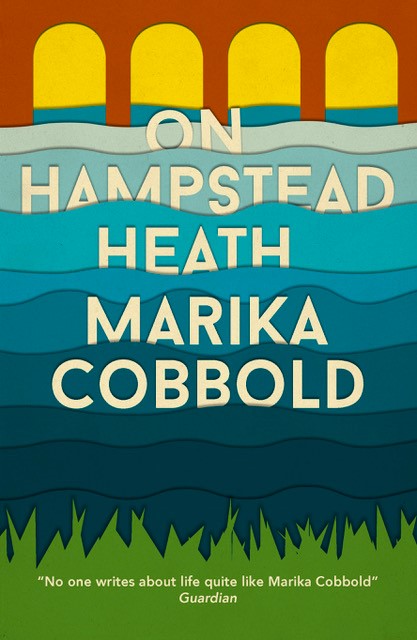
Marika Cobbold‘s Guppies for Tea was a heart-warming, family story about Amelia and her struggle to care for her much-loved grandmother, now showing signs of dementia. She’s also battling a mother with an obsession with germs and a defecting boyfriend, but Amelia finds help in unexpected ways. I really enjoyed this novel, and would also recommend Shooting Butterflies as well as Cobbold’s previous book Drowning Rose, both of which have characters revisiting the past in a way that changes their view of their lives. It’s been a quiet ten years from Cobbold since then, but just published is On Hamstead Heath. Here’s what the blurb says:

“Sharp, poignant, and infused with dark humour, On Hampstead Heath is an homage to storytelling and to truth; to the tales we tell ourselves, and the stories that save us”.

Sarah Winman‘s latest book, Still Life, is only her fourth in ten years and therefore something to be excited about. When God Was a Rabbit was one of those love it or hate it books, if GoodReads is anything to go by. I found it brilliant and original, so that puts me definitely in the ‘loved it’ camp. Now I have a reader’s copy of Still Life and the first page has me hooked already, even though I’ve three other books already on the go. What to do?

Moving from the Tuscan Hills and piazzas of Florence, to the smog of London’s East End, Still Life is a sweeping, joyful novel about beauty, love, family and fate.

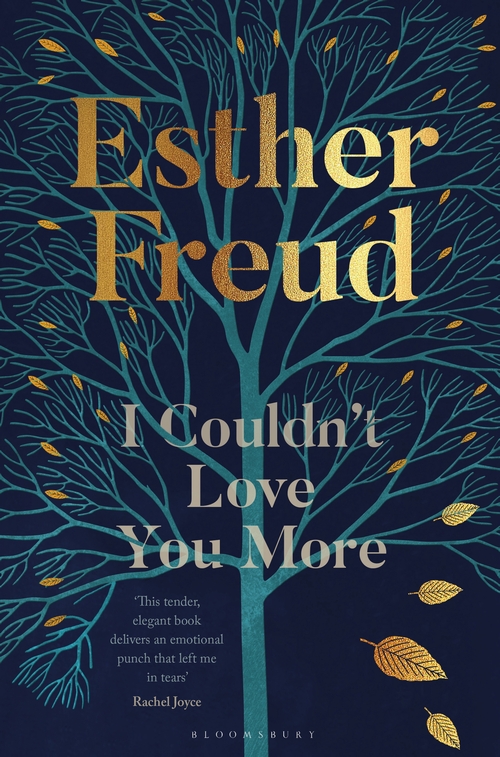
Esther Freud‘s debut novel, Hideous Kinky, is a story from Freud’s own childhood and concerns a woman living the hippie dream in Morroco with her two young daughters. They live a hand-to-mouth existence and the reader feels for the girls who really need more stability and well, safety. It was made into a film starring Kate Winslet (also worth a watch). There followed a string of very readable novels, her last outing, Mr Mac and Me (2014), set during WWI and has a basis in the true story of Scottish architect Charles Rennie Macintosh, a mysterious visitor to the south of England as seen through the eyes of a young boy. Coming soon in July is I Couldn’t Love You More, which according to the blurb is:

A sweeping story of three generations of women, crossing from London to Ireland and back again, and the enduring effort to retrieve the secrets of the past.

Out of interest, Freud’s lineage includes the painter Lucian Freud (father) and Sigmund Freud (great-grandfather).

Andrew Martin has been busy. He’s always got some new project on the go, it seems, fiction and non-fiction, but it’s been a while since he abandoned, or so I thought, his wonderful Jim Stringer railway detective series. The series has taken us from the early 1900s with Jim as a mere teenager, through marriage and war service, to France, the Middle East (The Bahgdad Railway Club is a particular favourite) and to India. The mysteries are full of wonderful north of England wit, odd-bod characters on either side of the law, enough action to keep things humming along and, well, trains. Jim is always battling the establishment, various railway bosses, while attempting to keep ‘the wife’ happy. Eight years after Night Train to Jamalpur was published, here we suddenly have a new Jim Stringer mystery to look forward to. Powder Smoke comes out in November.

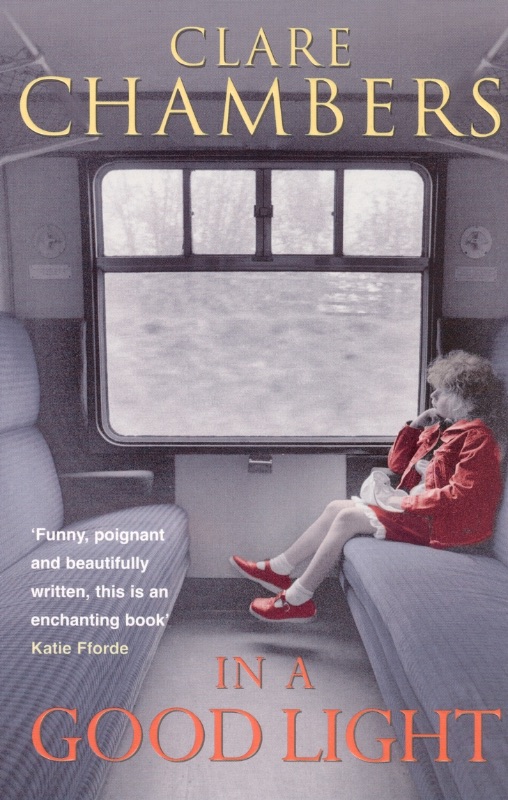
Clare Chambers has been one of my favourite authors in the field of contemporary fiction, particularly for her warmth and wit and quirky characters. I’ve already reviewed her new book, Small Pleasures, which wove a story around a couple of historical events from the late 1950s – an interesting departure for this author but still showcasing her gift with characters and humour, but with a darker theme this time and a powerful emotional punch. It sent me off to her previous works and I enjoyed myself hugely rereading In a Good Light as well as The Editor’s Wife. I seriously hope she doesn’t abandon her writing desk for another decade before releasing a new novel, as she’s just so talented.

Book Review: Nothing But Blue Sky by Kathleen MacMahon

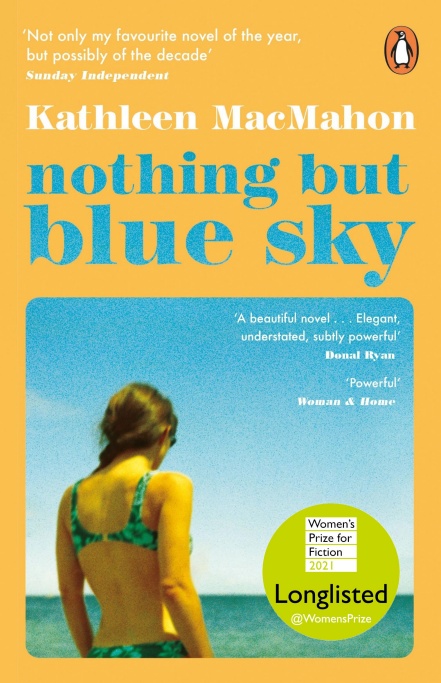
When winter starts to bite, there’s nothing like a book cover showing a summery scene to make you want to pick it up. Kathleen MacMahon’s latest book, Nothing But Blue Sky describes a succession of summer holidays spent abroad, mostly on the sunny Costa Brava. 

David Dowling is recently bereaved – his wife, Mary Rose, killed in a plane crash while she was on her way to a wedding. Ever since they were newly married, the couple have holidayed at the same Spanish seaside town, visiting the same restaurant over the years, the same bar for their pre-dinner aperitif. They’ve people watched, making up stories in particular about a glamorous French family.

In many ways, this is the story of a marriage. David is a cynical foreign correspondent, who doubts his capacity for happiness. His parents seemed to live in a loveless marriage, his father bullying his mother, just as his older brother bullied David. When David meets Mary Rose, he is swept up into the world of his girlfriend’s family, a home full of joy and conversation and people who actually seem to like each other. David discovers another way to live, but can’t quite shake off his inner doubts, his bad cop to Mary Rose’s good cop routine.

When Mary Rose dies, David’s grief is all-consuming. He revisits the events of his marriage – Mary Rose’s goodness and optimism, their childlessness, the way they just seemed to gel, their disagreements. The book weaves their story together in chapters that read a little like a succession of short stories highlighting different aspects of their relationship.

A summer holiday with friends, soon after the air crash, is a miserable affair for David, so he bravely takes himself off to Aiguaclara one more time, and the possibility of starting again takes shape. 

MacMahon draws you slowly into the novel, and in David has created a brilliant character study. How do you deal with feelings, when you’ve spent a lot of your life suppressing them? David is a difficult character but oddly likeable, and you want him to learn a little empathy and trust. This is such a sensitive portrayal about love and loss, about happiness and grief, nuanced and yet also very entertaining. 

The book reminded me a little of novels I’ve read by Anne Enright as well as Andrea Levy. I can’t wait to read more by MacMahon. Nothing But Blue Sky earns a four and a half out of five from me.

Book Review: Home Stretch by Graham Norton

I listened to Home Stretch as an audiobook, and this is a terrific option in this case as the book is read by the author. Graham Norton has a warm and vivid reading style – he has the kind of voice that sounds friendly and the humour never seems all that far away, even when the plot takes a serious turn. Which it does quite often.

The story concerns young Connor, who is caught up with a bunch of local teenagers on the eve of a wedding, tagging along on a trip to the beach. He’s the son of a publican in one of those tiny Irish coastal towns where everybody knows everybody and there’s no hiding any secrets, or so we might suppose. When the car crashes and three are killed, including the bride and groom, another girl left fighting for her life, Connor carries the shame of being the driver responsible.

After the court case, Connor is sent to Liverpool to work for a cousin’s building business and sets out to forget his family, his town and all that has gone on before. But Connor has another secret – he is gay – something he has never been able to mention to his family; this is 1987 after all. When fate conspires to send Connor to London and later to the US, it seems like he can never go home.

The story weaves between Connor’s and that of his sister, Ellen, rescued from shame by Connor’s fellow crash survivor, Martin, the doctor’s son. Martin seems to be the white knight, dazzling Ellen with thoughts of new beginnings. Things don’t quite turn out for Ellen as she may have hoped, and eventually the past will come back and secrets will emerge. Can Connor ever make his way home again and find acceptance in his family?

The story switches between viewpoints and jumps through the decades to the time of the referendum that voted for legalising gay marriage in Ireland. Even Connor’s dad put up a ‘vote yes’ poster in the pub, so the book mirrors changes in society as well as several dawning realisations among the main characters. I felt this was perhaps a more personal story from this author, and it is easy to imagine Norton weaving in some of his own experiences and insight about the gay scene and the shifts in public perception over time.

My only reservation was that sometimes we seem to be fairly galloping through the years and I could happily have stayed awhile longer here and there. But at least this keeps the reader hooked on the story, wondering if Connor will ever make it home to face the past. The book is told with very real feeling and any parent will relate to the fear of never seeing their child again. Norton has such a deep empathy for his characters, even the ones we are not supposed to like are not painted entirely black – there is understanding for them as well.

I loved the dialogue which is very real and lively – Norton having a keen ear for the way people express their personalities in speech. And then there’s the humour, just twinkling away in the background, caught in the banter of characters’ interactions, the way they perceive themselves, the foolishness of youth, the misunderstandings. Home Stretch is a heartfelt and entertaining read, and I thoroughly recommend the audiobook version and Graham Norton’s splendid performance. A three and a half out of five read from me.

Book Review: The Weekend by Charlotte Wood

This is such a different sort of novel from Wood’s earlier work, The Natural Way of Things, which was a dystopian novel with an underlying tone of menace. I thought it was a stunning read and was happy to hear she had a new book out. The Weekend is a more character driven novel, told with wit and insight, following three women in their seventies who have lost their former glory, are bitter or desperate – is it too late to recover, recharge and reinvent themselves?

The women are old friends who are missing the fourth of their circle, Sylvie, who has recently died. They gather at Sylvie’s beach house just on Christmas to clean it and clear out the junk, ready to sell. First there’s Jude – she’s the bossy one who likes things done properly. She’s worked in a fashionable restaurant, makes a terrific pavlova, and has been the mistress of a wealthy married man for decades. After the house clear-out, she and David will steal a precious few days together. Jude is the first to arrive, but where are the other two? So typical of them to let her down.

We catch up with Wendy, who has car trouble, sweltering as she waits for the breakdown service – we’re in Australia and Christmas is in summer. Adding to her discomfort is her ancient dog, Finn, seventeen, blind, deaf and incontinent – a raft of conditions that make him constantly fretful. If only Wendy would listen to her daughter and have the dog put down. But Finn has been her consolation ever since her husband passed away. It’s hard to imagine Wendy is an academic of some repute who has written books on feminism that have been received with widespread critical acclaim.

Then there’s Adele, an actress who keeps missing the train, facing a bunch of problems including imminent homelessness, and a lack of available stage roles which is galling for someone who dazzled with her Blanche DuBois, Mother Courage, Lady Macbeth – so many brilliant performances. Then there’s the lack of cash – at least she’s well turned out, her figure still good for her age, her stunning breasts still shapely, her recent pedicure money well-spent.

Most often when Adele was exposed, or shamed, she turned for courage to the moment every actor knew: the moment on stage, entirely yours, waiting in the pitch-dark before the lights came up, the most powerful privacy a person could have. The fear drained away and adrenaline replaced it, and you were ready on your mark, in the darkness….In that moment of taut, pure potential, everything, everyone, was yours.

Jude doesn’t expect a lot from Adele, but has made a list none the less and the three crack on, each imagining the past, their petty grievances, their fears and insecurities. They don’t seem to be getting along at all – was it only Sylvie who kept them all connected?

The Weekend is a wonderful story about friendship and the odd ties that bind it, the feelings that threaten to break it, told in brilliant, witty prose. I hadn’t expected to like it as much as I did, but found myself drawn into a story about three women in the autumn years of their lives – a time when there may not be many more chances for new horizons, but still, who knows? There is just enough plot to keep things bubbling along, with some revelations towards the end that bring things to a head.

I loved the way Wood creates physical discomfort that mirrors the discomfort of the characters’ interactions: the rusty inclinator – a lift-like contrivance that clunks its passengers up to the house; a drenching storm; Wendy’s uncomfortable sandals; Adele caught out needing a pee at the beach with no facilities in sight; anything to do with the dog, Finn. And clearing out a house you have all those years of accumulated junk – the flotsam and jetsam that make a life – now decaying and useless.

It all adds up to a brilliant read, which reminded me a little of Jane Gardam, another writer who has created some brilliant older characters (see Old Filth trilogy), or maybe it was the similar wry tone. The Weekend earned Wood a spot on the Stella Prize shortlist and I will be keeping her on my radar, eager to see what she comes up with next. A four and a half out of five read from me.

Book Review: The Lost Girls of Paris by Pam Jenoff

I read the audio version of The Lost Girls of Paris, having first been intrigued by the book when it came out. Perhaps I was a little reluctant to read about female agents dropped into France during the war, as I knew many fell straight into enemy hands only to be tortured and killed. The title of the book offers no consolation but trialling the first few minutes of the audiobook, I found I was immediately hooked.

It’s New York in 1946, and Grace Healey is on her way to work after a tumble in the sack with an old friend of her late husband. She’d bumped into Mark on the street, had too much to drink, etc. etc. and now she feels a little ashamed of herself. She feels scruffy in yesterday’s clothes and is running late. Near Grand Central Station, she comes across the aftermath of an accident – a woman hit by a car and killed, a sobering moment for sure. Determined to clean herself up in the station bathroom, Grace discovers an abandoned suitcase and takes a peek inside to look for the owner’s identity. There are no obvious clues, but tucked within is a packet of photographs showing women in uniform.

The sight of the photos does something to Grace and before she knows it, she’s stuffed them into her handbag before hurrying off to work. Planning to return them later, events conspire against her. Grace learns the photos belonged to the dead woman, Eleanor Trigg, a former British secret service officer in charge of women agents sent to France. She becomes determined to find out what Trigg was doing in New York and the significance of the photos. Slowly, the story of the women agents who lost their lives in the build-up towards D-Day unfolds.

The novel is told partly from Grace’s point of view, with her developing and bumpy relationship with Mark as a back story. We also have the narrative voice of Eleanor Trigg herself, a former Polish refugee, with indispensable skills at the conference table at SOE headquarters. When male agents keep getting captured in France, Eleanor points out that they are too easily spotted in a country where nearly all the younger men have been sent to camps as either POWs or for work. She suggests sending women. The idea seems shocking at first, but before long, Eleanor finds herself in charge of their recruitment and supervision.

The third narrator is Marie, noticed on a train reading Baudelaire in the original French and offered an interview. Marie is just scraping by, trying to maintain payments on her London home, her husband having decamped for South America and leaving her with a young daughter, now in the care of an aunt. It’s hard to imagine why Marie would be a good agent, apart from the faultless French, as she’s always asking questions and struggles with the training. Only her rapport with Josie, a former street kid with plenty of nous and well-honed survival skills, keeps Marie going. We follow Marie through her first missions in France as a radio operator, her friendships with fellow agents, particularly the gruff young man in charge of operations.

The story keeps you on the edge of your seat, with the Allied invasion looming, the liberation of France can’t be far away. But this only adds to the risks Marie and co must take, sabotaging the enemy’s potential to fight back and that will mean reprisals. Meanwhile, Grace struggles to learn more about Eleanor and the women agents who failed to return after the war. No one knows what happened to them, they just disappeared.

I enjoyed the characters of Marie, Eleanor and especially Grace, who is still coming to terms with being a war widow, but is determined to forge an independent life for herself in New York, rather than relying on her comfortably off parents. There are some interesting minor characters – I particularly enjoyed Grace’s boss, an overworked solicitor advocating for recently arrived immigrants. The writing however was a little overwrought at times when I felt the events of the story often spoke for themselves. This was a little disappointing as this is such a story worth telling. Still, the narration of the audiobook made it all whizz by and the ending was reasonably satisfying. A three out of five read from me.

Book Review: The Inheritance of Solomon Farthing by Mary Paulson-Ellis

This is a very smart, quirky novel spanning two time periods, from the recent past and flipping back to tell a story from the final days of the First World War. Godfrey Farthing is a captain of a small group of men who stumble upon an abandoned farmhouse with cabbages stored in the larder, chickens in the yard. As November 1918 dawns, rumour has it that an armistice will soon be signed – all Godfrey has to do is keep his men safe until then. Godfrey grieves all the young boys who have died when he sent them over the top, especially young Beach – surely there can’t be any point in more fighting.

If only his raw, straight out of training second-in-command, Lieutenant Svenson, wasn’t so eager to get some action before it’s too late. He’s two things Godfrey wished he wasn’t: a keen gambler and a man who loves his Webley revolver. The men, sequestered in the barn, pass the time with trivial games of chance, betting with odd trifles: a spool of thread, a sixpence, a wishbone, a piece of ribbon. Against Godfrey’s orders, Svenson insists on joining the men, but his manner is teasing, creating edginess and discord. When a young soldier (they are mostly still in their teens) arrives with the orders Godfrey dreads, personality clashes and secrecy threaten to destabilise Godfrey’s plans with tragic results.

Woven in with this story is that of Godfrey’s grandson, Solomon Farthing, who, in Edinburgh decades later, is trying to work his way out of a run of bad luck. He owes a local criminal boss a load of money he doesn’t have, and to make matters worse he’s been caught breaking into a house for an oddly innocent reason. A police officer who owes Solomon a favour gets him off, but there’s a catch. He must track down the family of one recently departed elderly gent, Thomas Methven who has no obvious next of kin. Thomas had 50,000 pounds in used notes sewn into his burial suit, a tidy sum with the kind of commission that might see Solomon through his tight patch.

Solomon is an heir hunter, and with four days to come up with an answer, the story takes him on a roller-coaster through the past, connecting dots and in particular the odd objects left behind, some of which have their origins in his grandfather’s pawn shop – another trip down memory lane. It’s a problematic case in many ways, and Solomon will have to face down rival heir hunters and his own demons, charging about the country-side in his aunt’s borrowed mini, acquiring a dog and the help of a miscreant boy along the way.

Solomon’s character reminds me a bit of someone from a Restoration comedy – he is such an unlikely hero. But somehow he makes connections that others don’t and it all harks back to those days just before the Armistice, on an abandoned farm in France. The fragments come together that explain the fifty thousand pounds, but also the story of Solomon himself – his parentage, his life with his grandfather at the Edinburgh pawn shop, his love and loss. The war story that is the basis of all that follows is a tense counterpoint to the more madcap story of Solomon’s search, because we all know that many soldiers died in those final days of the war and there are sure to be losses. But who?

The Inheritance of Solomon Farthing takes some interesting turns and produces an unexpected ending and resolution. It is such an original story with a cast of memorable and odd-ball characters – that Restoration comedy thing again, maybe. The writing is crisp with a smartly sardonic undertone that makes it a pleasure to read. Overall it might read like two distinctly different stories woven into one and not everyone will agree that this works successfully. However, I found that the Solomon story made for pleasantly light relief from the war story, with its sense of impending tragedy. I enjoyed the book a lot and will definitely read more by Mary Paulson-Ellis. A four out of five read from me.

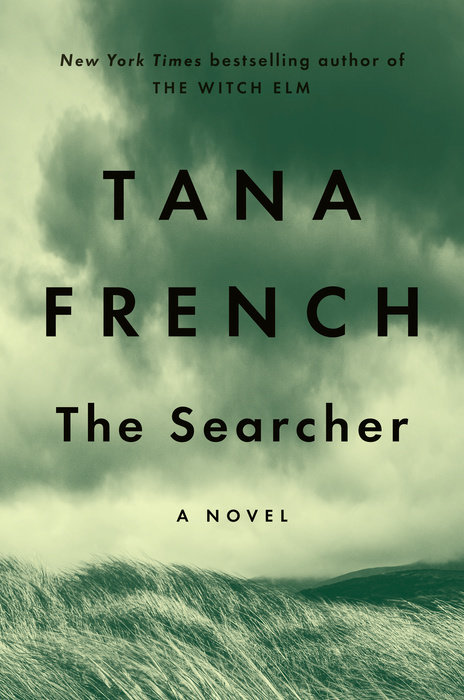
Book Review: The Searcher by Tana French

I loved Tana French’s last book, The Wych Elm – a twisty, psychological mystery with loads of secrets, a troubled, unreliable main character and a beguilingly chatty narrative voice. So naturally, I was keen to see what she would come up with next. I expected something similar with The Searcher, but really this is quite a different sort of novel altogether.

For while we back in Ireland, this is rural Ireland, not an Irish city, and we have a very different way of doing things, a slower pace that suits the story as well. And our narrator, Cal Hooper, is a retired cop from Chicago, so the narrative voice is quite different too. He’s not a high flying ex-detective either, more a veteran of the beat, well aware of the sorts of crimes committed by the young and the desperate. Which comes in handy when he meets thirteen-year-old Trey.

Cal is two-years single, and for some reason thinks what he wants is a small holding in the middle of nowhere, the local village boasting a shop and a pub and not much else. His house needs everything done to it, and he is slowly putting in the hours with the paint and sandpaper when his cop’s sixth-sense tells him someone is watching him. So what does he do? He puts soil under his windows so he can check for footprints. Eventually he meets the ‘spy’ – a scrawny teenager with a problem, if only Cal can get the truth out of him.

Eventually Trey spills the beans – his older brother is missing. Trey comes from a family shunned by the villagers because of a bad-news father, now in Dublin, and a bunch of kids known for truancy and minor misdemeanours, a mother that’s not really coping. Nobody gives them a hand, which says something about the locals. Cal tells Trey how the police go about investigating missing persons and reluctantly puts together a plan. This includes talking to witnesses, the friends and associates that might know something to create a picture of what Brendan was up to before he disappeared.

The Searcher is a slow-burner that may lose the less-persistent reader. We have to meet the locals: Mart the chatty neighbour who gives Cal stick about women and invites him to the pub; Noreen, shopkeeper and town gossip; Lena, the potential love-interest. There’s Donie MacGrath, the town low-life who thinks he’s way smarter than he is and Mart’s odd-ball friends. Random sheep are savaged and down at the pub there is talk of wild cats and UFOs. It’s hard for Cal to get anybody’s story straight, there is just so much blarney.

But the pace picks up and pretty soon Cal finds there are secrets someone is determined to keep hidden to the point that things take a more violent turn. This does a lot to add suspense, but so does the atmosphere which is created out of the setting with its wild and lonely scenery, the natural distrust of the villagers for any disruption to their way of life. The author also creates a picture of a place with no future, its youth leaving in droves, or finding other outlets for their desperation.

Tana French does a brilliant job to bring this all together in a dramatic and sensitive way, making this a very intelligent sort of crime novel. Cal is a great character, being such a fish out of water and surprisingly trusting for an ex-Chicago cop. He has plenty to learn about people and his place in village life. The story builds to an ending that keeps you with bated breath, and a resolution that for me was deeply satisfying. And while The Searcher is quite a different reading experience from The Wych Elm, the two are both crafted, character-driven novels exploring the dark side of human nature. This one’s easily a four out of five star read from me.