Book Review: Gabriel’s Moon by William Boyd – much more than your average spy novel

I’m always keen to read anything by William Boyd – his prose is crafted, his characters complex and there is always an interesting historical setting. And story-wise, you can never tell what’s going to happen next.

With Gabriel’s Moon we are in London, at least some of the time, in the early 1960s, and our complex protagonist this time is Gabriel Dax. He’s a travel writer at that time when travel writing was really popular, and at thirty, is already very successful.

The book opens with a prologue describing the house fire that killed his mother and when, as a six-year-old, Gabriel was lucky to escape with his life. Ever since, Gabriel has struggled to sleep – with nightmares of the fire plus troubling missing elements of his memory. He has sleeping pills, and not surprisingly he drinks a lot. A doctor recommends he see a therapist and these sessions lead him to investigate just what really happened that night.

Gabriel’s recent jaunt abroad has taken him to Léopoldville, and the newly independent Republic of the Congo. He takes an opportunity to interview the new prime minister, Patrice Lumumba, who wants to set the record straight. It seems his life is in danger, and there are names he wants recorded, should he be assassinated. This is way out of Gabriel’s usual sphere as a writer, but he does what he’s asked, making taped recordings of the interview.

But Gabriel’s work hasn’t always been just about travel. His brother Sefton, being something in the Foreign Office, has on occasion asked Gabriel to make deliveries for him to the Continent. When Faith Green, a secretive woman Gabriel has clocked reading his book on the plane home, contacts him with a commission of her own, his first instinct is to refuse. Faith works for MI6 and is something of a femme fatale. But the money’s good, and the trip to Spain tempting. Before you know it, Gabriel’s involved in more and more dangerous work for Faith and in spite of his niggling doubts, seems unable to refuse.

Gabriel’s an interesting character and not always likeable. You want to give him a good shake, tell him not to drink so much and get a grip on his life. There are sadly not many people he gets close enough to call friends. His girlfriend Lorraine hasn’t a clue about what is going on in his head, while he and his brother are somewhat distant having been brought up by different relatives after the death their mother. So there’s no one there to offer a reality check. How he handles the increasingly tricky situations he gets himself into sees a new Gabriel emerge.

Undercurrents of the political situation with the USSR, the Cuban Missile Crisis, as well as social politics of the time round the story out and the period really comes to life. There are glimpses of the ordinary, such as Gabriel’s ongoing battle with a savvy mouse in his flat; the pest-eradication advice from Tyrone, his streetwise locksmith. The book reminded me a little of A Bird in Winter by Louise Doughty – another really intelligent and nuanced spy novel with a main character on their own and battling for survival. This makes both books really engaging and gripping.

Then there are the settings. As well as Congo, there’s Warsaw and Cádiz, rural England and sixties London. If you’re after a satisfying, pacy but intelligent novel, Gabriel’s Moon might just do the trick. It’s a four-star read from me.

Book Review: This Strange Eventful History by Claire Messud – a novel about displacement, diaspora and a family through three generations

If you’ve ever had a scroll through the Booker Prize website, you’ll discover it’s full of all kinds of interesting information for readers. Here I discovered a quiz that helped you decide which book to start with from this year’s long-list, based on your reading preferences. I could’t resist having a go, and was prompted to try This Strange Eventful History.

The book is described as being of ‘breathtaking historical sweep and vivid psychological intimacy’, which certainly whetted my appetite. It begins in Greece 1940, as the Nazis have captured Paris, leaving French naval officer, Gaston Cassar afraid for his family. So he packs them all up for the arduous journey across Europe in wartime to the old family home of Algiers. That’s his very dear wife, Lucienne, her frail older sister, and his two children, François and Denise, with Gaston returning to the navy.

The family have been moved around before, but home is always Algiers. Until it’s not. With the Algerian Revolution in the 1950s and the country’s eventual independence, the Cassars try to resettle in France, but they are not easily accepted as French, and they miss the beauty of Algeria. Francois moves to Amherst to study and meets Canadian Barbara. The two make a life together, but nowhere seems quite like home. Throwing in the promise of an academic future Francois decides on a business career to better support his family – long hours and work that takes him around the world. His family moves to Australia at one point, try Canada and Switzerland.

Francois seems a perpetually unhappy man. He longs for the intense devotion in his marriage that his own parents experience. But it’s not just his story. We also have Denise’s time in Argentina as a young woman, where she settles with her parents following a breakdown. We get to know the next generation through young Chloe, who also settles somewhere different from where she was born. We see Barbara’s own misery, the issues of having a family and a career, and being responsible for the home. It’s the 1970s and women “can have it all”, but it’s not easy..

As the characters take you around the world, you are not so much shown what happens, but let into their minds at moments of reflection – waiting for a guest to arrive, getting ready for a family event. It is very much an introspective sort of story. As the chapters jump through time, it’s a way of catching up with what has brought them to this point. But it means the story is often less immediate than it might be. More “told” than “shown”. If you’re used to a more plot-driven story, you might find this frustrating. Then, at the end, there is a startling revelation – so don’t whatever you do think, I might just skip the epilogue, or flip to the back to see where you’re headed.

I am certainly glad I read This Strange Eventful History as it evocatively describes the effects of losing your homeland, of dislocation and the importance of somewhere you call home. It’s cleverly written, threads going back to the past that have you thinking, “so that’s what happened”, rather like real life. And the characters are certainly interesting and well rounded, if at times not all that likeable. But overall I found the book a bit of a slog. I’ll certainly go back to the Booker Prize website for more reading advice, and I don’t mind the occasional slog of a read. This one’s a three-and-a-half star read from me.


Book Review: Confessions by Catherine Airey – a compelling story of three generations of Irish women, their secrets and their choices

Rather than following Cora’s fresh start in Ireland, the story switches back to describe two sisters growing up and struggling with the sudden loss of their father. Their mother takes to her bed and the sisters, Maire and Roísín, do their best. Maire is a brilliant artist but has mental health issues. Fortunately there’s Michael who adores her and is like a brother to Roísín. We’re also with Maire when she earns a scholarship to New York and her struggles to fit in with a narrative shift told interestingly in the second person.

Almost like a character in itself is the big old mansion outside the village, once a stately home, that has become a refuge for women seeking an alternative lifestyle. Known as The Screamers, it offers a new chance first to Maire, and later the home for Roísín and the returning young Cora. It is where Cora’s daughter, Lyca, digs into the past and finds some long buried secrets.

On the walk home from midnight mass you go inside a phone box. Shutting yourself in reminds you of being inside the confessional booth back home. Your first confession, when you wanted to tell Father Peter about Jesus winking at you from the cross over the altar. Your mother had told you that this was a false image, that you were imaging things. But it didn’t feel fair to count this as a sin when you weren’t the one doing the winking. Instead, said you sometimes wished your sister was dead. This seemed to satisfy the priest, who sent you off to pray the rosary.

In Confessions we have the repeated themes of girls growing up without a father, teen pregnancies, too much freedom or too much restraint. These young women are all smart enough to do well in a world that accepts them for who they are, but it’s going to take more recent generations – Cora, and then Lyca – for that to happen, and a more modern Ireland. But it’s the long buried secrets that keep the reader on their toes to the end. How will they disturb the fragile memories Cora in particular has of her parents?

And the writing is wonderful, finely tuned to each character and allowing them to tell their story, vivid and at times very intense. The setting of New York in particular is an interesting highlight – it comes through as a walker’s city, shown from the ground up, as well as a place of surprising vistas when seen from a high-rise building. The contrast with a small Irish town couldn’t be more stark – the closed-in feel of the early interiors, then Screamers with its warren of rooms.

This is a well put-together story, the threads of the different characters carefully woven in and, at the same time, written from the heart. I was glad to receive this advance reader copy thanks to Netgalley, in return for an honest review. Confessions is due for release late January and a four-and-a-half star read from me.

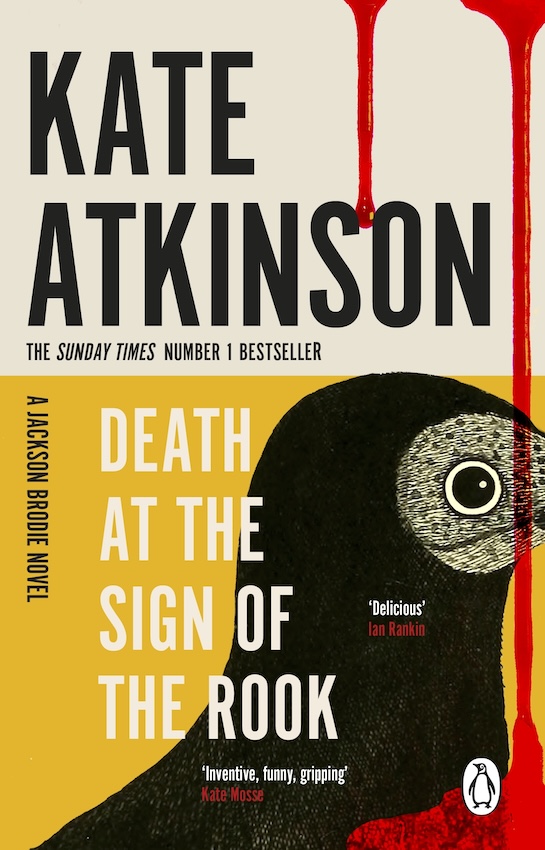
Book Review: Death at the Sign of the Rook by Kate Atkinson – more fun and games with the latest Jackson Brodie mystery

I have to admit to being a Jackson Brodie fan since we met the beleaguered private investigator in the first book, Case Histories. I’ve read them more than once as well as enjoying immensely the TV adaptations starring Jason Isaacs. So here we are, five years since the last one (Big Sky), with another in the series – something I wasn’t really expecting, and you can imagine my delight.

Atkinson has a habit of not really continuing where she left off in the last book. Instead we seem to catch up with Jackson some years later, or with a completely different set of circumstances. Sometimes he’s flush and others he’s down on his luck. In Death at the Sign the Rook, Jackson is living with his girlfriend, Tatiana, and has had enough income from his PI work to buy himself a lovely big Land Rover Defender. His new case involves the theft of what looks like a Renaissance painting – a portrait of a Woman with a Weasel, which until recently hung on the bedroom wall, out of reach of prying eyes, of an elderly lady who has recently died.

It seems Dorothy Padgett’s carer Melanie Hope has taken it, and just disappeared without notice, leaving only an old mystery novel: Hark! Hark! The Dogs Do Bark by Nancy Styles. Dorothy’s daughter Hazel and her son Ian want Jackson to track Melanie down rather than calling the police – the painting may have some dodgy provenance. We get Jackson’s usual internal sizing up of the situation with Dorothy’s grasping offspring, squabbling over their mother’s possessions.

The story weaves in and out of Jackson’s investigation, bringing in several other main characters, beginning with Lady Milton over at her cash-strapped stately home, Burton Makepeace. LM has similarly lost a valuable painting, this one a Turner, at the same time as her companionable housekeeper Sophie disappeared. She is struggling to keep control of things while her eldest son Piers is trying to turn the big house into a hotel complete with staged murder mystery evenings. She’s an impossible character to like with her old-world thinking and arrant snobbery, but you can’t help feeling a bit sorry for her.

There’s also the boring vicar, Simon Cate, who has had a complete loss of faith, but battles on regardless, a fondness for animals, his only saving grace. And then there’s Ben, ex-military and a bit sorry for himself having lost a leg on his last tour, while missing his mates in the Army. He’s living with his sister, and learning to look after bees. We also meet Reggie Chase again – you’ll remember her from previous books – now a Yorkshire police detective.

These threads all slowly weave the characters into a plot involving a blizzard, a murderer on the run who’s armed and dangerous, and a murder mystery evening at Burton Makepeace. Somehow all of the characters end up there – we’re given a hint of what’s to come in a kind of prologue – and Jackson’s going to feel glad he bought the Defender. As usual it isn’t always the crooks that are the baddies, or not all of them anyway, and Jackson may or may not err on the wrong side of the law.

Atkinson is a master of creating a tantalising story with plenty of humour and surprise twists. However, I did feel this story took a while to get going. We get stuck for chunks of narrative with Simon the vicar, and Lady Milton, both of whom can be a bit tiresome. But once the story gets going, there’s plenty to enjoy and the ending’s a cracker. Not the best Jackson Brodie, but still worth reading. A three-and-a-half star read from me.
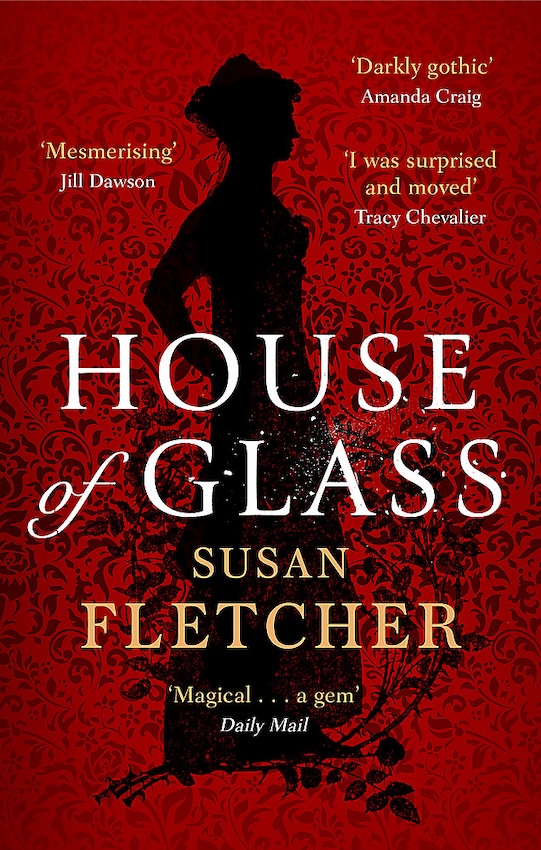
Book Review: House of Glass by Susan Fletcher – a chillingly gothic novel with an extraordinary heroine

I was so taken with Susan Fletcher’s recent novel, The Night in Question, that I thought I’d try one of her earlier books. I picked up House of Glass, a historical mystery novel which oozes creepy house atmosphere.

We start off in London at the turn of the twentieth century, where we first meet Clara as a child, unable to leave her house. She has osteogenesis imperfecta, a kind of brittle bone disease, which means the slightest stumble or fall can cause a broken bone. The doctor thinks it best if she doesn’t go outside until she has grown up – or as grown up as she ever will be.

Clara is well cared for – there are endless books to read, and her mother, Charlotte, and her stepfather love her. Charlotte is a suffragette who left India as a young woman in disgrace and has made a marriage of convenience to Patrick. At the age of eighteen, Clara is able to explore the world with care, but the early death of Charlotte leaves her devastated. She finds herself at Kew Gardens in winter, befriended by one of the gardeners, and is slowly restored to herself by learning about the plants.

The story takes us to Shadowbrook, a once stately home with impressive gardens, where Clara takes on a short-term job – to oversee the establishment of a glass house of tropical plants, delivered from Kew. The new owner of Shadowbrook, a Mr Fox, is rarely at home, so Clara is left to get on with the glass house. But there are ghostly occurrences in the house – footsteps upstairs, where none of the staff or Clara are allowed to venture; flowers that are torn to shreds in the vases; things moved around. The housekeeper talks of paintings thrown from the walls, books flung from the shelves – which explains the bareness in many of the rooms.

Clara is a young woman who has immersed herself in science and doesn’t believe in ghosts. Even so she can’t help but be curious about the Pettigrew family that once lived at Shadowbrook, the stories of wild and cruel behaviour that have made them hated in the village. But the more questions she asks, the more suspicious the locals are of Clara, with her long, pale and untamed hair, her stoop and walking stick, her strange-coloured eyes. She begins to feel as much an outsider as the mysterious Veronique Pettigrew, whose ghost supposedly haunts Shadowbrook.

I had a curious sense of being watched; throughout the garden, I felt it. It was as though I had entered a part of it – the orchard, the lime bower – at the very moment that someone else had risen and left; I felt any metal chair might retain that person’s heat. It was an unsettling notion. I chastised myself for it – it was foolishness – yet I also looked down the lines of hedges. On the croquet lawn, I turned a slow, complete circle to see it all.

House of Glass is a novel that works on many levels. It reminded me of Wilkie Collins’ The Woman in White, with its mix of suspense and mystery. There’s atmosphere by the truckload in the house and the gardens, both evocatively described. Many of the characters seem to be harbouring secrets, some of them quite devastating as the story emerges, and there are a few twists before you get to the end.

My body was discoloured, marked. I was perhaps, more bruised than I had ever been; mauve and dark red and yellow in places. I examined the bruises one by one. I tried to remember the cause of each – a branch or a door frame, my own touch – and once, I might have minded such injuries. But now I saw those bruises as proof that I was living. I was no longer watching life from a London window, my hands on the glass; I was a part of it.

And then there’s the conjuring up of England on the brink of war – it’s 1914, the summer that Clara comes to Shadowbrook – so you’re constantly aware that the futures of the young gardeners and other characters are hanging in the balance. The place of women, not only the suffragettes, but any woman wanting to make a life of her own, to live the way she wants to is a theme that is depicted in the characters of Clara, Charlotte and in the story of Veronique.

House of Glass is a terrific read for anyone who loves a good historical mystery, or enjoys an atmospheric setting, particularly the way an English country house can be almost a character in itself. The characters are interesting more than likeable, while the plot has plenty to get you rushing through the final chapters. Throw in some nicely crafted writing and there’s plenty here to enjoy – it’s a four-star read from me.

Book Review: The Long Water by Stef Penney – an enthralling Nordic mystery with dark echoes from the past

I’m always excited to see a new novel by Stef Penney. Her new novel, The Long Water, takes its name from a river in a rugged part of Norway within the Arctic Circle, where there’s a string of lakes and rivers, guarded by “mountains that rise out of the water like teeth”. It’s a remote area that once fostered mining, but with most mines now closed, the economy is now more reliant on tourism.

In the town of Fauske, senior high school students are enjoying “russ”, a kind of spring break, taking part in dares, general mayhem and partying all night before the hard work of exams begins. In the middle of this, a popular boy goes missing. Daniel was one of a group of friends who called themselves the Hellraisers and who are admired by everyone for their general coolness. A police search that goes on for days and then weeks yields not the missing boy, but a body in a mine that dates back to 1968, when the mine was closed.

The story draws you in through the eyes of several characters beginning with Svea, an elderly woman living on the outskirts of town with her dog who likes to keep to herself. Her one good friend is Odd Emil, a widower who is also Daniel’s grandfather. Svea has fallen out with her daughter, but is in contact with a granddaughter, Elin, who lives with her father, a rather conservative vicar. Now sixteen, Elin has just come out as gender fluid which at first perplexes her father, but fortunately Svea lends a sympathetic ear.

As well as being a mystery, this is also the story of Svea’s family and ongoing damage from their horrific upbringing. Svea has become strong in spite of this – the father she never knew was a German soldier stationed in Norway during the war, and her mother’s one true love. Her violent drunk of a stepfather taunted her with her doubtful parentage, but at least she had the love of her two sisters.

Elin worries that her being neurodiverse is what drove her mother away, but Svea thinks it’s more likely that her daughter has been troubled by her family’s mental health problems, in particular, an alcoholic grandmother and a fey aunt who disappeared some years ago.

The story also follows Benny, Elin’s friend who gets inadvertently caught up as a witness to events on the night of Daniel’s disappearance, while doing something he probably shouldn’t. And then there’s Daniel’s teacher, Marylen, who has a troubled home life and a secret attraction to Elin’s father. They are all interesting characters, well-drawn, who throw different lights onto the central mystery.

So there’s plenty of story threads. How the town deals with the disappearance of Daniel, as well as the discovery of a body pushes the plot along nicely. Elin and Svea can’t help but ask questions while hints of what happened decades ago make you whip through the pages. On top of which, Fauske is such an interesting place for a reader to visit – Stef Penney is brilliant at creating evocative settings – and you have the feeling that there are darker undercurrents that need to be brought to light, particularly around misogyny and prejudice.

While all the characters are easy to sympathise with, Svea is a particularly brilliant creation. She’s crusty and plain-spoken, loves her dog but has secrets too. Her story is slowly revealed, while we wonder if it isn’t too late for her to find peace with the past, reconnection with her family, even love. Stef Penney, who wrote the Costa Award winning: The Tenderness of Wolves, is always worth waiting for and her new book didn’t disappoint. The Long Water is a four and a half star read from me.

Book Review: The Vanishing Act of Esme Lennox by Maggie O’Farrell – a disturbing story about family secrets and the spectre of madness

I’ve had this book on my bedside table for what seems like forever – a ‘just in case’ sort of book for when I’d run out of anything else that begged me to pick it up. I knew it would be good – Maggie O’Farrell is always good, but the subject matter sounded sobering.

The Vanishing Act of Esme Lennox follows an Edinburgh family. Iris receives a letter from a solicitor about a relative she didn’t know she had, the sister of her grandmother, about to be released from care. Esme Lennox has been in a mental hospital for sixty odd years and now needs to be rehoused. Her name has been put down for a rest home, but there’s not a bed available for some weeks. Can Iris look after her in the meantime?

Iris assumes Esme must be unsafe, or unable to care for herself, or both, and with a shop to run and a busy life, is not confident she can take her aunt on. Her initial impulse is to agree to a temporary solution in a hostel. She collects Esme, a woman in her seventies, but the hostel is unwelcoming, peopled with drug addicts and volatile personalities. What can she do but put Esme up in her spare room and explore other options.

In the meantime we get Iris’s story – her close bond with step-brother Alex; the father who died young; her mother in Brisbane; her affair with a married man. Her little shop selling gorgeous pre-loved clothes and accessories. But the bulk of story is about Esme – her childhood in India with an older sister and baby brother. Her quirky personality, her stuffy, unloving parents and the terrible tragedy before the family’s return to Edinburgh. Esme is bright and rebellious, not sensible and manageable like her sister, Kitty. We follow her growing up and the events that tip her over the edge.

Iris waits for Esme to open the door but nothing happens. She puts her hand on the doorknob and turns it slowly. ‘Good morning,’ she says, as she does so, hoping she sounds more upbeat than she feels. She has no idea what she will see behind the door.
Esme is standing in the middle of the room. She is fully dressed, her hair brushed and neatly clipped to one side. She is wearing her coat, for some reason, buttoned up to the neck. There is an armchair next to her and Iris realises that she must have been pushing it across the floor. The expression on her face, Iris is astonished to see, is one of absolute, abject terror. She is looking at her, Iris thinks, as if she is expecting Iris to strike her.

It’s not a happy story, not at all, but it casts a light on the way women with mental health problems, or even if they were just a bit unruly, could be sent away to asylums. All was needed was a determined, usually male relative, and the signing off a doctor. Maggie O’Farrell imagines how a young woman like Iris would feel on discovering that her grandmother had a sister she’d never mentioned, and that that sister had been never been out of her mental facility for sixty years. Just how do you deal with that?

The two discover more about each other as secrets emerge, and in facing up to the truth, Iris also faces up to the truth of her own life, in particular her own relationships. It’s a compelling read and I was not in the least disappointed, in spite of the tragedy of Esme’s situation, as the story surges on to an attention-grabbing finale. I was hooked – I am always hooked with Maggie O’Farrell. I’m not sure if it’s her crisp writing style, or her immensely interesting and empathetically drawn characters, but her books are just so satisfying. As is this one. The Vanishing Act of Esme Lennox is a five star read from me.

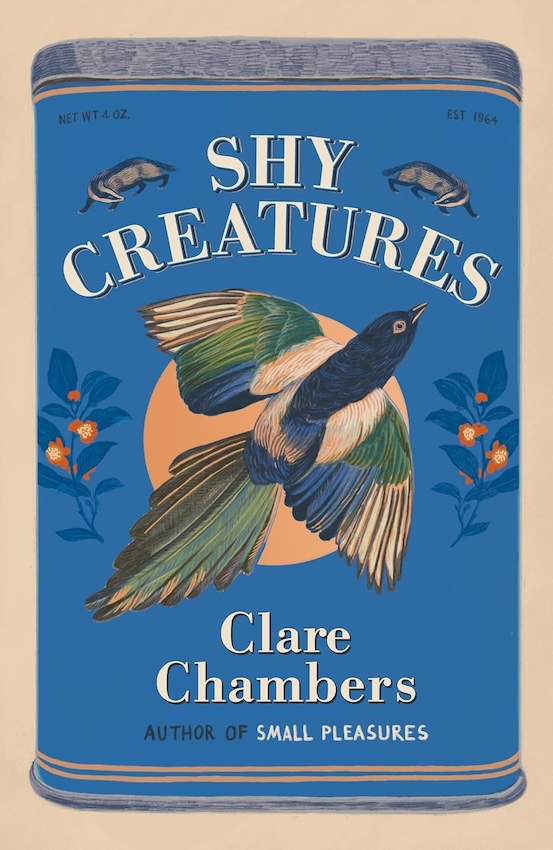
Book Review: Shy Creatures by Clare Chambers – a remarkable story, engrossing and heart-warming

I bought Shy Creatures as soon as it came out as an ebook, and unlike many previously purchased novels, it didn’t sit on my bedside table languishing while I was distracted by other books passing by. It beckoned to me and I was soon engrossed – and gosh, what a satisfying read it is.

Shy Creatures is set for the most part in 1964. Helen Hansford is an art therapist at Westbury Park, a facility for mental health patients. She has been having an affair with Gil Rudden, one of the doctors, which is complicated by his wife being a distant cousin of her mother’s. Gil has promised Helen that as soon as his children are old enough to leave home, he will divorce his wife and marry her. Helen accepts the status quo and muddles on with a less than satisfactory home life, a nagging mother, and a job where she doesn’t feel she makes a lot of difference.

For all that, Helen is passionate about her work and the way Westbury Park is run. The gates are always open, and while some therapy involves dulling the patients’s minds with drugs, doctors like Gil have more modern ideas, which is one of the reasons Helen fell for him. An incident at a nearby house leads Helen and Gil to discover a man who has been shut up indoors for at least ten years along with his only relative, a frail and elderly aunt.

William Tapping, now in his late thirties, has been found in a bad way, in a state of undress, a beard down to his stomach and apparently mute. The house is in a state of disrepair, filthy windows letting in no light, the garden a jungle. When social services intervene, William and his aunt are whisked away to Westbury Park. Here Aunt Louisa implores Helen to find a container hidden in the flour bin that no one else should see, but while she’s at the house, Helen also discovers some drawings in William’s room that display the work of a talented artist.

At the discovery of this cache, Helen’s pulse quickened and she felt a tingle of excitement. No one who had passed through the art therapy room during her residency had shown anything approaching this level of talent. Of all the professionals at Westbury Park, she was uniquely placed to help this hidden man emerge from his place of silence. Even Gil did not have her advantage.

The story follows Helen’s efforts to make a connection with William through art as well as her tracking down some old acquaintances – people he knew at school – in an attempt to find out more about him. We have the ups and downs of Helen’s relationships with Gil, as well as her family, particularly with a teenage niece who has a kind of breakdown. Woven into all of this is William’s story, going back steadily in time until we get to the day when his life changed dramatically, putting in place the kind of house arrest his family imposed on him.

It’s a fascinating story with Clare Chambers’s usual wit and brilliantly evoked characterisation – one of the things that puts her books on my must-read list. And it’s a sad story too, as we consider William’s wasted years. The author recreates the era of the sixties – the music and clothes as well as social attitudes to women, to the mentally frail. The limited choices for girls once they leave school – particularly if they want to please their mothers. We also have the war years, and the privations of rationing, the nightly fear of air raids.

If there’s a theme that often appears in books by this Clare Chambers, it is about finding a place in society when you’re not a natural fit. Many of her characters are on the quirky side and with William, we have someone who quite possibly never will find a suitable niche in the world – particularly a world like Britain in 1964. This, plus Helen’s relationship woes pulls you through the story, along with the eventual revelation of a terrible secret. It’s another brilliant read from Clare Chambers – I can’t recommend it enough – a five-star read from me.

Book Review: Back Trouble by Clare Chambers – an oldie but a goodie from a favourite author

If you enjoyed Clare Chambers’s last book, Small Pleasures, as much as I did, you’ll be pleased to know her new book, Shy Creatures, is out soon. I’ve always loved this author’s particular way with empathy and humour, so when I found an earlier book by Chambers at a second-hand bookshop, I was delighted, in spite of having read it years before.

Back Trouble, first published in 1994, is about Philip, who is about to turn forty, and his life for the most part seems to have gone to custard. We first catch up with him at an awkward family New Year’s celebration. His insurance broker brother Raymond is over from Canada with a new batch of photos of his children, recounting their successes (the football and the gymnastics), while Philip has never felt less like celebrating. With the failure of his publishing company he is in debt up to his eyeballs and the love of his life having gone home to New Zealand, life couldn’t get any worse, could it?

A cold chip from an overflowing municipal bin sends Philip head over tail and the ensuing back injury leaves him bedridden. There’s nothing to do but to fish out the notebook and pens from under his bed and begin to write the story of his childhood – a New Year’s challenge flung out by Raymond, to be completed in three months – just a thousand words a day – no probs. We are reminded that this is the 1990s and the Internet is in its infancy, although probably a more modern-day Philip wouldn’t be diverted by technology as he’d be out of data anyway – he’s that strapped for cash.

The kitchen was the first room to be tackled. One of the men from the building site had given Dad and industrial-sized drum of bottle green paint from the batch which his brother, who worked for the Council, had been using to paint the park railings. Cost was Dad’s only criterion in selecting materials. This meant garish rolls of wallpaper from the bargain bucket outside the DIY shop, the top six inches of every roll faded by the sun, and brushes which moulted into the paint. He had an idiosyncratic way of decorating. Being both nervous and impatient he didn’t believe in preparing surfaces, always fearing that something terrible might be lurking beneath a layer of bubbly paper or flaking paint. So instead of stripping paintwork, or even washing it, he would set straight to work, brushing gloss over old gloss, dust, mould and even, in one instance, a dead spider which lay preserved like a Pompeian relic in its shell of green paint.

Philip is such a self-deprecating narrator – he has no illusions about where he’s at as he approaches forty – and his story is warmly humorous as it rattles along to a nicely surprising ending. There are some poignant moments too, particularly in Philip’s childhood, with adults not behaving as they ought to and the weight of knowledge that falls on a young boy growing up. It is easy to blame Philip’s careless yet penny-pinching father, but other adults also turn out to be unreliable or even predatory.

Odd allusions to Great Expectations add an interesting twist. There are a raft of curious characters, quirky, helpful or otherwise, which may be another nod to Dickens, particularly the scene at Philip’s grandmother’s house – the blind matriarch and hoarder of useless furniture, including four unplayable pianos, terrifying in her fierceness; the black-toothed Auntie Florrie smoking her woodbines; Punnet the obese black labrador. It’s like stepping back in time.

For a small book, Clare Chambers packs quite a lot in and it’s hugely entertaining. I know she can always be relied upon for an original and big-hearted read so I am so looking forward to Shy Creatures, released on Amazon at the end of the month. Back Trouble is a four-star read from me.

Elektra by Jennifer Saint – a retelling of the Sophocles tragedy for a modern audience

These retellings of stories from Ancient Greek classics can be oddly compelling. The latest to hit my bedside table is Jennifer Saint’s Elektra, a new version of the tragedy by Sophocles. If you haven’t met her before, the eponymous heroine is the youngest daughter of Agamemnon and Clytemnestra. You’ll remember Agamemnon as the leader of the Greek fleet that waged war on Troy – the thousand ships that sought revenge on Paris for making off with Helen – the world’s most beautiful woman, and also Agamemnon’s sister-in-law.

The story starts off with Helen choosing her husband. All the suitors have gathered at the court of her father, the king of Sparta, where she chooses the adoring Menelaus, a second son who will let her stay in Sparta to help rule her father’s kingdom. At the same choosing party is Helen’s sister Clytemnestra. She is impressed by the two brothers from the House of Atreus, particularly the powerful energy emanating from Menelaus’s brother, Agamemnon. After the marriage of Helen, the brothers set sail for the home they have lost to the uncle who’d murdered their father, and with the Spartan fleet behind them, enact vengeance.

It is this house that Clytemnestra marries into, and discovers the terrible curse on the House of Atreaus, one that just won’t leave them alone. It involves murder of innocents, fratricide and revenge – an on-going intergenerational battle for the throne. Things may have settled down after Agamemnon took back his kingdom – if only Paris hadn’t stolen Helen and spirited her away to Troy. You know how it goes.

Jennifer Saint tells the story from the point of view of three women: Clytemnestra, her daughter Elektra and Cassandra, a daughter of Trojan King Priam. Clytemnestra witnesses her husband sacrifice their eldest daughter Iphigenia so that the gods will grant him a wind to take his fleet to Troy. In her grief, she vows to kill Agamemnon on his return, but that’s another ten years away, and her grim decision takes over her life.

Elektra is a child when her father sails off to vanquish the Trojans, and misses him terribly. She is fierce, loyal and ignored by her mother. Clytemnestra’s intentions will set in motion a vengeance of her own. In Cassandra we have the story from the Trojan point of view. Badly treated by Apollo, Cassandra is cursed with a gift to predict the future, but to have her warnings disbelieved. Everyone therefore thinks she is mad – even when she predicts the fall of Troy and sees what’s hidden in the Trojan horse. Taken as a war prize by Agamemnon himself, her story will connect with that of Clytemnestra.

It surprises me just how readable and compelling this novel is given the content. Jennifer Saint does a brilliant job of envisaging the war, the plotting and scheming, the cruel indifference of the gods. One terrible deed just seems to lead to the next, and the characters have few redeeming features. So much bitterness and fury. All three women are trying to make a stand in some way, to determine their future, to make changes – difficult in a world run by power-hungry men and unreliable gods. Humming in the background is the question: if we leave one evil deed unpunished, do we not show contempt for the victim, for human kind and also for the gods?

The ending is brutal, but allows for a small glimmer of hope that the curse has finally come to an end – but who knows? Perhaps that’s another story. Elektra is another excellent addition to the genre, well-researched, intense and atmospheric. A terrific read for anyone who wants to immerse themselves in classical legends – four-stars from me.