Book Review: House of Glass by Susan Fletcher – a chillingly gothic novel with an extraordinary heroine

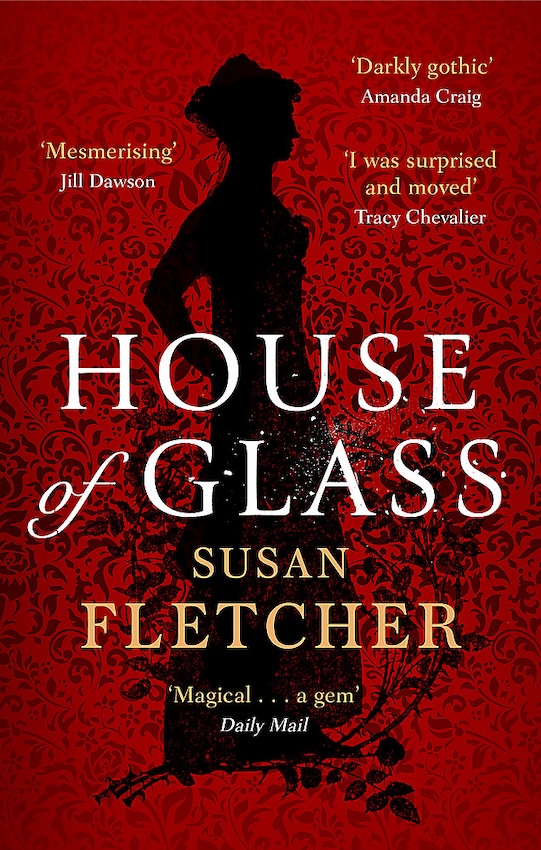
I was so taken with Susan Fletcher’s recent novel, The Night in Question, that I thought I’d try one of her earlier books. I picked up House of Glass, a historical mystery novel which oozes creepy house atmosphere.

We start off in London at the turn of the twentieth century, where we first meet Clara as a child, unable to leave her house. She has osteogenesis imperfecta, a kind of brittle bone disease, which means the slightest stumble or fall can cause a broken bone. The doctor thinks it best if she doesn’t go outside until she has grown up – or as grown up as she ever will be.

Clara is well cared for – there are endless books to read, and her mother, Charlotte, and her stepfather love her. Charlotte is a suffragette who left India as a young woman in disgrace and has made a marriage of convenience to Patrick. At the age of eighteen, Clara is able to explore the world with care, but the early death of Charlotte leaves her devastated. She finds herself at Kew Gardens in winter, befriended by one of the gardeners, and is slowly restored to herself by learning about the plants.

The story takes us to Shadowbrook, a once stately home with impressive gardens, where Clara takes on a short-term job – to oversee the establishment of a glass house of tropical plants, delivered from Kew. The new owner of Shadowbrook, a Mr Fox, is rarely at home, so Clara is left to get on with the glass house. But there are ghostly occurrences in the house – footsteps upstairs, where none of the staff or Clara are allowed to venture; flowers that are torn to shreds in the vases; things moved around. The housekeeper talks of paintings thrown from the walls, books flung from the shelves – which explains the bareness in many of the rooms.

Clara is a young woman who has immersed herself in science and doesn’t believe in ghosts. Even so she can’t help but be curious about the Pettigrew family that once lived at Shadowbrook, the stories of wild and cruel behaviour that have made them hated in the village. But the more questions she asks, the more suspicious the locals are of Clara, with her long, pale and untamed hair, her stoop and walking stick, her strange-coloured eyes. She begins to feel as much an outsider as the mysterious Veronique Pettigrew, whose ghost supposedly haunts Shadowbrook.

I had a curious sense of being watched; throughout the garden, I felt it. It was as though I had entered a part of it – the orchard, the lime bower – at the very moment that someone else had risen and left; I felt any metal chair might retain that person’s heat. It was an unsettling notion. I chastised myself for it – it was foolishness – yet I also looked down the lines of hedges. On the croquet lawn, I turned a slow, complete circle to see it all.

House of Glass is a novel that works on many levels. It reminded me of Wilkie Collins’ The Woman in White, with its mix of suspense and mystery. There’s atmosphere by the truckload in the house and the gardens, both evocatively described. Many of the characters seem to be harbouring secrets, some of them quite devastating as the story emerges, and there are a few twists before you get to the end.

My body was discoloured, marked. I was perhaps, more bruised than I had ever been; mauve and dark red and yellow in places. I examined the bruises one by one. I tried to remember the cause of each – a branch or a door frame, my own touch – and once, I might have minded such injuries. But now I saw those bruises as proof that I was living. I was no longer watching life from a London window, my hands on the glass; I was a part of it.

And then there’s the conjuring up of England on the brink of war – it’s 1914, the summer that Clara comes to Shadowbrook – so you’re constantly aware that the futures of the young gardeners and other characters are hanging in the balance. The place of women, not only the suffragettes, but any woman wanting to make a life of her own, to live the way she wants to is a theme that is depicted in the characters of Clara, Charlotte and in the story of Veronique.

House of Glass is a terrific read for anyone who loves a good historical mystery, or enjoys an atmospheric setting, particularly the way an English country house can be almost a character in itself. The characters are interesting more than likeable, while the plot has plenty to get you rushing through the final chapters. Throw in some nicely crafted writing and there’s plenty here to enjoy – it’s a four-star read from me.

Book Review: The Long Water by Stef Penney – an enthralling Nordic mystery with dark echoes from the past

I’m always excited to see a new novel by Stef Penney. Her new novel, The Long Water, takes its name from a river in a rugged part of Norway within the Arctic Circle, where there’s a string of lakes and rivers, guarded by “mountains that rise out of the water like teeth”. It’s a remote area that once fostered mining, but with most mines now closed, the economy is now more reliant on tourism.

In the town of Fauske, senior high school students are enjoying “russ”, a kind of spring break, taking part in dares, general mayhem and partying all night before the hard work of exams begins. In the middle of this, a popular boy goes missing. Daniel was one of a group of friends who called themselves the Hellraisers and who are admired by everyone for their general coolness. A police search that goes on for days and then weeks yields not the missing boy, but a body in a mine that dates back to 1968, when the mine was closed.

The story draws you in through the eyes of several characters beginning with Svea, an elderly woman living on the outskirts of town with her dog who likes to keep to herself. Her one good friend is Odd Emil, a widower who is also Daniel’s grandfather. Svea has fallen out with her daughter, but is in contact with a granddaughter, Elin, who lives with her father, a rather conservative vicar. Now sixteen, Elin has just come out as gender fluid which at first perplexes her father, but fortunately Svea lends a sympathetic ear.

As well as being a mystery, this is also the story of Svea’s family and ongoing damage from their horrific upbringing. Svea has become strong in spite of this – the father she never knew was a German soldier stationed in Norway during the war, and her mother’s one true love. Her violent drunk of a stepfather taunted her with her doubtful parentage, but at least she had the love of her two sisters.

Elin worries that her being neurodiverse is what drove her mother away, but Svea thinks it’s more likely that her daughter has been troubled by her family’s mental health problems, in particular, an alcoholic grandmother and a fey aunt who disappeared some years ago.

The story also follows Benny, Elin’s friend who gets inadvertently caught up as a witness to events on the night of Daniel’s disappearance, while doing something he probably shouldn’t. And then there’s Daniel’s teacher, Marylen, who has a troubled home life and a secret attraction to Elin’s father. They are all interesting characters, well-drawn, who throw different lights onto the central mystery.

So there’s plenty of story threads. How the town deals with the disappearance of Daniel, as well as the discovery of a body pushes the plot along nicely. Elin and Svea can’t help but ask questions while hints of what happened decades ago make you whip through the pages. On top of which, Fauske is such an interesting place for a reader to visit – Stef Penney is brilliant at creating evocative settings – and you have the feeling that there are darker undercurrents that need to be brought to light, particularly around misogyny and prejudice.

While all the characters are easy to sympathise with, Svea is a particularly brilliant creation. She’s crusty and plain-spoken, loves her dog but has secrets too. Her story is slowly revealed, while we wonder if it isn’t too late for her to find peace with the past, reconnection with her family, even love. Stef Penney, who wrote the Costa Award winning: The Tenderness of Wolves, is always worth waiting for and her new book didn’t disappoint. The Long Water is a four and a half star read from me.

Book Review: The Vanishing Act of Esme Lennox by Maggie O’Farrell – a disturbing story about family secrets and the spectre of madness

I’ve had this book on my bedside table for what seems like forever – a ‘just in case’ sort of book for when I’d run out of anything else that begged me to pick it up. I knew it would be good – Maggie O’Farrell is always good, but the subject matter sounded sobering.

The Vanishing Act of Esme Lennox follows an Edinburgh family. Iris receives a letter from a solicitor about a relative she didn’t know she had, the sister of her grandmother, about to be released from care. Esme Lennox has been in a mental hospital for sixty odd years and now needs to be rehoused. Her name has been put down for a rest home, but there’s not a bed available for some weeks. Can Iris look after her in the meantime?

Iris assumes Esme must be unsafe, or unable to care for herself, or both, and with a shop to run and a busy life, is not confident she can take her aunt on. Her initial impulse is to agree to a temporary solution in a hostel. She collects Esme, a woman in her seventies, but the hostel is unwelcoming, peopled with drug addicts and volatile personalities. What can she do but put Esme up in her spare room and explore other options.

In the meantime we get Iris’s story – her close bond with step-brother Alex; the father who died young; her mother in Brisbane; her affair with a married man. Her little shop selling gorgeous pre-loved clothes and accessories. But the bulk of story is about Esme – her childhood in India with an older sister and baby brother. Her quirky personality, her stuffy, unloving parents and the terrible tragedy before the family’s return to Edinburgh. Esme is bright and rebellious, not sensible and manageable like her sister, Kitty. We follow her growing up and the events that tip her over the edge.

Iris waits for Esme to open the door but nothing happens. She puts her hand on the doorknob and turns it slowly. ‘Good morning,’ she says, as she does so, hoping she sounds more upbeat than she feels. She has no idea what she will see behind the door.
Esme is standing in the middle of the room. She is fully dressed, her hair brushed and neatly clipped to one side. She is wearing her coat, for some reason, buttoned up to the neck. There is an armchair next to her and Iris realises that she must have been pushing it across the floor. The expression on her face, Iris is astonished to see, is one of absolute, abject terror. She is looking at her, Iris thinks, as if she is expecting Iris to strike her.

It’s not a happy story, not at all, but it casts a light on the way women with mental health problems, or even if they were just a bit unruly, could be sent away to asylums. All was needed was a determined, usually male relative, and the signing off a doctor. Maggie O’Farrell imagines how a young woman like Iris would feel on discovering that her grandmother had a sister she’d never mentioned, and that that sister had been never been out of her mental facility for sixty years. Just how do you deal with that?

The two discover more about each other as secrets emerge, and in facing up to the truth, Iris also faces up to the truth of her own life, in particular her own relationships. It’s a compelling read and I was not in the least disappointed, in spite of the tragedy of Esme’s situation, as the story surges on to an attention-grabbing finale. I was hooked – I am always hooked with Maggie O’Farrell. I’m not sure if it’s her crisp writing style, or her immensely interesting and empathetically drawn characters, but her books are just so satisfying. As is this one. The Vanishing Act of Esme Lennox is a five star read from me.

Book Review: Shy Creatures by Clare Chambers – a remarkable story, engrossing and heart-warming

I bought Shy Creatures as soon as it came out as an ebook, and unlike many previously purchased novels, it didn’t sit on my bedside table languishing while I was distracted by other books passing by. It beckoned to me and I was soon engrossed – and gosh, what a satisfying read it is.

Shy Creatures is set for the most part in 1964. Helen Hansford is an art therapist at Westbury Park, a facility for mental health patients. She has been having an affair with Gil Rudden, one of the doctors, which is complicated by his wife being a distant cousin of her mother’s. Gil has promised Helen that as soon as his children are old enough to leave home, he will divorce his wife and marry her. Helen accepts the status quo and muddles on with a less than satisfactory home life, a nagging mother, and a job where she doesn’t feel she makes a lot of difference.

For all that, Helen is passionate about her work and the way Westbury Park is run. The gates are always open, and while some therapy involves dulling the patients’s minds with drugs, doctors like Gil have more modern ideas, which is one of the reasons Helen fell for him. An incident at a nearby house leads Helen and Gil to discover a man who has been shut up indoors for at least ten years along with his only relative, a frail and elderly aunt.

William Tapping, now in his late thirties, has been found in a bad way, in a state of undress, a beard down to his stomach and apparently mute. The house is in a state of disrepair, filthy windows letting in no light, the garden a jungle. When social services intervene, William and his aunt are whisked away to Westbury Park. Here Aunt Louisa implores Helen to find a container hidden in the flour bin that no one else should see, but while she’s at the house, Helen also discovers some drawings in William’s room that display the work of a talented artist.

At the discovery of this cache, Helen’s pulse quickened and she felt a tingle of excitement. No one who had passed through the art therapy room during her residency had shown anything approaching this level of talent. Of all the professionals at Westbury Park, she was uniquely placed to help this hidden man emerge from his place of silence. Even Gil did not have her advantage.

The story follows Helen’s efforts to make a connection with William through art as well as her tracking down some old acquaintances – people he knew at school – in an attempt to find out more about him. We have the ups and downs of Helen’s relationships with Gil, as well as her family, particularly with a teenage niece who has a kind of breakdown. Woven into all of this is William’s story, going back steadily in time until we get to the day when his life changed dramatically, putting in place the kind of house arrest his family imposed on him.

It’s a fascinating story with Clare Chambers’s usual wit and brilliantly evoked characterisation – one of the things that puts her books on my must-read list. And it’s a sad story too, as we consider William’s wasted years. The author recreates the era of the sixties – the music and clothes as well as social attitudes to women, to the mentally frail. The limited choices for girls once they leave school – particularly if they want to please their mothers. We also have the war years, and the privations of rationing, the nightly fear of air raids.

If there’s a theme that often appears in books by this Clare Chambers, it is about finding a place in society when you’re not a natural fit. Many of her characters are on the quirky side and with William, we have someone who quite possibly never will find a suitable niche in the world – particularly a world like Britain in 1964. This, plus Helen’s relationship woes pulls you through the story, along with the eventual revelation of a terrible secret. It’s another brilliant read from Clare Chambers – I can’t recommend it enough – a five-star read from me.

Book Review: Back Trouble by Clare Chambers – an oldie but a goodie from a favourite author

If you enjoyed Clare Chambers’s last book, Small Pleasures, as much as I did, you’ll be pleased to know her new book, Shy Creatures, is out soon. I’ve always loved this author’s particular way with empathy and humour, so when I found an earlier book by Chambers at a second-hand bookshop, I was delighted, in spite of having read it years before.

Back Trouble, first published in 1994, is about Philip, who is about to turn forty, and his life for the most part seems to have gone to custard. We first catch up with him at an awkward family New Year’s celebration. His insurance broker brother Raymond is over from Canada with a new batch of photos of his children, recounting their successes (the football and the gymnastics), while Philip has never felt less like celebrating. With the failure of his publishing company he is in debt up to his eyeballs and the love of his life having gone home to New Zealand, life couldn’t get any worse, could it?

A cold chip from an overflowing municipal bin sends Philip head over tail and the ensuing back injury leaves him bedridden. There’s nothing to do but to fish out the notebook and pens from under his bed and begin to write the story of his childhood – a New Year’s challenge flung out by Raymond, to be completed in three months – just a thousand words a day – no probs. We are reminded that this is the 1990s and the Internet is in its infancy, although probably a more modern-day Philip wouldn’t be diverted by technology as he’d be out of data anyway – he’s that strapped for cash.

The kitchen was the first room to be tackled. One of the men from the building site had given Dad and industrial-sized drum of bottle green paint from the batch which his brother, who worked for the Council, had been using to paint the park railings. Cost was Dad’s only criterion in selecting materials. This meant garish rolls of wallpaper from the bargain bucket outside the DIY shop, the top six inches of every roll faded by the sun, and brushes which moulted into the paint. He had an idiosyncratic way of decorating. Being both nervous and impatient he didn’t believe in preparing surfaces, always fearing that something terrible might be lurking beneath a layer of bubbly paper or flaking paint. So instead of stripping paintwork, or even washing it, he would set straight to work, brushing gloss over old gloss, dust, mould and even, in one instance, a dead spider which lay preserved like a Pompeian relic in its shell of green paint.

Philip is such a self-deprecating narrator – he has no illusions about where he’s at as he approaches forty – and his story is warmly humorous as it rattles along to a nicely surprising ending. There are some poignant moments too, particularly in Philip’s childhood, with adults not behaving as they ought to and the weight of knowledge that falls on a young boy growing up. It is easy to blame Philip’s careless yet penny-pinching father, but other adults also turn out to be unreliable or even predatory.

Odd allusions to Great Expectations add an interesting twist. There are a raft of curious characters, quirky, helpful or otherwise, which may be another nod to Dickens, particularly the scene at Philip’s grandmother’s house – the blind matriarch and hoarder of useless furniture, including four unplayable pianos, terrifying in her fierceness; the black-toothed Auntie Florrie smoking her woodbines; Punnet the obese black labrador. It’s like stepping back in time.

For a small book, Clare Chambers packs quite a lot in and it’s hugely entertaining. I know she can always be relied upon for an original and big-hearted read so I am so looking forward to Shy Creatures, released on Amazon at the end of the month. Back Trouble is a four-star read from me.

Elektra by Jennifer Saint – a retelling of the Sophocles tragedy for a modern audience

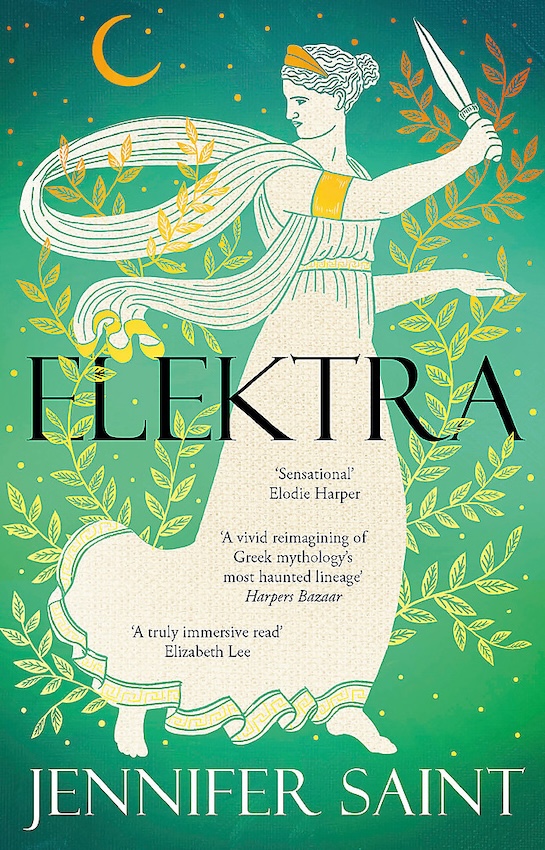
These retellings of stories from Ancient Greek classics can be oddly compelling. The latest to hit my bedside table is Jennifer Saint’s Elektra, a new version of the tragedy by Sophocles. If you haven’t met her before, the eponymous heroine is the youngest daughter of Agamemnon and Clytemnestra. You’ll remember Agamemnon as the leader of the Greek fleet that waged war on Troy – the thousand ships that sought revenge on Paris for making off with Helen – the world’s most beautiful woman, and also Agamemnon’s sister-in-law.

The story starts off with Helen choosing her husband. All the suitors have gathered at the court of her father, the king of Sparta, where she chooses the adoring Menelaus, a second son who will let her stay in Sparta to help rule her father’s kingdom. At the same choosing party is Helen’s sister Clytemnestra. She is impressed by the two brothers from the House of Atreus, particularly the powerful energy emanating from Menelaus’s brother, Agamemnon. After the marriage of Helen, the brothers set sail for the home they have lost to the uncle who’d murdered their father, and with the Spartan fleet behind them, enact vengeance.

It is this house that Clytemnestra marries into, and discovers the terrible curse on the House of Atreaus, one that just won’t leave them alone. It involves murder of innocents, fratricide and revenge – an on-going intergenerational battle for the throne. Things may have settled down after Agamemnon took back his kingdom – if only Paris hadn’t stolen Helen and spirited her away to Troy. You know how it goes.

Jennifer Saint tells the story from the point of view of three women: Clytemnestra, her daughter Elektra and Cassandra, a daughter of Trojan King Priam. Clytemnestra witnesses her husband sacrifice their eldest daughter Iphigenia so that the gods will grant him a wind to take his fleet to Troy. In her grief, she vows to kill Agamemnon on his return, but that’s another ten years away, and her grim decision takes over her life.

Elektra is a child when her father sails off to vanquish the Trojans, and misses him terribly. She is fierce, loyal and ignored by her mother. Clytemnestra’s intentions will set in motion a vengeance of her own. In Cassandra we have the story from the Trojan point of view. Badly treated by Apollo, Cassandra is cursed with a gift to predict the future, but to have her warnings disbelieved. Everyone therefore thinks she is mad – even when she predicts the fall of Troy and sees what’s hidden in the Trojan horse. Taken as a war prize by Agamemnon himself, her story will connect with that of Clytemnestra.

It surprises me just how readable and compelling this novel is given the content. Jennifer Saint does a brilliant job of envisaging the war, the plotting and scheming, the cruel indifference of the gods. One terrible deed just seems to lead to the next, and the characters have few redeeming features. So much bitterness and fury. All three women are trying to make a stand in some way, to determine their future, to make changes – difficult in a world run by power-hungry men and unreliable gods. Humming in the background is the question: if we leave one evil deed unpunished, do we not show contempt for the victim, for human kind and also for the gods?

The ending is brutal, but allows for a small glimmer of hope that the curse has finally come to an end – but who knows? Perhaps that’s another story. Elektra is another excellent addition to the genre, well-researched, intense and atmospheric. A terrific read for anyone who wants to immerse themselves in classical legends – four-stars from me.

Book Review: The Hazelbourne Ladies Motorcycle and Flying Club by Helen Simonson – a fun historical read set in post WWI England

I’d really enjoyed both of Helen Simonson’s earlier books, Major Pettigrew’s Last Stand and The Summer Before the War, so was looking forward to her new book. And it’s a treat. Peppered with a cast of interesting characters, the story follows Constance Haverhill, who has recently lost her mother to the Spanish Flu. She has been taken pity on – and by that we mean made use of – by her mother’s old school friend, Lady Mercer. Constance is to accompany Lady Mercer’s mother to the seaside for an extended stay as a lady’s companion.

As you can guess, it’s just after World War I and Britain is both reeling from the devastation of losing so many soldiers, as well as celebrating peace. Women who have had to step up and take jobs formerly held by men are returning to traditionally female work, struggling to make ends meet on widows pensions, or depending on relatives.

Constance had made herself useful in the Mercer household managing the farm accounts – she’s a farmer’s daughter, after all – and has also trained as a bookkeeper. But with nowhere to go except her brother’s farm, her unpaid accounting work for the Mercers no longer required, Constance sees her short visit to Hazelbourne as a chance to evaluate her options. Fortunately, the elderly lady, Mrs Fog, is kindly and appreciative, allowing Constance plenty of time off to see the sights.

At the Meredith Hotel Constance is unable to have a table on her own as an unaccompanied young woman, as is Poppy Wirrall, who has just blown in on her motorcycle and is unsuitably attired. The two girls bond over a loaned skirt and before you know it, Constance is swept up into Poppy’s world. Poppy is a fan of motorcycles – she was a courier at the front – and has collaborated with some other women friends to set up a motorcycle and sidecar taxi service. One of the crew, Iris, is a keen motorcycle racer, but it’s hard breaking into a field dominated by men.

“I say, is there any chance you would help me?” said the girl, jumping up and extending a slightly oil-stained hand. “I’m Poppy Wirrall. I’ve been out all day on the motorcycle and damn it all if I didn’t leave my bag behind at home. My mother is still out visiting and the powers that be here have decided that after four years of war and pestilence they should still have the vapours over a woman having tea in trousers.”

Pippa’s family have decamped to the hotel while Mrs Wirrall is spending the family fortunes lavishly renovating their stately home. Brother Harris is an amputee, bitter at being treated like an invalid and desperate to fly bi-planes again. Several characters face difficulties in being seen for who they are, not just what they are. So Harris is expected to be an invalid, and his sister to marry, rather than run around on motorcycles. There’s also hotel waiter Klaus, a naturalised Englishman, but no one can see past his German origins. Class rears its ugly head as Constance knows only too well.

There is an element of Pride and Prejudice in the way Constance and Harris interact in the early parts of the book. Harris is haughty to protect himself from ridicule, and is bitter at seeing so many of his fellow pilots killed in the war. Constance, ever the poor cousin, bridles at his rudeness. But Harris at least is not a snob like the Mercers, and knows the value of people who have a good heart.

Everything comes together in a plot that simmers with exciting events – motorcycle races and aerobatic displays, dances and weddings, romances and disasters. Not everyone gets a happy ever after, but there’s hope and fresh starts aplenty as characters face challenges and rise to the occasion. The Hazelbourne Ladies Motorcycle and Flying Club is a charming story, nicely recreating the post WWI period in an English seaside setting – a light, fun read with moments that make you want to cry or cheer. A four-star read from me.

Book Review: Goyhood by Reuven Fenton – a hilarious road-trip story full of unexpected detours

People often expect twins to be alike – even the non-identical ones. But you couldn’t find two brothers more different than David and Marty Belkin, the main characters in Reuven Fenton’s debut novel Goyhood. We meet them during a heatwave in small-town Georgia when they’re twelve, the day that young Marty, soon to become Mayer, has an epiphany.

The boys are doing it tough, living with a mother who frequently absents herself and drinks too much. So it’s not surprising that when Marty is offered a chance to study at an Orthodox Jewish school, or yeshiva, in New York, he jumps at it.

Switch forward thirty odd years and Mayer is still a student of holy scripture, that’s all he has to do, thanks to the generosity of his father-in-law. His marriage to Sarah is not a happy one, weighed down by difficulties in conceiving a child. Things are all set to change again for Mayer when he gets the news that his mother has died. He will have to sit shiva for her and he’ll see his twin brother again for the first time in decades.

David has had a completely different life to Mayer, having to learn the lessons of life the hard way. There have been a lot of drugs and career misfires, but now he’s made his fortune in the e-cigarette market and turns up to collect Mayer at the airport looking the essence of prosperity. The two hardly recognise each other. A letter written shortly before their mother’s death reveals the bombshell that the boys aren’t technically Jewish which throws Mayer into a spin. With the help of their old rabbi, Yossi, he’ll have the chance to remedy that situation, in a week’s time.

But David’s still a wild boy at heart and persuades his twin to travel to New York with him for the appointment for his ‘conversion’ in a muscle car he nicknames Daisy. They take their mother’s ashes with them, the plan being to scatter them somewhere she would enjoy, and along the way collect an unappealing dog, but not Mayer’s luggage, which has not arrived with him at the airport. David has plans that Mayer should enjoy his week of ‘goyhood’ and live a little, while Mayer is like a rabbit caught in the headlights.

“And due to an unprecedented turn of events, we find ourselves facing an entire week with empty schedules.”
“You’re talking about a vacation,” Mayer said.
“A rehabilitation period to wrap our heads around the existential vortex we’ve fallen into.”
“A vacation.”
“A pilgrimage.”
“I don’t need a vacation. I don’t want to wrap my head around this. If it were up to me, I’d spend the week in a medically induced coma.”
“Listen, Ese, if there’s one thing I’ve learned, it’s when the going gets tough, the tough get in the car and drive.”

The story builds in tension as Mayer is pulled in different directions – his sense that he must live according to religious principals constantly under fire. As Mayer struggles to rein his brother in, Sarah is continually on the phone about his luggage and her sudden plans to join him at his mother’s house. She would be appalled by what Marty has been up to with David and all this adds brilliantly to the story’s humour.

Meanwhile there is plenty of temptation on offer to a man who has never been tried before, particularly when the two hit New Orleans and David offers a ride to Charlayne, an attractive acquaintance of his who is about to walk the Appalachian Trail. David is the sort who lives for the moment and acts on impulse, so the road trip takes some unexpected turns.

Fenton piles on one madcap scene after another, putting our characters through their paces, and even allowing the dog, Popeye, a moment of glory. Intermingled with all this is some deep soul-searching – by the end of the book, the reader has an inkling that change is in the air for Mayer, and possibly for David as well.

It all adds up to an entertaining, feel-good read enhanced by lively dialogue as the characters bounce off each other. The writing is polished and witty and the story never lags for a moment. I enjoyed it immensely and will be keen to read more by this author. Due for release on 28 May, Goyhood is a four-star read from me..

Book Review: All Day at the Movies by Fiona Kidman – a carefully observed story of siblings through the decades

In All Day at the Movies, Fiona Kidman has devised the perfect protagonist to chronicle the story of a family amid the wider social changes of her time. Belinda is a film-maker, known for her sharp eye for detail. Her story is a struggle for survival, for love and for a career, but it’s also one of those sins of the father’s stories too. The events around her arrival in the world are horrific and tragic.

Kidman takes us back to the post-war years, with war-widow Irene, striking out for a new beginning in an attempt to provide a better life for her young daughter, Jessie. Leaving Wellington and the industrial dispute that has put her father off work and caused unbearable tension at home, the two have settled on the tobacco-growing town of Motueka. They have basic housing, a kind of worker’s shack, while Irene does hard physical toil in the fields. Kidman highlights the lack of choices open to Irene, a former librarian, who settles for marriage to the creepy foreman, Jock Pawson.

“There was that girl Iris who wrote books and had babies when she wasn’t married and her life was just all sorrow, mental hospitals and … but her mother couldn’t bring herself to say the word suicide. In the end, dead, anyway. Irene’s mother had known Mrs Wilkinson, the mother of Iris, although she called herself something else, and it had been a terrible thing for her to have to lose a daughter to books. And, Irene’s mother had said, she hoped that Irene wasn’t thinking of writing books. It brought disgrace on a family.”

The story flips forward through the decades, each chapter like a short story in the chronicles of the Pawsons. We’re with young Belinda after her mother’s death and her banishment to live with a grim, sanctimonious aunt, her younger siblings, Grant and Janice left to the mercies of an unloving stepmother and a predatory father. The three siblings each take a turn with the narrative, as they try to make their way in life.

And in spite of an unplanned pregnancy, Belinda finds both love and a career, although there is still much that troubles her. We are in the midst of social change in New Zealand, with events around social justice and women’s rights a part of the wider story. As Belinda attempts to be a good wife and mother to her children, while building a career – thank God for dependable Seth at home – what has become of Janice and Grant?

They’re all walking some dark path, Belinda thinks. The marches have brought out the best and the worst in them all. ‘Are we really marching because black people in South Africa are oppressed by white people?’ she asks Nick. ‘Or are we doing it for ourselves because we have stuff and things and good lives and we feel bad about it?’

Belinda is an interesting character – one of the era when women were encouraged to ‘have it all’, but this also means being pulled in so many directions at once. Grant also seems set on a path that will see him succeed in life, if he can get past the terrible events of his upbringing. He has ambitions of becoming a pilot, and there’s a brilliant scene with four fairly refined elderly women having lunch, and the dramatic effects their actions that day have on Grant’s life to come. Meanwhile Janice seems to have one struggle after another. All three seem to belong to such different worlds – can they ever reconnect?

Fiona Kidman writes with such honesty and naturalness, you are brought into the lives of these characters in a way that seems very real, and so the tragic events that happen hit hard. But there is a wry humour too as she shows the foibles of people, their awkward interactions, their obsessions.

All Day at the Movies is just one novel among a long list of novels that have made Fiona Kidman a household name in New Zealand. As well as a winner of many literary prizes, she’s now Dame Fiona Kidman, and even the recipient of the French Legion of Honour. This book may seem just the story of a family, but probably only Fiona Kidman could write a book like this. Like Belinda she has that telling eye for the detail that captures so much more. It’s a five-star read from me.

Book Review: Lessons by Ian McEwan – an epic read in more ways than one

Ian McEwan is usually a reliable author, one I’ve turned to before anticipating a satisfying and intelligent read. And that’s pretty much what you get with Lessons. The story follows Roland Baines from his childhood and delivery to an unusual boarding school – we’re in the late 1950s – through his schooling and into adulthood, and on to the present day. Critical to his story are the lessons he has at school with a predatory and obsessive piano teacher.

Rolande’s experiences, the grooming and sexual predation by Miriam Cornell, have an ongoing effect on his life. At first the story weaves these scenes from school with a police enquiry into the disappearance of Rolande’s wife Alissa in the 1980s. She has left a note and sent postcards from Europe, so there’s no obvious reason to suspect foul play, but DI Browne wants to be sure. Roland has been left holding the baby, literally, seven-month-old Lawrence.

The story meanders through the years bringing the past up to the time of Alissa’s vanishing and beyond and along with Roland’s story we have key moments of recent history. There’s the Cuba Missile Crisis, which is what sends Roland into a spin, cycling towards danger and Miss Cornell. There’s the fall of the Berlin Wall, another key factor in Roland’s life, the rise of New Labour and much more. Roland is a political animal and there are groups of friends around the dinner table, and lively discussions.

Throughout, Roland considers the effects of broader events in history on his path through life. It is obvious that Roland had potential to have a solid career in something, possibly even as a concert pianist. But failing at school and then bringing up a child on his own have led to a working life that is a cobbling together of hotel piano playing, occasional journalism, and tennis coaching. He’s also a terrific dad. He has relationships with other women but most of them don’t stick. Has he been ruined emotionally by Miss Cornell?

Against his chest he felt the baby’s heartbeat, just under twice the rate of his own. Their pulses fell in and out of phase, but one day they would be always out. They would never be this close. He would know him less well, then even less. Others would know Lawrence better than he did, where he was, what he was doing and saying, growing closer to this friend, then this lover. Crying sometimes, alone. From his father, occasional visits, a sincere hug, catch up on work, family, some politics, then goodbye. Until then, he knew everything about him, where he was in every minute, in every place. He was the baby’s bed and his god. The long letting go could be the essence of parenthood and from here was impossible to conceive.

And yet all in all, Roland’s has been a good life. A life rich in people, experiences and love. He hasn’t been a big achiever; he’s had to be a parent, rather like the lives of many women. So there’s a feminist message here too – not only through Roland, but in the stories of Alissa, her mother and Roland’s mother too.

Roland’s a likeable protagonist, which is just as well as we are with him throughout all the things in life that trouble everyday people. What secrets have his parents kept all these years? How will a new government affect things? Or even, are we on the brink of another world war? The tiny things as well as the broader issues. It’s a novel full of wisdom, and the gaining of it, and I suppose these are also the lessons of the title.

For quite a way through I thought nobody, and certainly not Roland, was learning any lessons. He really does seem to bumble along, reacting to things, rather than making decisive steps in any direction. But he mostly gets there in the end and there are some memorable scenes. McEwan creates these beautifully. The scenes with Miss Cornell are somewhat creepy, but affecting.

While not especially long, it’s a monumental work, and I admire Lessons hugely, but somehow it felt at times rather a slog. I think this is down to the lengthy timescale of the book and also the way it lingers on life’s more difficult moments, of life slipping away, of our mortality. You can relate to this for sure, but you long for lightness and hope. In the end I was glad to have read Lessons, but certainly glad to finish it too. So it’s a four-star read from me.