Book Review: The Bee Sting by Paul Murray – a riveting novel about a family in strife

This is a superbly clever book that seemed to me particularly clever in that its cleverness isn’t at first all that obvious. One thing obvious about The Bee Sting is that it is very long. I don’t often go for long books. They have to have instant readability for me to want to persevere, because of the reading time involved. But once I embarked on this story of a family going through a tough time in small-town Ireland, I just couldn’t stop, because the writing is just so lively, character-driven and, at times, funny.

The story moves between the four points of view of Cass and PJ, teenage children of Dickie and Imelda. Dickie has taken on the family business built up by his father, a car dealership that has, until the recent economic downturn, been a reliable money maker. So much so that the family are among the most well-to-do around town. But now times are tough and Dickie doesn’t know how to fix it. Instead he’s spending his days in the woods with his weird mate Victor, building a bunker in case of an apocalypse.

Dickie was always the smarter son, but less successful with people than his famous footy-playing brother Frank. Everyone remembers Frank, not just for his flair on the sports field, but because of his charm and good-looks. His sudden death a couple of decades before in a car accident only made him seem more of a hero. At the time he was all set to marry Imelda. Dickie with his lack of social finesse and looks that were nothing to write home about seemed like a consolation prize.

Over the course of the book, we discover how Imelda came to marry Dickie instead, as well as both their back stories, Imelda’s coming from a family of ne’er do wells, a violent father with criminal tendencies. Imelda is astonishingly beautiful, which is how she caught Frank’s eye. Marrying Dickie so young and having children soon after, she’s never had a job, but is a brilliant shopper. As money troubles start to bite, she’s in a permanent fury, cross with Dickie and selling off anything she can online to keep at least some money coming in.

Meanwhile Cass has reached that age when everything – her family and life in a town where everyone knows everyone’s business – has become utterly impossible. With her best friend Elaine, she’s plotting to leave as soon as she can. Trinity College in Dublin beckons, but can she keep her studies up enough to pass her A levels when Elaine hauls her off to all kinds of pubs and clubs while they should be studying?

PJ is also having a tough time. His parents aren’t there for him, Cass is eternally cross with him and he’s not socially adept either, parroting facts he’s discovered supplied by his active and curious brain. With the failing of his father’s business, all the town knows about it so school can be hard. He loses himself in violent computer games, leading him to an online friendship. But is that new friend as genuine as he pretends to be?

I hadn’t expected to care for these four characters as much as I did. But Paul Murray takes you right inside their heads, revealing their secrets. In the background we’ve got a support cast of interesting support characters, among them dodgy opportunist Big Mike, Imelda’s great aunt Rose who can see the future, and Ryszard, the handsome charmer and baddie of the story.

While the novel carries you along entertainingly enough, there is a clever plotting that takes the book to the next level. There are very long chapters that build things up, and then very short ones that ramp up the tension. There’s clever stuff with the prose too, the personalities of the main characters reflected in the style. Imelda’s point of view, for instance, is written without punctuation, perhaps an echo of her fierce and furious way of thinking and speaking. There are no quotation marks for speech either, but somehow you soon get used to it and wonder, why do we ever have them in the first place?

Then there’s the ending. I wasn’t going to mention that as I’m still thinking about it, but WOW. Enough said. I’m certainly glad to have read The Bee Sting, even if it was very long, and yes, I’ll look out for more books by Paul Murray, for the writing alone. The Bee Sting is five star read from me.

Book Review: Tell Me Everything by Elizabeth Strout – a welcome return to the world of Bob Burgess

The Burgess Boys was the first novel by Elizabeth Strout I ever read. I was soon a fan of Strout’s particular way of storytelling, never missing a book since and catching up with Olive Kitteridge, Lucy Barton and co, the small towns of Amgash Illinois, or as with this book, Crosby, Maine.

But I never forgot the wonderful character of Bob Burgess, the self-deprecating legal-aid lawyer, working the cases that don’t bring in a fat pay-cheque. He’s got plenty of history with his well-to-do, more confident brother, Jim – another lawyer and winner of a famous case people still talk about.

In Tell Me Everything, we catch up with Bob, who in the previous Lucy Barton book (Lucy by the Sea) has become Lucy’s friend. They take walks most days together, Bob having a furtive cigarette. Our other Elizabeth Strout character of note, Olive Kitteridge also enters the plot, having a story she wants to share with Lucy. Bob brings Lucy to visit the elderly Olive in her care facility, and Olive immediately detects that Bob is in love with Lucy. This is awkward, as Bob is married to Margaret, a church minister, and Lucy has settled in Crosby with her ex-husband William.

Lucy is a famous author, though a quietly unassuming one. Olive finds her a bit mousey but the two soon get along well, sharing stories of ordinary folk. They’re often rather sad stories, but the two feel they are worthy of sharing, as being otherwise undocumented lives. I feel this is Elizabeth Strout’s goal too – to write about ordinary folk, their burdens and their hopes, their failures and secrets, as well as the talents they don’t know they have. Some are more ordinary than others.

When elderly Gloria Beach goes missing from Shirley Falls, suspicion lands on her son Matthew, a strange, shy, reclusive man who has always lived with his mother. Bob finds himself reluctantly agreeing to defend Matthew against what seems to be an imminent charge of murder. Again, what is on the surface hides a grim set of family secrets, “lives of quiet desperation” indeed. So Bob has a lot going on with the legal case and his feelings for Lucy. A terrible illness in his brother’s family throws more light onto his relationship with Jim and events from the past.

Poor old Bob. He’s such a nice guy but gets caught up in everyone else’s troubles. He’s what Lucy calls a “sin-eater” – he seems more ministerial than his wife, Margaret, who he’s beginning to have some doubts about. On top of everything else, Margaret is having a difficult time with a partitioner.

I rattled through Tell Me Everything, particularly interested in the murder case and wanting to find out what had happened. But there’s nothing sensational here, it’s all very much like real life, another tragedy in an already tragic family. How Bob spots what happened and deals with it reveals an astuteness that is easily hidden within his seeming ordinariness.

Tell Me Everything is another terrific addition to the canon of novels about characters I have come to care about. They’re so realistic with their good points and bad, but Olive, Lucy and Bob are all people who take an interest in the lives of others, even people they hardly know. The stories of these people that come to the surface are often somewhat bleak, heartbreaking even, but they’re nonetheless fascinating. Tell Me Everything‘s a four-and-a-half-star read from me.

Book Review: The Twins by L V Matthews – a twisty psychological thriller with dark family secrets

This novel is the sort of psychological thriller that has you hooked from the beginning. Yes, it’s about twins, and I know there have been so many stories about twins, you often feel you’ve heard them all before. But that didn’t stop me picking this one up and getting immersed in the story of Margot and Cora.

For twins, the two couldn’t be more different. Margot is quiet and responsible, a dedicated nanny to a well-to-do London family. She has a comfortable life and makes sure everything is as it should be for her young charges. It’s a twenty-four seven kind of gig, but you get the feeling Margot is creating a warm and loving environment because that seems to have been absent in her own childhood.

Cora on the other hand lives in a cramped flat across town with a flatmate, and the two are complete hedonists, living on the edge, while Cora will stop at nothing to get that big break as dancer. She’s confident, a bit crass, breezy and somewhat heartless. Glimpses of her at school, a decade before, reveal she’d been in with the in-crowd, while Margot lingered in the background, friendless and the butt of jokes.

The Twins begins with a mishap during a family holiday on a yacht which sees Margot lose the medication that keeps her anxiety at bay, and slowly memories start to creep back. These are events from her late teens, when something terrible happened involving the death of the twins’ younger sister Annie. Desperate to know more, Margot toys with the idea of seeing a therapist, an idea that Cora vehemently opposes. What is the secret that Cora wants to keep from Margot?

The story flips between the two sisters as we watch Margot attempt to reclaim the past, questioning her grandmother, in a care-home, her own memory now patchy. She trawls the internet to find the one person who might help her – Cora’s high-school boyfriend and Margot’s secret crush. Meanwhile Cora trains for a role in a dance performance that echoes parts of their story.

As more and more shadowy secrets rise to the forefront of Margot’s mind, you can’t help but feel for her and worry that when she finds out the truth it will be worse than not-knowing. She’s a much more sympathetic character than Cora, who seems like the dark to Margot’s light. Besides which, Margot’s grip on her life seems more and more rickety. This really racks up the tension.

Altogether, this is a nicely escapist read that keeps you hooked. However there was one point at which I wanted to throw the book across the room – a twist that I wasn’t expecting, not at all. I wasn’t even sure I wanted to finish the book after that. But I’m glad I did. It all comes together quite well and it makes the book seem rather more psychologically interesting than it might have been.

So if you like a good twisty, suspenseful read, this one’s worth persevering with, even if it is about twins. There is a really nasty character who makes a good villain; and the story plays with the fickleness of memory and the effects of trauma to create an interesting psychological situation. The plot really keeps you on your toes as a reader, so The Twins definitely does the job. A four-star read from me.

Book Review: The Mischief Makers by Elisabeth Gifford – an imagining of the life and creativity of Daphne du Maurier

As a girl, I remember being given a number of Daphne du Maurier’s books and enjoying them immensely – particularly Rebecca and The Scapegoat. There were adaptations of her novels and stories that appeared on TV – I’ve seen several versions of Rebecca, and then there was Hitchcock’s The Birds. I read her darker, spookier short stories too. She always struck me as a master storyteller and remarkably original for her time.

Elisabeth Gifford explores what made du Maurier tick in her new novel The Mischief Makers – how she got her inspiration as well as her family life, before and after marriage. It also describes the encouragement she got from J M Barrie, her Uncle Jim, the author of Peter Pan and guardian to her five cousins, the Llewelyn Davies boys.

I’m not sure how Elisabeth Gifford managed to write such a nicely concise and well put together story because there must have been such a lot left on the cutting room floor. The du Mauriers and J M Barrie are all such fascinating people. As a young girl Daphne was often at the theatre, her father, Gerald du Maurier, one of the outstanding theatre actors of his time. It was during a run of Barrie’s The Admirable Crichton that her parents had met, her mother starring opposite Gerald. Daphne’s grandfather was the author of Trilby and creator of the character Svengali, the evil mesmerist whose name lives on.

Daphne married Major Frederick (Tommy) Browning, himself an interesting man, a career soldier who set up the first British Airborne Division that was instrumental in the defeat of Germany during WWII. Knighted for his war work, Daphne became known as Lady Browning, although the strain the war put on their marriage was one they struggled to recover from. And of course Daphne’s immersion into her work as a writer, her determination to live quietly in Cornwall, which at times cut herself off from her husband, even, at times, her children.

But it’s the stories of her cousins, the Davies boys, and their recollections of their guardian that is really interesting. Peter as an older man is constantly engrossed in letters and memorabilia, trying to make sense of his childhood, whether or not they were simply used by Barrie, and the tragic death of his brother Michael as a young man. Was Barrie somehow at fault?

Daphne sees similarities between Barrie and herself, as writers stepping into imaginary worlds, discovering their characters in the people they meet, as well as in themselves. She even seems to feel Rebecca watching her, a somewhat disturbing presence. This insight into the mind of Daphne the writer is illuminating and fascinating. You also get a strong sense of what people went through in the last century with two world wars, and the social changes that followed, as seen through Daphne’s eyes.

The Mischief Makers is quite a tour de force, a brilliant read, particularly for a life-long Daphne du Maurier fan like me. The writing is pared back and straight-forward, mostly written from inside Daphne’s head, but with some extra chapters slipped in from earlier family experiences, the results of Peter’s research. It all comes together to create an overall picture of a very complex woman and her world. I wonder if we’ll see the book among those long-listed for the Women’s Prize for Fiction this year. It’s a five-star read from me.

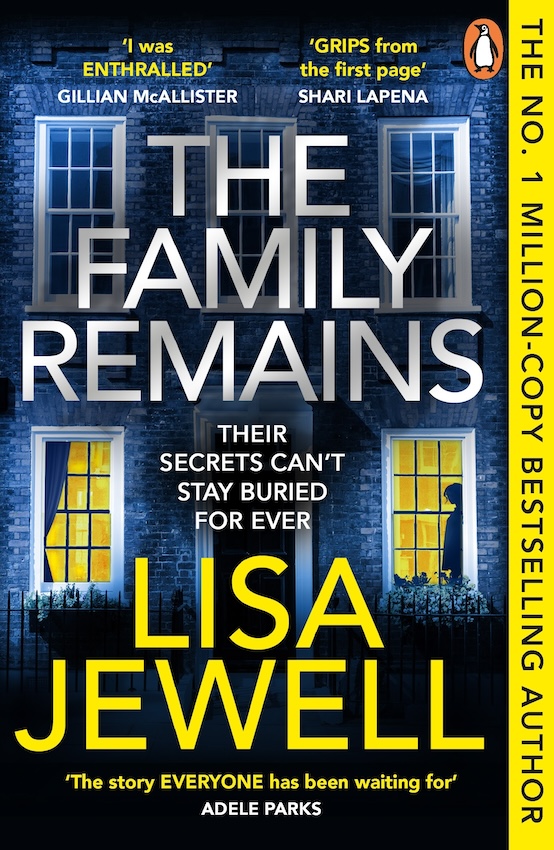
Book Review: The Family Remains by Lisa Jewell – a twisty, psychological thriller sequel that will have you hooked

The sequel, The Family Remains picks up the story of the younger generation, having been reunited in the first book and who are now trying to each build a future. This includes Libby Jones, the daughter Lucy had as a teenager, brought up by adoptive parents and who inherited the house in Chelsea. But the shadows of what went before still linger and there’s a sense that Henry and Lucy in particular are still looking over their shoulders.

When a bag of bones is found by mudlarkers on the riverbank, DI Samuel Owusu traces them back to the old Lamb residence and all the things that Henry and Lucy hoped would be forgotten about forever may now come to light. But Henry and then Lucy are on a quest to find Phin, Libby’s father, supposedly working in a safari park in Botswana, but who has high-tailed it, for some reason, to Chicago.

So while Henry and Lucy are hunting down Phin, DI Owusu is trying to piece together the life of Birdie Dunlop-Evers, a former member of a pop-group, reported missing in the 1990s. The story also works in the story of Rachel, a jewellery designer, who is told at the start of the book of the death of her estranged husband. We’re well aware of the particularly nasty type of guy Michael was – we met him in the earlier book when he was married to Lucy.

Golly, there’s a lot going on here, so never before was there a better reason to read the earlier book before the sequel. But somehow it all makes sense, and even if it’s a while since you read The Family Upstairs, you never feel completely bamboozled. Yes, you will have questions, loose ends and half-forgotten pieces of the overall puzzle. But Lisa Jewell will have you hooked, never the less, as I was.

I steamed through this novel in a couple of days, desperate to know if things would work out all right in the end. There’s always the sense that even though Henry and Lucy and even perhaps Phin, have been driven to do desperate and even quite bad things, they were very damaged children. We still feel for them, as well as Rachel, getting caught up in a relationship with a monster. It’s a twisty, original psychological thriller and as such a compelling read, but it’s very empathetic too.

And the characters are just so interesting. DI Owusu is a really nice guy, thoughtful, intelligent and sympathetic, which helps balance out the potential darkness and selfishness of Henry. Rachel’s story takes us into a character who has lived for the moment when it comes to relationships and suddenly in her thirties, feels it’s time to make a commitment. If only she hadn’t settled on Michael. But it’s Lucy I really enjoyed the most – she is so fragile on the one hand and yet has had to be strong and think on her feet for her children.

It is probably the characters and their unique situation that prompted so much demand from readers for the sequel that Lisa Jewell hadn’t planned to write. Which is probably why her books are so good, so moreish. Whenever I feel like a book to unwind with, she’s a top choice. If only I could make them last a day or two longer. This one’s a four-star read from me.

Book Review: When We Were Orphans by Kazuo Ishiguro – an unsolved mystery and a journey back to pre-war Shanghai

I’d had this book on my bookcase from a decade or two before, and thought I’d revisit it in audiobook form. But the writing was just so engaging, the narrative voice of the main character drawing me in, I got the paperback out after all, the better to absorb it all at my own pace.

When We Were Orphans begins with its main character, Christopher Banks, having recently moved to London after graduating from Cambridge, when he bumps into an old friend from school. Over the course of their conversation it emerges that Christopher was considered a bit of odd character as a boy, while the two think about what they want to do with their lives. And it seems that Christopher has always wanted to be a private investigator. We’re in the early 1930s, the Golden Age of the detective novel, which is what may have inspired him.

This may seem a little ridiculous, but Christopher is deadly earnest, and soon sets about fulfilling his ambition. But the big mystery that has dogged his life so far has always been the disappearance of his parents when Christopher was a young boy. The story flips back to his childhood in Shanghai, where his father had a job with a company that was involved with the trade of opium.

It is slightly surprising to me, looking back today, to think how as young boys we were allowed to come and go unsupervised to the extent we were. But this was, of course, all within the relative safety of the International Settlement. I for one was absolutely forbidden to enter the Chinese areas of the city, and as I know, Akira’s parents were no less strict on the matter. Out there, we were told, lay all manner of ghastly diseases, filth and evil men. The closest I had ever come to going out of the Settlement was once when a carriage carrying my mother and me took an unexpected route along that part of the Soochow creek bordering the Chapei district; I could see the huddled low rooftops across the canal, and had held my breath for as long as I could for fear the pestilence would come airborne across the narrow strip of water. No wonder then that my friend’s claim to have undertaken a number of secret forays into such areas made an impression on me.

Eventually, Christopher makes his way back to find his parents, which he is confident he can do, now that he’s become renown as a top detective. He does this regardless of the fact that China has been invaded by Japanese armed forces and nothing from his childhood is the same. Among the expats he meets there is Sarah Hemmings, a girl he’d found attractive at one time, now married to Sir Cecil, an aging diplomat who she is attempting to inspire into stopping the tide of war. Delusion among the expats seems to be catching.

Christopher ploughs on looking for his parents – surely they can’t really still in the house where they were taken all these years later? But he is convinced he will succeed, as is everyone else – he’s a famous detective after all. Yet he’s also something of an unreliable narrator – Ishiguro contrasts the workings of Christopher’s mind, his blindness to reality, with the chaos all around him. Is he a symbol of British interests in the East, of colonialism and the imagined superiority of the British Empire? There are a lot of ideas at play here.

When We Were Orphans was shortlisted for a Booker Prize although it hasn’t been a favourite with the critics.. I found the plot lagged a little towards the end, while the ending itself seemed a little rushed. But I did enjoy the world the author created and the characters, though obviously flawed, are still interesting and engaging enough to spend time with. Ishiguro sets up wonderful scenes, and creates settings you can really visualise. The writing is as it always is with Ishiguro, fabulous. I am glad I picked this up for a second time – another reason to hang on to those old books bought decades before, just in case. Even so, it’s probably only a three-and-a-half star read from me.

Book Review: Gabriel’s Moon by William Boyd – much more than your average spy novel

I’m always keen to read anything by William Boyd – his prose is crafted, his characters complex and there is always an interesting historical setting. And story-wise, you can never tell what’s going to happen next.

With Gabriel’s Moon we are in London, at least some of the time, in the early 1960s, and our complex protagonist this time is Gabriel Dax. He’s a travel writer at that time when travel writing was really popular, and at thirty, is already very successful.

The book opens with a prologue describing the house fire that killed his mother and when, as a six-year-old, Gabriel was lucky to escape with his life. Ever since, Gabriel has struggled to sleep – with nightmares of the fire plus troubling missing elements of his memory. He has sleeping pills, and not surprisingly he drinks a lot. A doctor recommends he see a therapist and these sessions lead him to investigate just what really happened that night.

Gabriel’s recent jaunt abroad has taken him to Léopoldville, and the newly independent Republic of the Congo. He takes an opportunity to interview the new prime minister, Patrice Lumumba, who wants to set the record straight. It seems his life is in danger, and there are names he wants recorded, should he be assassinated. This is way out of Gabriel’s usual sphere as a writer, but he does what he’s asked, making taped recordings of the interview.

But Gabriel’s work hasn’t always been just about travel. His brother Sefton, being something in the Foreign Office, has on occasion asked Gabriel to make deliveries for him to the Continent. When Faith Green, a secretive woman Gabriel has clocked reading his book on the plane home, contacts him with a commission of her own, his first instinct is to refuse. Faith works for MI6 and is something of a femme fatale. But the money’s good, and the trip to Spain tempting. Before you know it, Gabriel’s involved in more and more dangerous work for Faith and in spite of his niggling doubts, seems unable to refuse.

Gabriel’s an interesting character and not always likeable. You want to give him a good shake, tell him not to drink so much and get a grip on his life. There are sadly not many people he gets close enough to call friends. His girlfriend Lorraine hasn’t a clue about what is going on in his head, while he and his brother are somewhat distant having been brought up by different relatives after the death their mother. So there’s no one there to offer a reality check. How he handles the increasingly tricky situations he gets himself into sees a new Gabriel emerge.

Undercurrents of the political situation with the USSR, the Cuban Missile Crisis, as well as social politics of the time round the story out and the period really comes to life. There are glimpses of the ordinary, such as Gabriel’s ongoing battle with a savvy mouse in his flat; the pest-eradication advice from Tyrone, his streetwise locksmith. The book reminded me a little of A Bird in Winter by Louise Doughty – another really intelligent and nuanced spy novel with a main character on their own and battling for survival. This makes both books really engaging and gripping.

Then there are the settings. As well as Congo, there’s Warsaw and Cádiz, rural England and sixties London. If you’re after a satisfying, pacy but intelligent novel, Gabriel’s Moon might just do the trick. It’s a four-star read from me.

Book Review: This Strange Eventful History by Claire Messud – a novel about displacement, diaspora and a family through three generations

If you’ve ever had a scroll through the Booker Prize website, you’ll discover it’s full of all kinds of interesting information for readers. Here I discovered a quiz that helped you decide which book to start with from this year’s long-list, based on your reading preferences. I could’t resist having a go, and was prompted to try This Strange Eventful History.

The book is described as being of ‘breathtaking historical sweep and vivid psychological intimacy’, which certainly whetted my appetite. It begins in Greece 1940, as the Nazis have captured Paris, leaving French naval officer, Gaston Cassar afraid for his family. So he packs them all up for the arduous journey across Europe in wartime to the old family home of Algiers. That’s his very dear wife, Lucienne, her frail older sister, and his two children, François and Denise, with Gaston returning to the navy.

The family have been moved around before, but home is always Algiers. Until it’s not. With the Algerian Revolution in the 1950s and the country’s eventual independence, the Cassars try to resettle in France, but they are not easily accepted as French, and they miss the beauty of Algeria. Francois moves to Amherst to study and meets Canadian Barbara. The two make a life together, but nowhere seems quite like home. Throwing in the promise of an academic future Francois decides on a business career to better support his family – long hours and work that takes him around the world. His family moves to Australia at one point, try Canada and Switzerland.

Francois seems a perpetually unhappy man. He longs for the intense devotion in his marriage that his own parents experience. But it’s not just his story. We also have Denise’s time in Argentina as a young woman, where she settles with her parents following a breakdown. We get to know the next generation through young Chloe, who also settles somewhere different from where she was born. We see Barbara’s own misery, the issues of having a family and a career, and being responsible for the home. It’s the 1970s and women “can have it all”, but it’s not easy..

As the characters take you around the world, you are not so much shown what happens, but let into their minds at moments of reflection – waiting for a guest to arrive, getting ready for a family event. It is very much an introspective sort of story. As the chapters jump through time, it’s a way of catching up with what has brought them to this point. But it means the story is often less immediate than it might be. More “told” than “shown”. If you’re used to a more plot-driven story, you might find this frustrating. Then, at the end, there is a startling revelation – so don’t whatever you do think, I might just skip the epilogue, or flip to the back to see where you’re headed.

I am certainly glad I read This Strange Eventful History as it evocatively describes the effects of losing your homeland, of dislocation and the importance of somewhere you call home. It’s cleverly written, threads going back to the past that have you thinking, “so that’s what happened”, rather like real life. And the characters are certainly interesting and well rounded, if at times not all that likeable. But overall I found the book a bit of a slog. I’ll certainly go back to the Booker Prize website for more reading advice, and I don’t mind the occasional slog of a read. This one’s a three-and-a-half star read from me.


Book Review: Confessions by Catherine Airey – a compelling story of three generations of Irish women, their secrets and their choices

Rather than following Cora’s fresh start in Ireland, the story switches back to describe two sisters growing up and struggling with the sudden loss of their father. Their mother takes to her bed and the sisters, Maire and Roísín, do their best. Maire is a brilliant artist but has mental health issues. Fortunately there’s Michael who adores her and is like a brother to Roísín. We’re also with Maire when she earns a scholarship to New York and her struggles to fit in with a narrative shift told interestingly in the second person.

Almost like a character in itself is the big old mansion outside the village, once a stately home, that has become a refuge for women seeking an alternative lifestyle. Known as The Screamers, it offers a new chance first to Maire, and later the home for Roísín and the returning young Cora. It is where Cora’s daughter, Lyca, digs into the past and finds some long buried secrets.

On the walk home from midnight mass you go inside a phone box. Shutting yourself in reminds you of being inside the confessional booth back home. Your first confession, when you wanted to tell Father Peter about Jesus winking at you from the cross over the altar. Your mother had told you that this was a false image, that you were imaging things. But it didn’t feel fair to count this as a sin when you weren’t the one doing the winking. Instead, said you sometimes wished your sister was dead. This seemed to satisfy the priest, who sent you off to pray the rosary.

In Confessions we have the repeated themes of girls growing up without a father, teen pregnancies, too much freedom or too much restraint. These young women are all smart enough to do well in a world that accepts them for who they are, but it’s going to take more recent generations – Cora, and then Lyca – for that to happen, and a more modern Ireland. But it’s the long buried secrets that keep the reader on their toes to the end. How will they disturb the fragile memories Cora in particular has of her parents?

And the writing is wonderful, finely tuned to each character and allowing them to tell their story, vivid and at times very intense. The setting of New York in particular is an interesting highlight – it comes through as a walker’s city, shown from the ground up, as well as a place of surprising vistas when seen from a high-rise building. The contrast with a small Irish town couldn’t be more stark – the closed-in feel of the early interiors, then Screamers with its warren of rooms.

This is a well put-together story, the threads of the different characters carefully woven in and, at the same time, written from the heart. I was glad to receive this advance reader copy thanks to Netgalley, in return for an honest review. Confessions is due for release late January and a four-and-a-half star read from me.
Book Review: Death at the Sign of the Rook by Kate Atkinson – more fun and games with the latest Jackson Brodie mystery

I have to admit to being a Jackson Brodie fan since we met the beleaguered private investigator in the first book, Case Histories. I’ve read them more than once as well as enjoying immensely the TV adaptations starring Jason Isaacs. So here we are, five years since the last one (Big Sky), with another in the series – something I wasn’t really expecting, and you can imagine my delight.

Atkinson has a habit of not really continuing where she left off in the last book. Instead we seem to catch up with Jackson some years later, or with a completely different set of circumstances. Sometimes he’s flush and others he’s down on his luck. In Death at the Sign the Rook, Jackson is living with his girlfriend, Tatiana, and has had enough income from his PI work to buy himself a lovely big Land Rover Defender. His new case involves the theft of what looks like a Renaissance painting – a portrait of a Woman with a Weasel, which until recently hung on the bedroom wall, out of reach of prying eyes, of an elderly lady who has recently died.

It seems Dorothy Padgett’s carer Melanie Hope has taken it, and just disappeared without notice, leaving only an old mystery novel: Hark! Hark! The Dogs Do Bark by Nancy Styles. Dorothy’s daughter Hazel and her son Ian want Jackson to track Melanie down rather than calling the police – the painting may have some dodgy provenance. We get Jackson’s usual internal sizing up of the situation with Dorothy’s grasping offspring, squabbling over their mother’s possessions.

The story weaves in and out of Jackson’s investigation, bringing in several other main characters, beginning with Lady Milton over at her cash-strapped stately home, Burton Makepeace. LM has similarly lost a valuable painting, this one a Turner, at the same time as her companionable housekeeper Sophie disappeared. She is struggling to keep control of things while her eldest son Piers is trying to turn the big house into a hotel complete with staged murder mystery evenings. She’s an impossible character to like with her old-world thinking and arrant snobbery, but you can’t help feeling a bit sorry for her.

There’s also the boring vicar, Simon Cate, who has had a complete loss of faith, but battles on regardless, a fondness for animals, his only saving grace. And then there’s Ben, ex-military and a bit sorry for himself having lost a leg on his last tour, while missing his mates in the Army. He’s living with his sister, and learning to look after bees. We also meet Reggie Chase again – you’ll remember her from previous books – now a Yorkshire police detective.

These threads all slowly weave the characters into a plot involving a blizzard, a murderer on the run who’s armed and dangerous, and a murder mystery evening at Burton Makepeace. Somehow all of the characters end up there – we’re given a hint of what’s to come in a kind of prologue – and Jackson’s going to feel glad he bought the Defender. As usual it isn’t always the crooks that are the baddies, or not all of them anyway, and Jackson may or may not err on the wrong side of the law.

Atkinson is a master of creating a tantalising story with plenty of humour and surprise twists. However, I did feel this story took a while to get going. We get stuck for chunks of narrative with Simon the vicar, and Lady Milton, both of whom can be a bit tiresome. But once the story gets going, there’s plenty to enjoy and the ending’s a cracker. Not the best Jackson Brodie, but still worth reading. A three-and-a-half star read from me.