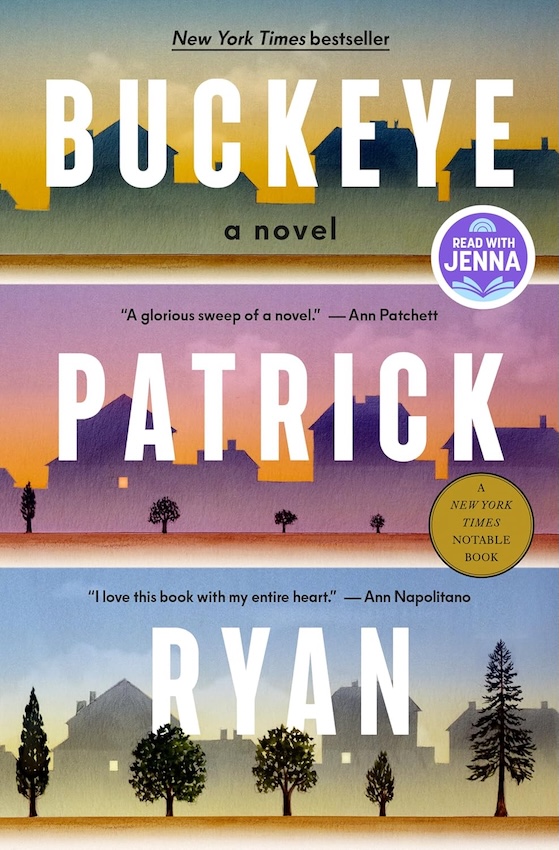
Patrick Ryan’s novel, Buckeye, haunted me for days after I finished it. The story takes us to the small town of Bonhomie, Ohio, starting off during World War II. We follow the lives of two couples, Becky and Cal Jenkins, and Margaret and Felix Salt, through the events of the war, and on to the lives of their children. Events of the twentieth century, wars certainly, but social changes too disturb their lives, but nothing compares to how they deal with events themselves.
All four of them have something that makes them different. Cal has one leg shorter than the other. This exempts him from military service, so he drifts into marriage with Becky, who has a gift. She can communicate with the dead. Astonishingly beautiful Margaret hides the secret of being abandoned as a baby at an orphanage, while Felix, who is gay, tries to lead a conventional life with her. The war shakes them all up, well and truely.
The story begins on the day victory is declared in Europe (VE Day), 1945, with a young Cal working in his father-in-law’s hardware store. He’s interrupted by the arrival of Margaret who has to know what all the commotion is all about and asks if Cal has a radio. They listen to the news together and exchange an unexpected kiss. From there we dip back into the past to discover Cal’s story and Margaret’s, each of which is tragic in its own way.
When he read, heard, and watched the news, he wondered how many people were out there doing the same thing he was—scratching their heads as they tried to figure out how to prioritize their worries and confront their prejudices; drawing their own maps with their fingers crossed.
Cal’s father Everett lives out of town, traumatised by a previous war as well as the loss of two children and his wife to illness, becoming irascible and a hoarder. I really enjoyed the character of Everett, particularly the way he writes angry letters to whichever president is in office at the time. His war service has made him fiercely against war and this theme recurs during the book as more wars upend people’s lives.
Margaret is an interesting character in that she never reveals anything about her upbringing, determined to appear ordinary – if only she knew what that looked like. And it’s hard to quietly figure that out when everyone, particularly men, see nothing but her stunning good looks. So she has secrets from Felix, who likewise hopes for a normal family life. If only the war hadn’t got in the way, he might have kept up the pretence.
Cal keeps on trying to make the best of things, dealing with a demanding father-in-law, as well as his own difficult father, who never shows him any affection. He struggles to understand his wife’s talent which puts her in demand for readings with people who have lost loved ones, some from WWI, and more when the next war rolls along. The complications of children put the characters through even more, with more secrets, but also possibilities.
Therein, she thought, lies the unbearable solitude of a lie: you’re alone when you tell it, alone when you live it, alone when you try to dismantle it.
Like many who lived through the twentieth century, the characters of Buckeye have had their lives overturned by world events. There’s trauma and the tragic losses incurred by war. The prosperous post-war period that imagined a bright future for people but with that a restrictive social order. The changing times with the Civil Rights movement, while gay rights and feminism also get a look in.
It all adds up to a gripping read and an emotional one, certainly enhanced by characters you sympathise with. And then there’s the fine writing. I shall certainly be looking out for more by this author. Buckeye is a five-star read from me.


You write such enticing reviews. Another one for me to read!
LikeLiked by 1 person