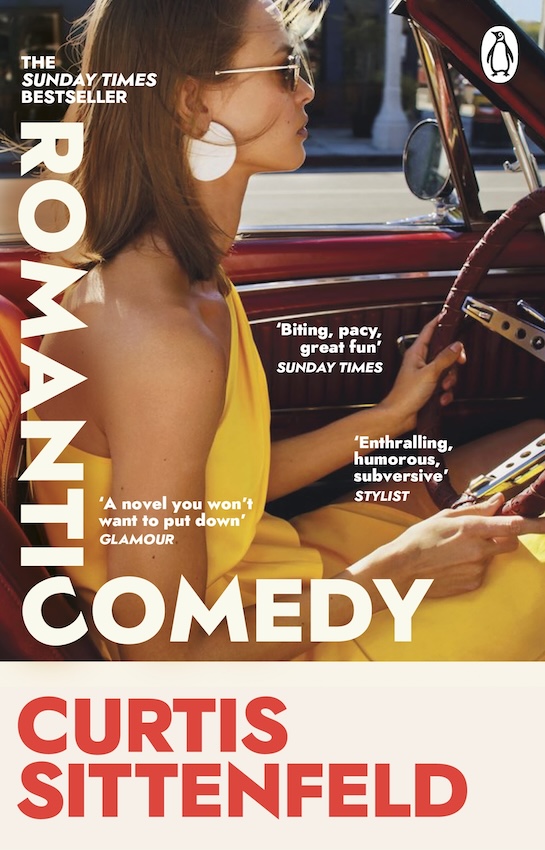
Book Review: Romantic Comedy by Curtis Sittenfeld – a warm and witty novel that explores the affairs of the heart

I loved Eligible, Curtis Sittenfeld’s modern interpretation of Pride and Prejudice, written for The Austen Project and published in 2016. It was smart, funny and romantic, and a very clever update. So I was expecting a similar vibe with Romantic Comedy, a novel about a sketch writer for a late night TV show and an unexpected romance.

Sally Milz has been writing comedy sketches for The Night Owls for almost ten years and has seen a lot of talent come and go. When fellow writer Danny starts dating Annabel, a beautiful actress who is also super talented and bright, Sally is peeved. Why is it that fairly ordinary guys like Danny can date and even plan a future with women who are way out of their league, when it never happens the other way around? There have been several Danny/Annabel type matches at the studio alone but you never see an ordinary-looking woman, or even a mildly pretty one, catching the eye of handsome star in his prime.

The arrival of Noah Brewster, a hugely successful and drop-dead gorgeous music star, as a guest host on the show gives Sally the perfect opportunity for a sketch to highlight this anomaly. The Danny Horst Rule would star Noah as the gorgeous guy who tries to date an average girl. Sally gets more of her skits voted in for the show that week, and so gets to spend more time with Noah at rehearsals. She finds him surprisingly nice, and what’s more, he apparently likes her. He’s easy to talk to and seems to seek her out.

The story follows their interactions and Sally’s growing attraction to Noah, a relationship that she discounts, because there’s no way a guy like that would ever think of her romantically, is there? We meet other people on The Night Owls, particularly fellow actors like Viv and Henrietta, who are Sally’s friends and sounding boards, whose advice is sometimes helpful, and often hilarious. Viv herself has met an eye doctor she’s attracted to so there’s advice going both ways. And we get a bit of Sally’s backstory – a failed marriage, the colleague who broke her heart.

Working on The Night Owls, Sally works excruciatingly long days, and nights, taking naps in her office, but then she’s a perfectionist and gives her work her all. She has decided never again to date a colleague, and has no time for more than an occasional night spent with someone she doesn’t care about. When Noah upsets the applecart of her carefully managed feelings, she doesn’t know what to do.

I heard someone say my name, but at first I was so deeply asleep that I incorporated the voice into my dream. I thought it was Bernard, the janitor, coming to empty my trash can, and, seamlessly, I mumbled, “You can leave the molluscs.” I felt a hand lightly pat my shoulder, and the person said, “Sally, I’m really sorry to bother you” – not a commonly uttered phrase at TNO – and I pulled the T-shrit off my eyes and the earplugs from my ears, sat straight up, and said, “What do you want?”
Hunched over the couch at such an angle that my sitting up had brought our faces within a few inches of each other was Noah Brewster.

This was a fun read for the most part. I found the look behind the scenes of a television show fascinating and Sittenfeld peoples it with plenty of interesting characters and scenarios. Danny’s and Annabel’s relationship has its ups and downs and so there’s plenty going on. There are ups and downs for Sally and Noah too, and a lot of the story has the reader wondering: will they or won’t they? There’s Covid and the lock-downs, long-distance communication and a lot of soul searching. So while this is in many ways a romantic comedy, it’s also at times a serious look at love and life.

Curtis Sittenfeld has written a smart, thoughtful and very romantic novel which has moments of laugh-out-loud humour. My only quibble is that Sally can be difficult company at times, with a tendency to shoot herself in the foot to make a point. Sometimes I wanted to give her a good telling off. So while I didn’t enjoy Romantic Comedy quite as much as Eligible, it’s still entertaining and clever – and a three-and-a-half-star read from me.

Book Review: Back Trouble by Clare Chambers – an oldie but a goodie from a favourite author

If you enjoyed Clare Chambers’s last book, Small Pleasures, as much as I did, you’ll be pleased to know her new book, Shy Creatures, is out soon. I’ve always loved this author’s particular way with empathy and humour, so when I found an earlier book by Chambers at a second-hand bookshop, I was delighted, in spite of having read it years before.

Back Trouble, first published in 1994, is about Philip, who is about to turn forty, and his life for the most part seems to have gone to custard. We first catch up with him at an awkward family New Year’s celebration. His insurance broker brother Raymond is over from Canada with a new batch of photos of his children, recounting their successes (the football and the gymnastics), while Philip has never felt less like celebrating. With the failure of his publishing company he is in debt up to his eyeballs and the love of his life having gone home to New Zealand, life couldn’t get any worse, could it?

A cold chip from an overflowing municipal bin sends Philip head over tail and the ensuing back injury leaves him bedridden. There’s nothing to do but to fish out the notebook and pens from under his bed and begin to write the story of his childhood – a New Year’s challenge flung out by Raymond, to be completed in three months – just a thousand words a day – no probs. We are reminded that this is the 1990s and the Internet is in its infancy, although probably a more modern-day Philip wouldn’t be diverted by technology as he’d be out of data anyway – he’s that strapped for cash.

The kitchen was the first room to be tackled. One of the men from the building site had given Dad and industrial-sized drum of bottle green paint from the batch which his brother, who worked for the Council, had been using to paint the park railings. Cost was Dad’s only criterion in selecting materials. This meant garish rolls of wallpaper from the bargain bucket outside the DIY shop, the top six inches of every roll faded by the sun, and brushes which moulted into the paint. He had an idiosyncratic way of decorating. Being both nervous and impatient he didn’t believe in preparing surfaces, always fearing that something terrible might be lurking beneath a layer of bubbly paper or flaking paint. So instead of stripping paintwork, or even washing it, he would set straight to work, brushing gloss over old gloss, dust, mould and even, in one instance, a dead spider which lay preserved like a Pompeian relic in its shell of green paint.

Philip is such a self-deprecating narrator – he has no illusions about where he’s at as he approaches forty – and his story is warmly humorous as it rattles along to a nicely surprising ending. There are some poignant moments too, particularly in Philip’s childhood, with adults not behaving as they ought to and the weight of knowledge that falls on a young boy growing up. It is easy to blame Philip’s careless yet penny-pinching father, but other adults also turn out to be unreliable or even predatory.

Odd allusions to Great Expectations add an interesting twist. There are a raft of curious characters, quirky, helpful or otherwise, which may be another nod to Dickens, particularly the scene at Philip’s grandmother’s house – the blind matriarch and hoarder of useless furniture, including four unplayable pianos, terrifying in her fierceness; the black-toothed Auntie Florrie smoking her woodbines; Punnet the obese black labrador. It’s like stepping back in time.

For a small book, Clare Chambers packs quite a lot in and it’s hugely entertaining. I know she can always be relied upon for an original and big-hearted read so I am so looking forward to Shy Creatures, released on Amazon at the end of the month. Back Trouble is a four-star read from me.

Book Review: Goyhood by Reuven Fenton – a hilarious road-trip story full of unexpected detours

People often expect twins to be alike – even the non-identical ones. But you couldn’t find two brothers more different than David and Marty Belkin, the main characters in Reuven Fenton’s debut novel Goyhood. We meet them during a heatwave in small-town Georgia when they’re twelve, the day that young Marty, soon to become Mayer, has an epiphany.

The boys are doing it tough, living with a mother who frequently absents herself and drinks too much. So it’s not surprising that when Marty is offered a chance to study at an Orthodox Jewish school, or yeshiva, in New York, he jumps at it.

Switch forward thirty odd years and Mayer is still a student of holy scripture, that’s all he has to do, thanks to the generosity of his father-in-law. His marriage to Sarah is not a happy one, weighed down by difficulties in conceiving a child. Things are all set to change again for Mayer when he gets the news that his mother has died. He will have to sit shiva for her and he’ll see his twin brother again for the first time in decades.

David has had a completely different life to Mayer, having to learn the lessons of life the hard way. There have been a lot of drugs and career misfires, but now he’s made his fortune in the e-cigarette market and turns up to collect Mayer at the airport looking the essence of prosperity. The two hardly recognise each other. A letter written shortly before their mother’s death reveals the bombshell that the boys aren’t technically Jewish which throws Mayer into a spin. With the help of their old rabbi, Yossi, he’ll have the chance to remedy that situation, in a week’s time.

But David’s still a wild boy at heart and persuades his twin to travel to New York with him for the appointment for his ‘conversion’ in a muscle car he nicknames Daisy. They take their mother’s ashes with them, the plan being to scatter them somewhere she would enjoy, and along the way collect an unappealing dog, but not Mayer’s luggage, which has not arrived with him at the airport. David has plans that Mayer should enjoy his week of ‘goyhood’ and live a little, while Mayer is like a rabbit caught in the headlights.

“And due to an unprecedented turn of events, we find ourselves facing an entire week with empty schedules.”
“You’re talking about a vacation,” Mayer said.
“A rehabilitation period to wrap our heads around the existential vortex we’ve fallen into.”
“A vacation.”
“A pilgrimage.”
“I don’t need a vacation. I don’t want to wrap my head around this. If it were up to me, I’d spend the week in a medically induced coma.”
“Listen, Ese, if there’s one thing I’ve learned, it’s when the going gets tough, the tough get in the car and drive.”

The story builds in tension as Mayer is pulled in different directions – his sense that he must live according to religious principals constantly under fire. As Mayer struggles to rein his brother in, Sarah is continually on the phone about his luggage and her sudden plans to join him at his mother’s house. She would be appalled by what Marty has been up to with David and all this adds brilliantly to the story’s humour.

Meanwhile there is plenty of temptation on offer to a man who has never been tried before, particularly when the two hit New Orleans and David offers a ride to Charlayne, an attractive acquaintance of his who is about to walk the Appalachian Trail. David is the sort who lives for the moment and acts on impulse, so the road trip takes some unexpected turns.

Fenton piles on one madcap scene after another, putting our characters through their paces, and even allowing the dog, Popeye, a moment of glory. Intermingled with all this is some deep soul-searching – by the end of the book, the reader has an inkling that change is in the air for Mayer, and possibly for David as well.

It all adds up to an entertaining, feel-good read enhanced by lively dialogue as the characters bounce off each other. The writing is polished and witty and the story never lags for a moment. I enjoyed it immensely and will be keen to read more by this author. Due for release on 28 May, Goyhood is a four-star read from me..

Book Review: All Together Now by Gill Hornby – a heart-warming read full of quirky characters, humour and song

Sometimes all you really want is a nice, “feel-good” novel – something to chase away the darker clouds of a difficult day. The best of them will have characters you’ll warm to, a plot with a few surprises and an emotional pull – tears or laughter, either way, I’m not fussy.

I haven’t been in a choir since school, but still remember the whoosh you get when a lot of people get together and harmonise in song. Gill Hornby brings her joy for choral singing into her story about a struggling choir in a dead-end town. All Together Now follows the lives of three main characters: socially-awkward Bennett, once a choir boy and now, recently single again, he’s at a loose end; librarian Annie who does all the donkey work for the choir as a way of dealing with her “empty nest”; and Tracey, who is too cool for choirs, but can really belt out a number in the privacy of her home. Tracey also has a burning secret.

The story starts off with a car accident that leaves the Bridgeford Community Choir rudderless, its choirmaster hospitalised and in a coma. There’s a county choral championship up for grabs, and a town in dire need of invigorating – but can a medley from The Sound of Music or The Carpenters be the answer?

Tracey spots the choir performing outside the station one day and it makes her cringe. She’s one of life’s soloists. When her layabout son of twenty-two goes out to work one evening, she suddenly feels liberated. She dusts off her old music collection and begins to sing. A knock on the door and there’s someone she recognises; it’s Lewis from the choir, surprisingly also a neighbour, who rather than demanding Tracey turn it down a bit, implores her to join their choir.

Tracey became aware that, rather than the raspy, throaty one that she used when she was singling along with Billy, she was using her chest voice for once, and she could feel the calming, anti-depressant effect it had on her stressed-out body. But it wasn’t until she was back in the living room, tucked up with her glass and the bottle on the sofa, that she realised exactly what it was she was singing. Christ almighty. Those bloody belters had wormed into her ear, through to her brain, down to her lungs. They had regressed her. She was regressing. For the first time in nearly thirty years, she was spending the night in alone pretending to be Karen bloody Carpenter. How sad was that?

The story follows the lives of Annie, Tracey and Bennett in parallel to the struggling choir that might just save them all. Tracey finds she’s not such a soloist after all, in the choir or in life; Bennett steps up to help save the town, and proves to his kids that he’s almost kinda cool; Annie takes a hard look at her marriage and makes a surprising discovery. And the choir gets a bit better. It’s an uplifting tale, but it’s also full of laughs and dry wit, particularly in the way the characters bounce off each other, disagree but also sing together. There are some amusing and some discordant minor characters that give the plot a bit of tension.

The story is peppered with music – the lines of songs nicely mixed in the scenes describing the choir in rehearsal so you have a sense of how it all sounds. Most of the songs are pretty familiar, but in case you don’t know them there’s a handy play-list of at the back and even a Spotify link so you can hear them as well.

All Together Now really hits the spot for a big-hearted, cheering sort of read, more character driven than a gripping page-turner, the prose bright and witty. I’ll probably not be rushing off to join a choir anytime soon, but will happily curl up on the sofa with another book by Gill Hornby. This one’s a four-star read from me.

Book Review: Prettier if She Smiled More by Toni Jordan – another hilarious round with the Schnabels

I hadn’t realised until I started it, that Toni Jordan’s latest novel features a bunch of the same characters we met in Dinner with the Schnabels – one of my favourite reads from 2022. In Prettier if She Smiled More, we follow the story of Kylie Schnabel who at the start of the book is about to experience three disasters that upend her life – all before Wednesday. By the end of the week, nothing will be the same.

Kylie Schnabel, if you remember, is the oldest sibling, daughter of Schnabel matriarch Gloria. She works as a pharmacist and likes to think she has everything under control. She’s very serious and is a stickler for detail, hardworking and a little abrupt. She’s been working at the same small suburban pharmacy since she graduated, living frugally and planning her life around one day buying the shop from her genial boss Tim who’s approaching retirement.

Life’s all going to plan, until one day it isn’t. Kylie gets to work on Monday to discover that Tim is selling his shop to a chain of pharmacies, a big business conglomerate all set to modernise and refurb. Gail from Pharmacy King insists Kylie reapply for her job – just a formality, and even though Kylie has a work ethic second to none and has won a Young Pharmacist of the Year award, the reader knows it’s going to be tricky. Kylie’s sometimes grim, no-nonsense manner is going to be a problem.

Then there’s Colin, Kylie’s partner, who is supposedly away at a business conference but activity on his Fitbit suggests he’s getting up to some extra-curricular hanky-panky. Kylie suddenly sees unpatchable cracks in their relationship. When Gloria breaks her ankle and needs full-time care, Kylie finds herself back at her childhood home, dealing with a mother who doesn’t want to be looked after and somehow ends up baby-sitting Caesar, a tiny Pomeranian.

There are plenty of funny moments, and Kylie’s internal monologue is always entertaining – she’s such a force of nature. But coming home where the decor is still stuck in the 1980s and there are so many reminders of her childhood, suddenly the past comes back with a wallop. Why has Kylie’s bedroom been turned into a sewing room, while her siblings, Tansy and Nick’s rooms are still intact, just as they left them? Then there’s her parent’s acrimonious divorce and memories of her childhood anguish, of being the eldest and having to be the sensible one when her mother was in pieces.

‘Your … father, is this?’ Ramona said, picking up one of the photos. ‘Is very handsome, but familiar somehow?…
  …In those years before Photoshop, what could be done about David, who was in the centre of many of the said photos and who Gloria wished dead several times a day in a variety of painful ways? Facing the grinning face of her ex-husband every day in her own home was untenable.
  Gloria’s solution had been to cut out a range of Kevin Costner heads of varying sizes from different magazines and glue them over similarly sized David heads. Now the family photos lined up on the mantel were of Gloria and Kevin, standing proudly behind their children, young Kylie, Tansy and Nick.

There’s a lot for Kylie to deal with, all in one week, including a tennis open day for Gloria, who is a children’s tennis coach. There’s finding a nurse who will want to stay with her mother so that she can get back to work when Gloria has other ideas. Kylie’s brother Nick talks her into going on a date with one of his mates. And on top of everything, Kylie has agreed to host the family lunch on Sunday. As the pressure mounts, something has to give.

Prettier if She Smiled More is a smart and often hilarious second-chances kind of novel. The format is similar to Dinner with the Schnabels, with one character having a lot to get done as the days of a single week slip by and each day heralds more problems. The final chapter brings everything to a head and somehow everything gets fixed, but in a way Kylie, the meticulous over-planner, would never have predicted a week earlier. I loved it and wouldn’t say no to another Schnabel novel if Toni Jordan feels so inclined. This one’s gets an easy five out of five stars from me.

Book Review: No Life for a Lady by Hannah Dolby – a light and humorous adventure

This novel was a breath of fresh air, a lively read that was a welcome pick-me-up without challenging the brain cells too much. Part rom-com, part mystery with a little comedy of manners thrown in, No Life for a Lady follows Violet Hamilton who lives with her father in the English seaside town of Hastings.

We’re in the final years of the 19th century, and at 28, Violet should be happily married off by now, according to her respectable banker dad. But Violet is determined never to marry, her parents own marriage having been somewhat less than blissful. So much so that a decade ago, Violet’s beautiful mother Lily disappeared. She’d just popped out to visit friends one evening and never returned.

Lily’s disappearance might have been an accidental drowning as she was last seen on the pier. Had she fallen into the sea and been washed away? That certainly seems to be a possible theory and the one Mr Hamilton propounds to Violet, all the better for her to put her mother behind her and move on with her life. But Violet feels she would know if her mother had died, and thinks she could be out there somewhere, maybe even needing help.

When Violet decides to hire a detective, she sets in motion a chain of unforeseen events that spell disaster on one hand, but also push Violet to becoming a sleuth herself. Frank Knight is the only detective in town and eagerly takes on her case. But Violet is unimpressed with his lack of professionalism, and his assumptions about Lily seem set to defame her rather than save her.

The disappointments of the decade had been compounded by the realisation it was almost impossible for a lady to take up a respectable profession. I had been set on the idea, but now my attic was filled with the skeletons of half-finished hats, faded botanical specimens and, most tragic of all, dusty portraits of a few worthy occupants of the town. This last career had ended abruptly when I persuaded the wife of the town mayor to pose for a portrait. I had faithfully included all three of her chins, upon which she told me she had only sat for me out of sympathy, forbade me to continue as an artist and left, chins wobbling in fury.

Violet finds an old newspaper which leads her to Benjamin Blackthorn, a reluctant detective who has given up the trade in favour of selling furniture in the old, slightly seedy part of town. While he is the opposite of Knight in every way, Benjamin refuses to take on her case, but Violet wears him down enough to allow her to help with one or two cases that require a woman’s touch. Violet is more enthusiastic than subtle at the outset, which leads to some hilarious confrontations.

Dolby’s manuscript for the book was the runner-up in the Comedy Women in Print awards, and there are plenty of fun scenes, the writing’s witty, but there’s plenty to think about too. There are issues around the constraints placed on women in the era, of class and the lack of choice when it comes to making a living: marriage, servitude or prostitution seem to be the main options for women. Add to that the resigned tedium of being stuck in an unhappy marriage; the ignominy of divorce.

Packed with an assortment of quaint and humorous characters, the story builds to a dramatic conclusion involving surprising revelations and a fair amount of danger. For a young lady of her time, Violet has to step outside the norm of proper behaviour but finds allies in surprising places. The ending leaves us with possibilities for a sequel, perhaps more cases for Violet to solve. I shall certainly be keen to read more of Violet’s adventures. No Life for a Lady gets four out of five stars from me.

Book Review: Less Than Angels by Barbara Pym – anthropology meets comedy of manners

I seem to have got caught in the 1950s, first with the Charlotte Bingham memoir, and now with this book published in 1955.

Less Than Angels follows a group of people connected to an anthropology faculty at a London university. It opens in a café where Catherine, a freelance writer for women’s magazines, is sitting watching people go by from her seat by the window. Outside two anthropology academics are hurrying to a party at a new research centre that has been donated by a wealthy widow named Mrs Foresight.

At the party we meet Esther Clovis who is one of those ‘excellent women’ who keep everything ticking along, while the more senior men strut and proclaim. These include elderly Professor Mainwaring, once obviously devilishly handsome, who has secured the funding by charming his way into Mrs Forsight’s good books and who gets to choose the recipients of the research grants later in the book.

Esther is not an attractive character, but Pym gives her feelings none the less and makes her interesting. Here she is as the party is about to start, worrying about the students who have gathered in the library to study and how to throw them out nicely. In the end she invites them to stay for the party and we meet them all.

I confess I was a little put off by this lengthy party scene at the beginning of the book. So many characters to keep track of, including two young men in their third year, Digby and Mark, who add a touch of comedy, and new student Deirdre, who has begun to wonder why she decided on anthropology in the first place. Deirdre is a wistful, restless girl with the kind of languid beauty that goes with all that. She lives with her widowed mother and a ‘spinster’ aunt in a leafy suburb. They live next door to failed anthropologist, Alaric Lydgate, who has an alarming collection of African masks which he wears in the privacy of his garden.

It was odd to think that he himself had once been on the threshold of that kind of life and that he had thrown it all away, as it were, to go out to Africa and study the ways of a so-called primitive tribe. For really, when one came to consider it, what could be more primitive than the rigid ceremonial of launching a debutante on the marriage market?

The story really picks up when Tom Mallow returns from his stint in Africa to write his thesis, and to his domestic arrangements with Catherine, who has a bohemian style flat. Catherine obviously loves Tom, who seems surprised by his own easy charm with women, but he’s soon drawn to Deirdre.

So the story has a kind of love triangle in the centre of it, with a myriad of interesting characters and the small politics of a university faculty in the background. When it comes to anthropology, Pym seems to know her stuff – she was at one time the editor of the journal of the International Institute of African Languages and Cultures in London. And perhaps this has inspired her because while the novel’s academics are absorbed in the study of African tribes, their customs, values and intergenerational connections, Pym seems to casting her own anthropological eye over the British middle classes.

Barbara Pym has often been described as a twentieth century Jane Austen and this is particularly so when it comes to her thoughts on being a woman in her time, the sexism and the rocky road of making a place in the world for oneself. Universal themes, but enhanced with Pym’s sparkling wit and gentle send-up of social formalities. Once I’d settled into the book, I found this a brilliant story, both entertaining and thought-provoking – but then, I’ve been a Barbara Pym fan for decades, so I knew I was in safe hands. Less Than Angels is a four-and-a-half star read from me.

Book Review: Spies and Stars: MI5 Showbusiness and Me by Charlotte Bingham – Round Two in Bingham’s hilarious MI5 reminiscences

This is one of those memoirs that read like a like a novel. It’s the second of Bingham’s recollections of her career in MI5. In the first, MI5 and Me, Bingham was encouraged to join the secretarial staff at MI5 by her father – she’d been just faffing around at home. Her father was quite important in MI5 himself – according to notes at the rear of the book, the inspiration for the character of George Smiley, in the John le Carré novels. Which makes her story seem all the more extraordinary.

Charlotte, or Lottie as everyone calls her, is twenty-something, and her interactions with fellow secretaries, Arabella and Zuzu reminded me a little of the St Trinian’s stories. They’re probably a similar era too – the events in this book take place the 1950s. As well as her work in the War Office, there is her developing relationship with her boyfriend Harry and their writing. Lottie and Harry spend hours after work beavering away in cafés on their film scripts hoping to make it in showbusiness. The characters they meet – the producers and performers – are often oddball and flamboyant, and wonderfully brought to life here.

Harry is a struggling actor so the writing helps keep him busy when he’s ‘resting’. But like Lottie, Mr Bingham sees in Harry someone who can do a job for him. He’s already got a couple of actors on his team – Hal and Melville even live at the family home, Dingle Dell. So Harry finds himself hawking copies of the Communist paper The Daily Worker outside the entrance to the Kensington High St tube station, alongside a ‘blind’ match seller also working for Lottie’s dad.

I went back to Dingley Dell feeling thoughtful only to bump into Hal and Melville both hurrying back into the house carrying copies of the Daily Worker.

‘Really, Lottie darling, the things I do for England,’ Melville said, sighing.

‘I shall read it cover to cover,’ Hal boomed. ‘I think of it as a political Beano. Apparently these asses really believe we are all equal. They wouldn’t if they’d ever toured with Dougie Robinson.’

A lot of Spies and Stars describes how Lottie and Harry come up with scripts, then dealing with agents and producers. Their first, The Happy Communist, is inspired by Harry’s Daily Worker pushing stint. There’s a terrible panic when their agent says there’s someone interested. What will Lottie’s father say? But obviously there’s some writing talent on display, as the two carry on writing more scripts and even sell a few. They soon learn the lesson not to expect their scripts to resemble anything like their originals once they’ve been through the rewriting team.

As I said before the memoir reads like a novel. Bingham is just so good with her characters, who are all vividly drawn, full of the quirks that make them interesting. And well, between show business and MI5, they’re a madcap bunch. And then there’s her use of dialogue, which creates lively scenes. You can tell that she had the talent to go on to write for popular television series like Upstairs Downstairs, which I remember I never missed as a girl.

Charlotte Bingham’s memoirs are fun, light reading, and almost qualify as ‘strange but true’. But maybe 1950s England was like that. And she really knows how to tell a story. I am tempted to try Bingham’s novels – there are dozens of them mostly published in the 1990s up to 2014. Spies and Stars is a four-star read from me, but if you’re tempted to pick this up, you’re probably best to read MI5 and Me first.

Book Review: Good Riddance by Elinor Lipman – a witty New York comedy full of the unexpected

I’m often drawn to these sorts of New York comedies. I like the smart and snappy dialogue, the invigorating big city atmosphere – the apartments and the quirky characters who are always eating out or talking about eating out. I really enjoyed Elinor Lipman’s On Turpentine Lane, so was keen to snap this one up too. Both novels showcase this author as a writer of very original storylines.

In Good Riddance, the story follows Daphne Maritch, studying to be a chocolatier after a failed marriage and a recent move to a new apartment. It’s not long since her mother died, bequeathing Daphne, among other things, a 1968 Pickering High School yearbook. June Maritch was just a few years older than her students that year and had attended all the class of ’68 reunions, as well as annotating her yearbook with snarky comments about her former pupils.

Daphne doesn’t see any reason to keep the yearbook, and consigns it to the dumpster, where it is discovered by her neighbour, a budding documentary film maker. Geneva Wisenkorn sees all kinds of potential from interviewing the old classmates, showing them the yearbook and speculating about their teacher.

Suddenly Daphne rethinks her hasty ditching of the evidence. She doesn’t want her mother seen in a poor light and doesn’t trust her neighbour not to make her family look ridiculous. Her father was for many years principal at Pickering after all. Throw in a politician with a scandalous secret that also affects Daphne and suddenly she’s feels desperate to shut down the doco and reclaim the yearbook.

There’s a romantic twist to the story in the form of Jeremy, the young actor across the hall, who becomes Daphne’s co-conspirator. And things are complicated by Daphne’s father moving to New York. He plans to see a bit of life in the city he’s always dreamt of. When her dad takes on a dog-walking job, he has a chance to meet all kinds of women.

Lipman throws in loads of fun situations, including Daphne’s tagging along with Geneva to a reunion, a wedding, a funeral and a dramatic situation requiring Daphne to administer first aid. There’s a load of humorous dialogue and the characters butt heads and wind each other up spectacularly. It’s a fun read all round, but I have to say Daphne isn’t for me a particularly appealing character. She can be rather shouty and shrill. Maybe she needs more chocolate.

But on the whole, Good Riddance is an amusing read and Lipman’s writing crackles on the page. I whizzed through the book and will certainly read more by this author. Good Riddance is a three star read from me.

Book Review: Impossible by Sarah Lotz – an original and quirky fantasy-romance

I have to confess I nearly didn’t finish Sarah Lotz’s recent novel, Impossible (also marketed as The Impossible Us). The novel is largely email correspondence between two characters who meet accidentally when Nick sends a grumpy message to a customer who owes him money, and it somehow ends up in Bee’s (Rebecca’s) inbox. Bee’s dinner with a Tinder date isn’t going well and she distracts herself with flippant email banter with Nick.

The story of their romance is told largely in emails because, for mysterious reasons, the two seem doomed never to meet in person. At first they are separated by a train ride – Nick’s in Leeds; Bee in London. When they do decide to meet they discover they belong in alternate realities – how many versions of the world there are, they have no idea. But in Nick’s dimension the world has made huge inroads to solve climate change as well as some obvious political differences; Bee’s dimension is the world as we know it.

Being stranded in different versions of the world makes no sense to either of them, but Nick comes across an organisation called the Berenstains who have had dealings with this anomaly. Berenstains member Geoffrey provides some light relief, tasked with keeping an eye on Nick, and staking him out like someone from a comedy-spy movie. There are rules about the situation, in particular, no meddling with the versions of people you know from a reality that’s different from your own.

Nick and Bee are all set to break this rule, Bee hunting out the Nick in her reality, who happens to be a famous author. This is galling for the original Nick, who is a literary hack, ghost writing for authors with limited talent. Meanwhile Nick seeks out the version of Bee in his reality, a Becca with a child, the wife of a powerful businessman, which is equally perplexing. She has given up her fashion design career for a family, quite unlike Bee, who has a wedding dress make-over business. Bee worries that Becca is unfulfilled and could be in a controlling relationship.

The story lurches from one complication to another as Nick and Bee set out to overcome their cross-dimensional problem to find happiness. There are plenty of humorous scenes and weird and wonderful characters – Tweedy, the elderly County type, showing Nick how to use a gun; Magda and Jonas, Bee’s elderly neighbours who epitomise lifelong devotion as a couple; Erika, Nick’s no-nonsense Nordic landlady – among others.

And even if it did at first remind me of the movies You’ve Got Mail crossed with The Lake House, the story is still original and cleverly put together. And yet in the middle it seemed to drag for me. I think it was all those emails. I’ve read epistolary novels before and enjoyed them. But here there’s a lot of bad language, which I find tiresome, and the banter which Bee and Nick find so amusing wasn’t particularly amusing for me. I began not to care particularly whether Bee and Nick found happiness as I didn’t like them very much – it’s probably a generational thing. Two thirds through I was so desperate for some elegantly crafted writing I took a breather with some Jane Austen before going back in.

But I did go back in, because it is impossible not to want to know what happens in the end. And Sarah Lotz ties it all up well. She’s a seasoned screenwriter who obviously knows about plotting and this is her seventh novel. I can imagine Impossible would adapt well to the screen. Would I recommend it? Yes, probably, but with some reservations. It gets a fairly generous 3 stars from me.