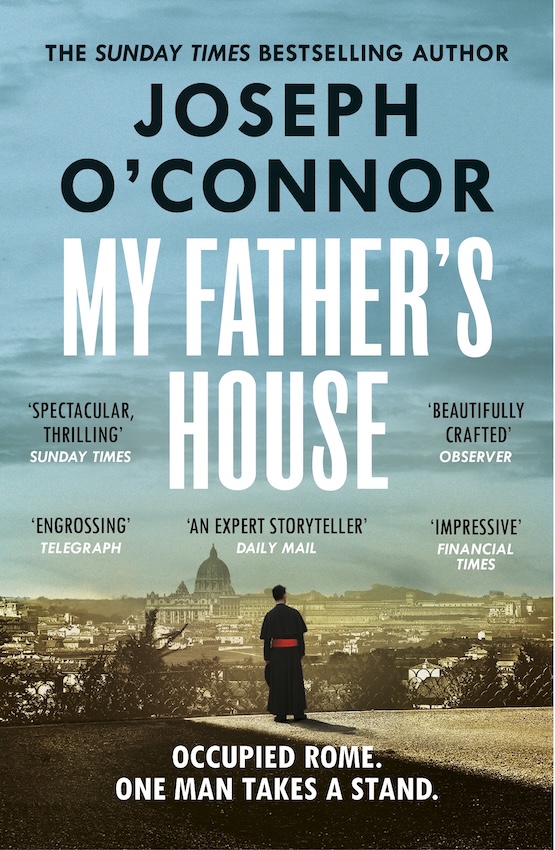
Book Review: My Father’s House by Joseph O’Connor – terror and courage in German occupied Rome

My Father’s House has been on my radar since it was short-listed for the Walter Scott Prize. With a second book in the trilogy already out (The Ghosts of Rome) and the third (The City of Echoes) due early next year, it was high time to pick it up. I was fascinated by the story of the daring escapades of the Escape Line, the underground network of unlikely comrades, knowns as The Choir, who worked to get Allied escaped prisoners, diplomats and refugees out of Rome during the German occupation. But also just as interesting were the characters of those involved, in particular, the Vatican priest who led their mission.

The occupation began in September of 1943 led by Gestapo chief, Obersturmbannfüher Paul Hauptmann, who is under pressure from Himmler to get results. It doesn’t take long for him to notice that one particular priest, Hugh O’Flaherty, gets about a lot and has some interesting friends. Among them singer and the Irish diplomat Delia Kiernan, Jo Landini a countess, and Sir D’Arcy Osborne, a British envoy to the Vatican. It’s fascinating that the Vatican City was a safe haven, a tiny, neutral and independent state within Rome. This made it a kind of bolt-hole when a bombed and terrorised Rome became unsafe for so many escapees.

The book opens with Delia driving through the night to get one of The Choir, Major Sam Derry, to hospital when he falls dangerously ill with appendicitis. He’s dressed in a Nazi uniform, the car is struggling and there’s a curfew on. So plenty to ramp up the tension. Derry is an important cog in the wheel of their work, as an important mission looms – the Rendimento. Money accumulated by the group needs to be dispersed among the safe houses around Rome to get the escapees out before an expected clamp-down by Hauptmann in the new year. Dated for Christmas Eve, there’s an expectation that German forces will be a little thin on the ground, so a good time for the plan.

Presently Ugo would call the group to order and play the keynote on a harmonica. As the singing began, which usually happened ten or fifteen minutes after the last of us had arrived, sometimes white-faced and breathless, up the haunted steps, his practice was to systematically make his way around the table, from one of us to another, talking in whispers or showing scribbled notes on lavatory paper, which he would tear up and burn in the stove when we had memorised them. Rome was of course a nest of spies in those months; Hauptmann’s Gestapo had planted microphones widely. It was common knowledge that they had taken over the telephone exchange, that every operator was now an SS agent, every call monitored, every meeting of more than six people covertly photographed. A secured radio transmitter at Nazi Headquarters in the fashionable hotel neighbourhood had a direct channel to Hitler’s lair, the Berghof at Obersalszberg.

With Derry ill, Hugh is anxious to find a replacement for the Rendimento, and this becomes a part of the plot, leading up to the night itself. But the story is told in an unusual way, swapping between the characters of The Choir and even a bit with Hauptmann himself. Some of these appear as transcripts from BBC interviews, parts of a memoir, as well as regular narrative. It keeps things interesting and also gives insight into the lives and characters of the key players.

I also really enjoyed the dialogue. Hugh, a big-hearted man, can be blunt and witty, Delia has the charm of the Irish, D’Arcy the languid insolence of someone of his class. Then there’s the Italian candle-seller, Enzo Angelucci, who knows Rome as well as anybody and has the passion of a man whose city is under siege. Hauptmann himself is well-imagined – a ruthless narcissist – but with an ability to shake off the horrors of his day by vanishing to his bolt-hole, a lakeside house in woodland, dreaming of catching his priest.

While Joseph O’Connor admits in his author’s note that this is a novel and that he has fictionalised much of what happens to suit the story, you can tell he’s done a heap of research and knows his subject well. You get an authentic feel of what Rome was like, its cobbled streets and dark alleyways, the bomb craters and riverside. While we get a satisfying ending – a glimpse of The Choir two decades later with a This Is Your Life TV episode – there’s still a way to go with the war. So plenty more work for the Escape Line. I will very much look forward to the next two books.

My Father’s House handily suited one of the tasks in the 52 Book Club challenge – a book “inspired by the top-grossing movie the year you were born”. For me this was Spartacus (yes, I know that’s a long time ago), similarly set in Rome and also with rebels and fugitives. The book was the perfect choice for me – and a terrific five-star read.

Book Review: The Marriage Portrait by Maggie O’Farrell – a tense and evocative story from the Italian Renaissance

This novel is inspired by the Robert Browning poem ‘My Last Duchess’ as well as the historical figure of Lucrezia, Duchess of Ferrara, who met an untimely death at the age of sixteen, supposedly murdered by her husband. I hadn’t known anything of the real duchess, but remember reading the poem in English Lit classes at uni and not realising it at the time that the duchess described had died so young.

It’s a shocking story in anybody’s book – Browning’s Dramatic Lyrics or this one, and so I demurred while The Marriage Portrait sat on my bedside table, distracting myself with every other book until, with nothing much else to read I finally picked it up. I shouldn’t have worried, having enjoyed Maggie O’Farrell’s books enormously in the past and it was only a page or two before I was engrossed in the story, as well as in awe at the writing.

Lucrezia is a difficult child, the least favourite it seems in her family, and as she grows she seems a thin little thing, quite unlike her lively, dark-haired older sisters. She’s smart though, sitting in a corner where the children are taught their lessons, but learning much faster the Latin and Greek, the history and geography than her siblings. Her real talent is art, although she could be a master spy the way she sneaks around the palace, listening at doors.

When her older sister Maria suddenly dies before her wedding can take place, Lucrezia is promised to Maria’s fiancé instead, to unite the grand houses of Medici and Ferrara, even though Lucrezia is only thirteen. She’s a spirited child, who likes her freedom, but also cherishes the safety of her home – her life has been a sheltered one. So at the time of her wedding a couple of years later, she is ill prepared to be the docile wife of a powerful ruler.

The gown rustles and slides around her, speaking a glossolalia all of its own, the silk moving against the rougher nap of the underskirts, the bone supports of the bodice straining and squealing against their coverings, the cuffs scuffing and chafing the skin of her wrists, the stiffened collar hooking and nibbling at her nape, the hip supports creaking like the rigging of a ship. It is a symphony, an orchestra of fabrics, and Lucrezia would like to cover her ears, but she cannot.

O’Farrell makes Lucrezia interesting, believable and vividly real, a complex character, as is her new husband Alfonso, who is on the surface so charming and solicitous, but also desperate for the heir that will secure his position. The book begins with Alfonso whisking Lucrezia off to a hunting lodge, away from the prying eyes of his palace, and where Lucrezia feels he is to do away with her. She has seen this other side to him before – the merciless capacity for violence, the lack of forgiveness. Will Lucrezia succumb and give in or will she fight back for her survival?

Sixteenth century Italy is brought to life – a time of a flowering of the arts which are lushly shown here in paintings, architecture and music. The intense richness of the language, vividly present tense, mirrors the gorgeousness of this Renaissance world. Yet this is also a time when well-born young women are just pawns on the chessboard of power to be married off by their fathers. Like Lucrezia they may have little idea of the politics around them or what will be expected of them.

This makes the novel a tense and gripping read as the story bounces between the hunting-lodge present where the moments tick away until Alfonso will act against his duchess, and the back-story that fills in Lucrezia’s life and how she has come to be in this predicament. It all seems so much more vivid because of the way O’Farrell writes – the intensity of Lucrezia’s feelings, the undercurrents that pass between characters, as well as the sensory details – the feel of fabric on skin, Lucrezia’s painterly eye that sees every colour and shade, the shock of seeing mountains for the first time, the descriptions of the music Alfonso gets lost in.

The Marriage Plot is a book that delivers on every level, giving you a glimpse into the past, an edge-of-the-seat story, as well as gorgeous writing. It isn’t surprising it’s been selected for the Women’s Prize for Fiction longest – I’ll be eager to see if it makes the shortlist, announced on 26 April. It will also be interesting to see what O’Farrell comes up with next. This book gets a full five stars from me.

Review: Miss Garnet’s Angel (kind of Eat, Pray, Love in half the time)

If you haven’t discovered Salley Vickers, she’s well worth a go for novels that explore the complexities of the human psyche while telling an entertaining story. Her first book is Miss Garnet’s Angel, a witty yet haunting novel about a retired school-teacher and the overwhelming effects visiting Venice has on her.

Julia Garnet decides to visit Venice in winter when the accommodation is half the price of the summer season. She and her old chum and housemate, Harriet, had planned to travel together. When Harriet suddenly dies, Julia on a whim decides to make the trip alone. Italy in general, with its Catholic traditions, emotional art and jaw-dropping beauty is an odd choice in many ways for Julia, a prickly, buttoned-up Englishwoman and paid-up member of the Communist Party.

However Venice is a revelation – the gorgeous churches and cathedrals, the quiet watery decrepitude, the food, wine and other indulgences. Julia falls in love with Venice, and in particular a little church near her digs – the Chapel of the Plague, and through its art becomes besotted with the Archangel Raphael and his story.

Salley Vickers really knows what makes people tick. Julia has had an upbringing lacking in love and thinks she is unloveable, and really not all that likeable either. Her stay in Venice sees her connect with other people, open up her heart, and even indulge herself a little.

Julia is a great character for the reader because Venice shown through her eyes is like seeing beauty through the eyes of someone recently cured of blindness. There’s plenty of humour in her interactions with others: the attractive, silver-haired Carlo, the American Cutforths who are much nicer to Julia than she really deserves, her CP friend Vera, who answers Julia’s requests for biblical texts and fears all that popery will have a bad effect on her friend.

Woven through Julia’s story is the biblical tale of Tobias and the Angel. Tobias, sent by his blind and dying father to collect a debt, is looked after on his journey by a guide who turns out to be Raphael. There are clever connections with Julia’s journey of discovery and the plot evolves in unpredictable ways.

Miss Garnet’s Angel first came out around twenty years ago and Vickers has added some terrific fiction to her list (Dancing Backwards, Cousins, The Cleaner of Chartres). Her first novel is timeless, original, full of heart, humour and brilliantly paced, pared down writing. Four out of five from me.