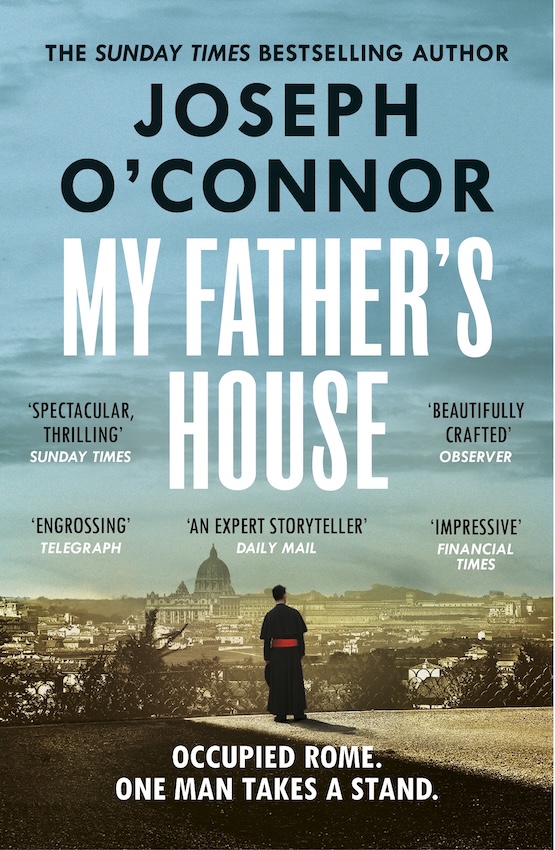
My Father’s House has been on my radar since it was short-listed for the Walter Scott Prize. With a second book in the trilogy already out (The Ghosts of Rome) and the third (The City of Echoes) due early next year, it was high time to pick it up. I was fascinated by the story of the daring escapades of the Escape Line, the underground network of unlikely comrades, knowns as The Choir, who worked to get Allied escaped prisoners, diplomats and refugees out of Rome during the German occupation. But also just as interesting were the characters of those involved, in particular, the Vatican priest who led their mission.
The occupation began in September of 1943 led by Gestapo chief, Obersturmbannfüher Paul Hauptmann, who is under pressure from Himmler to get results. It doesn’t take long for him to notice that one particular priest, Hugh O’Flaherty, gets about a lot and has some interesting friends. Among them singer and the Irish diplomat Delia Kiernan, Jo Landini a countess, and Sir D’Arcy Osborne, a British envoy to the Vatican. It’s fascinating that the Vatican City was a safe haven, a tiny, neutral and independent state within Rome. This made it a kind of bolt-hole when a bombed and terrorised Rome became unsafe for so many escapees.
The book opens with Delia driving through the night to get one of The Choir, Major Sam Derry, to hospital when he falls dangerously ill with appendicitis. He’s dressed in a Nazi uniform, the car is struggling and there’s a curfew on. So plenty to ramp up the tension. Derry is an important cog in the wheel of their work, as an important mission looms – the Rendimento. Money accumulated by the group needs to be dispersed among the safe houses around Rome to get the escapees out before an expected clamp-down by Hauptmann in the new year. Dated for Christmas Eve, there’s an expectation that German forces will be a little thin on the ground, so a good time for the plan.
Presently Ugo would call the group to order and play the keynote on a harmonica. As the singing began, which usually happened ten or fifteen minutes after the last of us had arrived, sometimes white-faced and breathless, up the haunted steps, his practice was to systematically make his way around the table, from one of us to another, talking in whispers or showing scribbled notes on lavatory paper, which he would tear up and burn in the stove when we had memorised them. Rome was of course a nest of spies in those months; Hauptmann’s Gestapo had planted microphones widely. It was common knowledge that they had taken over the telephone exchange, that every operator was now an SS agent, every call monitored, every meeting of more than six people covertly photographed. A secured radio transmitter at Nazi Headquarters in the fashionable hotel neighbourhood had a direct channel to Hitler’s lair, the Berghof at Obersalszberg.
With Derry ill, Hugh is anxious to find a replacement for the Rendimento, and this becomes a part of the plot, leading up to the night itself. But the story is told in an unusual way, swapping between the characters of The Choir and even a bit with Hauptmann himself. Some of these appear as transcripts from BBC interviews, parts of a memoir, as well as regular narrative. It keeps things interesting and also gives insight into the lives and characters of the key players.
I also really enjoyed the dialogue. Hugh, a big-hearted man, can be blunt and witty, Delia has the charm of the Irish, D’Arcy the languid insolence of someone of his class. Then there’s the Italian candle-seller, Enzo Angelucci, who knows Rome as well as anybody and has the passion of a man whose city is under siege. Hauptmann himself is well-imagined – a ruthless narcissist – but with an ability to shake off the horrors of his day by vanishing to his bolt-hole, a lakeside house in woodland, dreaming of catching his priest.
While Joseph O’Connor admits in his author’s note that this is a novel and that he has fictionalised much of what happens to suit the story, you can tell he’s done a heap of research and knows his subject well. You get an authentic feel of what Rome was like, its cobbled streets and dark alleyways, the bomb craters and riverside. While we get a satisfying ending – a glimpse of The Choir two decades later with a This Is Your Life TV episode – there’s still a way to go with the war. So plenty more work for the Escape Line. I will very much look forward to the next two books.
My Father’s House handily suited one of the tasks in the 52 Book Club challenge – a book “inspired by the top-grossing movie the year you were born”. For me this was Spartacus (yes, I know that’s a long time ago), similarly set in Rome and also with rebels and fugitives. The book was the perfect choice for me – and a terrific five-star read.


Wow what a great choice for that theme! Mine was Star Wars, so I read Celestial Lights.. 🙂 I do think that this theme has been the most fun.
LikeLiked by 1 person
I know, I was a bit perplexed at first but when I remembered this book, it seemed an obvious choice. And Celestial Lights looks a terrific read
LikeLiked by 1 person
Yes – Sci Fi was not really my thing and I thought I would have to read something of that genre! I am glad I thought more about it!
LikeLiked by 1 person