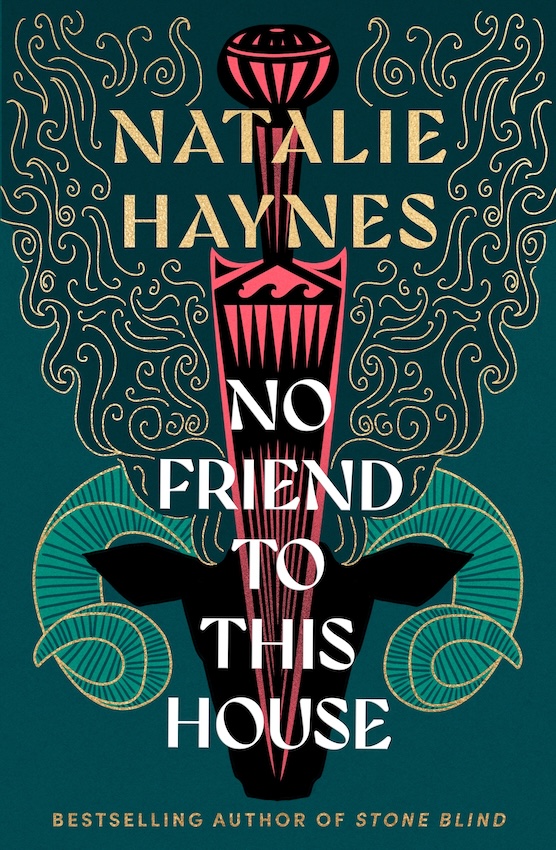
Natalie Haynes really knows her classics. Inspired by a performance of Euripides’ Medea with Diana Rigg in the lead role, it’s the novel, she says, she had wanted to write her whole life. She’s studied the original in Greek and her knowledge comes through in the way the story is layered with history and mythology going back in time.
Many stories about Jason focus on his adventures on his ship, the Argo, with his famous Argonauts who even include Heracles, and their quest to obtain the Golden Fleece. He has to fight a dragon, slay a field of warriors and sail his ship through the crashing rocks of the Symplegades, plus a whole lot more. But in this book, Natalie Haynes switches the focus onto Medea, the princess who defies her father to help him.. And it’s not a happy tale.
Before all that, Haynes weaves in a ton of backstory so that we learn about the fleece itself, the ram it came from and why it was so special. The actual taking of the fleece doesn’t happen until the middle of the book. There are tyrannous kings, including Jason’s uncle who steals the kingdom of Iolcus from Jason’s father. Perhaps it’s this trouble at home that urges Jason to want to seek adventure.
We’ve also got Aietes, king of Colchis, and owner of the fleece, who doesn’t hesitate to dispose of family members. We discover the backstory to why Medea chooses to help Jason and how she becomes besotted with the hero. There’s some meddling from the gods here as Medea is no pushover. She’s an interesting character, a powerful witch who worships Hecate.
It was hardly the fault of the Argo.
This was the kind of thing people said in those days: if you couldn’t blame anyone, you’d say it was the ship. But Jason didn’t set his Argonauts to row across the oceans because he was captain of the Argo; the men built the Argo because Jason wanted to find the fleece. So if you were trying to find the beginning of this story, then that’s where you would go: to the glimmering softness of the golden ram. Would you choose the day it was born? Or the day it appeared in Hellas to rescue two children, about to lose their lives?
Jason is a great leader, handsome, charismatic and skilled enough to win through – although he gets a lot of help, from the gods as well as Medea. But it’s really the story of Medea that anchors the novel. She’s interesting in that she has to deal with being wary of Jason as well as besotted with him – thank you, Cupid. She’s in survival mode a lot of the time, figuring things out, calling upon her magic. She’s clever and strong, but she’ll need to be as going off with Jason is no plain sailing.
If you know anything about the origins of this story, you will know that Medea has been given a lot of bad press. She does some truly terrible things, so she’s not your most likeable heroine. And in this world of legend, not many characters are as heroic or even as kind as you might expect. There’s a ton of characters too. Haynes piles in short episodes from the past to fill you in on why this happened, and why fate decrees that something else has to be the way it is. It’s complex and you will find yourself riffling back to the helpful List of Characters and the map at the start of the book time and time again.
No Friend to This House is a very readable and different sort of novel, abundantly well researched and this gives it that ring of authority. You come away feeling you know the real Jason and Medea, the way the ancient Greeks would have known them. It also shows how women can be marginalised in our histories, and what they may suffer because of the grand schemes of men. It’s a stunning read and stacks up well among other novels based on ancient legends – a four-and-a-half star read from me.

 Judith McKinnon
Thanks for this excellent review!
LikeLiked by 1 person
This sounds super interesting… it could work for two of my 52 prompts! Ancient civilisation or Character list!
LikeLiked by 1 person
And it’s got a map!
LikeLiked by 1 person