Lockdown Reading 1: A House of Ghosts by W C Ryan

We’re well into several weeks of lockdown and reading has been one way to escape when there’s really nowhere else to go. And you can’t get more escapist than this – a story concerning stolen plans for an aerial torpedo (this is WWI) set in an ancient abbey, complete with mediums and yes, inevitably, ghosts.

A House of Ghosts begins in the offices of Whitehall where a spymaster named C has a new mission for Captain Robert Donovan. It involves spending a weekend on a remote, storm-lashed island at the evocatively named Blackwater Abbey. The Abbey is home to Lord Highmount, a munitions manufacturer – hence the secret plans – which, because of its age and atmosphere, is haunted by multiple ghosts collected over the centuries.

So it’s also an ideal place for a séance. Highmount and his Austrian wife have lost two sons to the carnage of the trenches, and like many grieving families of the time, turn to spiritualism. Enter Count Olav and Madame Feda, two mediums who have become friendly with the Highmounts, as well as Kate Cartwright who is the character that bridges both worlds. Kate also works in Whitehall, but is an old family friend of the Highmounts, ideally placed to give Donovan a hand to keep an eye out for suspicious activity.

Kate is very intelligent, carries a pistol and has a talent that has got her into trouble in more genteel settings before – she can see ghosts. Donovan will act as valet to Capt. Rolleston Miller-White, invited as Kate’s fiancé. But along with the two mediums, suspicious because they have inveigled their way into the circle of the Highmounts, Rolleston, with his gambling debts, is also on the suspects list.

As the weather closes the island off from the mainland and the phone-lines are cut, the scene is set for a weekend of suspense, danger and mysterious goings-on. I was reminded of Agatha Christie and John Buchan, but the novel is witty and complex enough to suit a modern reading audience. The characters are quirky and interesting and I loved the way Kate and Donovan bounce off each other – Donovan, the stony-faced man of action; Kate with her matter-of-fact way of dealing with the supernatural.

A House of Ghosts was the perfect book for lockdown, reminding us that things could be a whole lot worse when you’re sequestered somewhere without choice. The plot is nicely paced and the writing intelligent and lively. I shall be looking out for more fiction by W C Ryan. Four out of five from me.
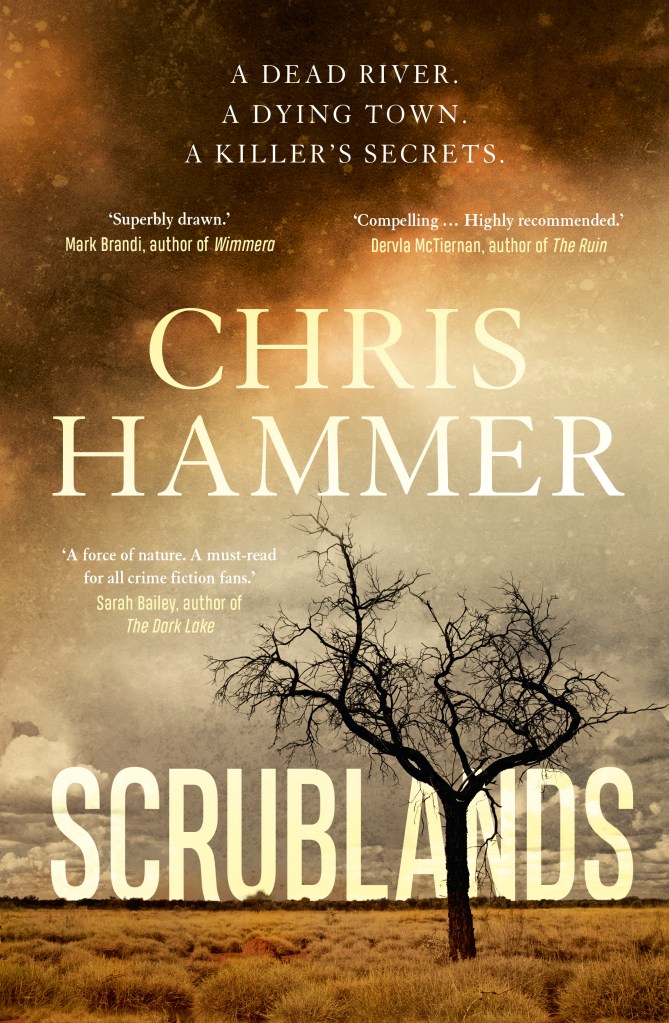
Book Review: Scrublands by Chris Hammer

Aussie Noir has become incredibly popular since The Dry by Jane Harper was published in 2016. Similarly drought and the high heat of summer, this time in outer New South Wales, is the setting for Hammer’s debut crime novel. Newspaper journalist Martin Scarsden visits Riversend, site of a mass killing, a year later to write an update on the town, a story previously covered by rival journo, D’Arcy Defoe.

Scarsden, once something of a lothario, suffers from PTSD following an incident when he was covering the Gaza Strip for his paper. His boss thinks this assignment will be a tonic – get him out of the office yet keep him busy. But Riversend is a depressed sort of place for recovery. The miserable Black Dog Motel lives up to its name; the town’s businesses are struggling and nobody’s very forthcoming – except for the young policeman, Robbie Haus Jones, the hero of the day.

Reverend Byron Swift was a good-looking, charismatic preacher, popular with the young and, with Jones, helped resurrect the youth centre, a Pied Piper figure it seems. So what made him open fire on his church steps, gunning down several men from the Bellington Anglers Club? Scarsden talks to the locals and gets a few more snippets out of Harley Snouch, the dero who says Swift was a pedophile. He takes coffee and comfort at the Oasis bookshop, run by drop-dead gorgeous, Mandalay Blonde – a what’s a beautiful girl like you doing in a place like this scenario.

Fortunately before you have too much time to wonder on the clunkiness of the love angle or the characters’ names, events start to hot up, literally. Martin becomes suddenly popular when he saves a teenager’s life and helps out with a bushfire. There are more murders, including a cold case involving two German backpackers. But Martin’s luck soon runs out as he tries to get his facts straight and more reporters and the police close in. People may be talking but everyone seems to have something to hide. Who can Martin trust?

Hammer manages a lot of plot threads in the novel, carefully reeling out backstory and tying them all together in the end. The pressure to file the story first and the mock camaraderie between the news teams add authenticity. I really enjoyed the lively, unmistakably Australian dialogue which spins the plot along nicely making Scrublands an entertaining read. And in the background there’s that oppressive, drought-stricken landscape.

Hammer earned a best new crime novel Dagger Award for Scrublands and it’s easy to see why. It’s an interesting story given weight by the way it deals with bigger things like evil and redemption. But I found the character of Mandalay Blonde (that surely should be a Bond heroine) and her relationship with Martin didn’t work for me. This one gets a three.

Book Review: Akin by Emma Donoghue

It is hard to imagine Akin was written by the same author who created mega-selling Room, shortlisted for the Booker and made into a movie in 2015. Room is a novel told from the point of view of a five-year-old boy held captive with his mother in a room custom built by a psychopath. Akin is quite a different style of novel, narrated by Noah, a retired science professor about to take a trip to Nice to investigate a few years in the life of his mother during World War II. What the two novels do have in common is Donoghue’s amazing skill with characters, an ability to get inside their heads to tell a story.

Noah is a New Yorker, scholarly, urbane and without any family – his wife, Joan, died some years ago and he has recently lost his sister. Mere days before he is due to depart for Nice, a social worker contacts him to ask if he can be the temporary carer for Michael, the eleven-year-old son of his late nephew. There’s nobody else, it seems. So suddenly Noah has a travel companion, a stressed and grieving boy from Brooklyn, who doesn’t know much about good manners but is streetwise when it comes to drugs and violence. The perfect odd couple.

Akin is a novel of many layers. The most obvious one is the story of Noah and Michael and what begins as a grudging acceptance of each other and how this develops into something more. Blood is thicker than water fortunately because there are lots of bridges to build here.

Then there is the story of Noah’s famous photographer grandfather, Père Sonne, and Margot, his mother, who stayed behind in France during the war, sending Noah to New York and his father. This has rankled with Noah, he was only three, and why did she leave with his sister a strange collection of photographs from her war years? The pictures are part of Noah’s luggage along with his grandfather’s famous fedora. Noah’s visit to Nice is about discovering the past and coincides with his eightieth birthday; now with Michael in tow, he is forced to think about a different kind of future.

Noah begins to fit together his mother’s story, with help from Michael who is unsurprisingly nifty on the ‘net. We learn more about Nice during the war, where a resistance group, the Marcel Network, saved over 500 Jewish children from the concentration camps. What was Margot’s connection? Was she a resistance fighter or a collabo? Noah is terrified the snapshots prove the latter. Michael also knows about ‘snitches’ and there are connections with the drug deal that was the undoing of his father, and the reason his mother is in prison. So many layers.

And then there is the story of Nice itself. Noah is the perfect tour guide. He speaks French and translates it for the benefit of Michael, often playing with words and meanings in an interesting way. We visit restaurants where they serve delicacies such as testicules de mouton panés (crispy fried sheeps balls) and tête de veau avec langue (calf’s head with tongue), while Michael holds out for for American hotdogs and chicken nuggets. There are stories about the Roman occupation of Nice, of saints and angels. Nice is a rich and colourful place.

Akin takes its time, slowly pulling you into Noah’s and Michael’s developing relationship and the story of Nice as well. It’s a book to savour, but it’s gripping too with plenty to entertain – a five out of five read from me.

Quick Review: Twenty-One Truths About Love by Matthew Dicks

What You Need to Know About This Book:

  • It’s about Dan and his failure to make any money from his bookshop;
  • Dan hides this fact from Jill, his wife, who wants a baby;
  • Dan loves Jill and will do anything to save his marriage except tell Jill the truth;
  • Dan worries he comes up short when compared with Peter, Jill’s previous husband who died;
  • Dan becomes increasingly desperate to make a lot of money fast;
  • He thinks of crazy schemes such as selling diapers emblazoned with helpful advice; ‘No Thank You Note Required’ greeting cards; and robbing a bingo hall;
  • Dan’s therapist once suggested he keep lists as a way to manage his anxiety;
  • Twenty-One Things About Love is written entirely in Dan’s lists.

The lists vary from poignant to wry to very funny, and capture the randomness of Dan’s thoughts, e.g.:

  • The list about Bingo with Bill (the old guy Dan makes friends with at bingo who has the same view of happiness as Don Draper)
  • Field & Stream’s Rules of Gunfighting
  • Any of the lists that feature Dan’s Laws of the Universe (Walk around with Diet Coke and half a dozen assholes will tell you how bad it is for you. Walk around with diet root beer and no one says a word)
  • Things I wish I Had Known 20 Years Ago When I Was 20 (Peppermint schnapps is not an acceptable substitute for mouthwash)
  • Deep thoughts related to food (If you’re going to more than one grocery store in a week, you have too much time on your hands and have somehow elevated the quality of your heirloom tomatoes over time spent with your family)
  • Dan’s 6 Rules of Drinking Stories (Drinking stories never impress the type of woman you want to impress; Even the best drinking stories are seriously compromised if told during the daytime and/or at the workplace)
  • Weird Things I Do ( I don’t look at the pilot when boarding a plane in fear that he will remind me on an idiot who I know)

What’s Great About This Book:

  • Clever sequencing of lists such as Reasons I fell in Love with Jill, followed by Reasons I Wouldn’t Have Married Jill If I Hadn’t Fallen in Love with Her gives you insightful information about the main characters quickly
  • There’s a bunch of peripheral but interesting characters (bossy Kimberley who thinks she should manage the bookshop; good-guy Steve who should manage the shop; Bill from bingo; Dan’s batty mother; Jake the successful, smart-arse brother; Dan’s father whom we never meet but who sends Dan letters he refuses to open)
  • The story builds to a gripping climax as Dan plans a crazy scheme to solve his money woes
  • The scheme involves a major felony
  • You don’t know if he’ll carry it out or not
  • You hope he doesn’t and this adds to the tension
  • Jake learns a lot more about love by the end, as well as about life
  • You will probably like the ending

I can’t help but congratulate the author on his ability to bring together humour, quirky characters, escalating tension and, of course, lists to tell a great story. A four star read from me.

Book Review: A Spell of Winter by Helen Dunmore

This novel was the first to win the Orange Prize in 1996, a prize that has had a few reincarnations, including the Baileys Prize and now simply The Women’s Prize for Fiction. It’s nice to think that Dunmore got the prize off to a flying start (just check out the people who have received the award since), especially as the author died a couple of years ago. Fortunately she left a fine backlist to dip into.

A Spell of Winter is a historical novel about two siblings, Cathy and Rob, whose parents have left them in the care of their grandfather and the servants that run his crumbling country house. No one talks about their mother, who has abandoned them to live in the south of France – she was a bit wild, with crazy Irish hair that poor young Cathy seems to have inherited. Their dad is in a home for the insane. They visit him one day as small children under the care of Miss Gallagher, the meddling governess who adores young Cathy but loathes Rob. The visit does not go well.

Mostly the children run wild in the woods and there is a sense of nature, both bounteous and grisly in Dunmore’s atmospheric setting where images of violence against small animals recur. Miss Gallagher fears for Cathy, as does her grandfather, and at seventeen, Cathy is introduced to Mr Bullivant, the wealthy new owner of the neighbouring estate who is fresh from Italy. He collects art, is pleasant company and knows Cathy’s mother. He also worries about Cathy and encourages her to leave and see the world, but she would rather stay at home with her grandfather.

‘You live in the past,’ Kate said. ‘You live in your grandfather’s time.’ But she was wrong. The past was not something we could live in, because it had nothing to do with life. It was something we lugged about, as heavy as a sack of rotting apples.

Everyone is right to fear for Cathy, as it turn out, and events reach a shocking climax, but with the First World War not far away, it seems everything’s is in a state of flux. Soon a new order will sweep through and you can’t help feeling that perhaps it needs to. The crumbling house with its wintry Gothic mood is perhaps symptomatic of the era and contrasts interestingly with Mr Bullivant’s stories of his Mediterranean home and his plans to replicate it in England.

A Spell of Winter is one of those novels that pulls you in with its secrets and sense of impending doom. Cathy’s intensity, her determination and her desire for things to stay the same add tension. But then all the characters are strongly drawn often with contradictory aspects to their character – the maid, Kate, is impulsive but wise; Miss Gallagaher can be rigid about rules but is also sentimental.

What particularly lifts the novel above being just another well-told story is the magic of Dunmore’s writing which is finely crafted in a way that is poetic, creative and vivid. And this is what keeps you reading, even when things get a little icky (don’t let the prologue put you off). This is a small work of brilliance and a four out of five read from me.

Book Review: The Stranger Diaries by Elly Griffiths

For some time I’ve been a fan of Elly Griffiths’ crime series featuring forensic archaeologist Ruth Galloway and DCI Harry Nelson. Griffiths does a great job of creating interesting plots around the watery in-between places of Norfolk, with all the ancient and not-so-ancient history of the setting. She also does terrific characters and has an engaging style that is hard not to like. Her Stephens and Mephisto series is equally well crafted, so I knew I would be in safe hands with the standalone novel The Stranger Diaries.

The story takes place in a small English town where Clare Cassidy teaches English at the local comprehensive school and where her daughter is a student. The old part of the school was once the house of Victorian ghost story writer, R M Holland, and in her spare time Clare is writing a book about his life and the questions around his wife whose ghost still haunts the school.

Clare’s a single mum and has built a pleasantly quiet life with a few friends, until one of them ends up dead. Fellow English teacher Ella has been discovered stabbed to death in her home and the police think it was someone she knew. Clare deals with this in her usual way, by confiding in her diary, but gets an unpleasant surprise when someone starts adding eery messages in spiky Italic writing.

The story is narrated by Clare, her daughter Georgie and also DS Habinder Kaur. Clare is a fairly intangible character (other characters find her cool) and lost in the world of Holland and his famous story ‘The Stranger’ (which is cleverly told in chunks throughout the book), seems to find reality hard to grasp. This makes her the perfect protagonist for things to happen to.

Harbinder is everything Clare is not: gutsy, to the point, and as an ex-pupil of the school, has plenty of interesting stories of her time there. She also lives at home with her parents (and her mum’s wonderful cooking) and dodges the issue of telling them she’s gay by throwing herself into her work. But this case has got her stumped.

The story builds to a thrilling ending as the killer looms ever closer and the cops eventually catch up. As usual Griffiths creates an atmospheric setting, with the haunted Holland house plus Halloween, while her short-story, ‘The Stranger’, would have done M R James proud. I wonder if he was an inspiration for the novel. My only grouch is I found Clare a wishy-washy sort of character; thank goodness for the determined DS Kaur and wilful young Georgie, who give the narration some balance. The supernatural is evoked without seeming ridiculous (ghosts and witchcraft) while DS Kaur grounds us in the real world. This is a light, entertaining read: three and a half out of five from me.

Book Review: Olive, Again by Elizabeth Strout

Olive Kitteridge first appeared in the eponymous novel which won the Pulitzer Prize for author Elizabeth Strout. A local personality in the small Maine town where Strout sets her books, Olive makes brief appearances in several other books so it isn’t surprising there is a new book about Olive. She seems to be one of those characters who has plenty more to say.

Olive used to be a school teacher in Shirley Falls, so that everyone seems to have a recollection of her in the classroom. Olive is loud, unfailingly honest and doesn’t suffer fools gladly. So I imagine she would have been a formidable teacher, and probably effective. She’s also sharp when it comes to seeing what’s going on with people and capable of surprising moments of kindness.

In Olive, Again, we catch up with Olive now widowed but with a new relationship on the cards with ex-academic Jack who drives a sports car and can be a bit of a snob. The book treats us to a series of episodes in Olive’s life which read like short-stories and which overall create a picture of Olive’s later years, now in Crosby, Maine. There’s a story about how she attends a baby shower – not really her kind of do at all – and somehow ends up delivering a baby in a car. We have her and Jack having dinner in a restaurant called Gasoline, where they bump into an old flame of Jack’s; another when Olive’s son Christopher visits with his wife and young family and the argument that ensues when Olive tells him about Jack.

Other stories are about entirely different characters – the old man who goes for a walk while remembering a girl from college who committed suicide and then does something exceptional; there’s the elderly couple who learn to accept the difficult news their daughter has to tell them. Some feature Olive as well so we see her from other people’s eyes. We even catch up with Jim and Bob, the two lawyer brothers from the novel, The Burgess Boys, and their problematic marriages.

Lives of quiet desperation seems to be a recurring theme, but there’s also humour, particularly around Olive, and hope too. Often there are turning points in people’s lives as well as the questions: Was it all my fault? Where do I go from here? Olive herself has plenty to feel sorry for, but seems capable of learning, accepting and moving on. Along the way she touches the lives of others one way or another. It makes for a very compelling and thoughtful collection. I was happy to return to small-town Maine and see what Olive has been getting up to again and I really enjoy Strout’s perceptive, character-driven storytelling. Like Olive, she doesn’t pull any punches. A four out of five read from me.

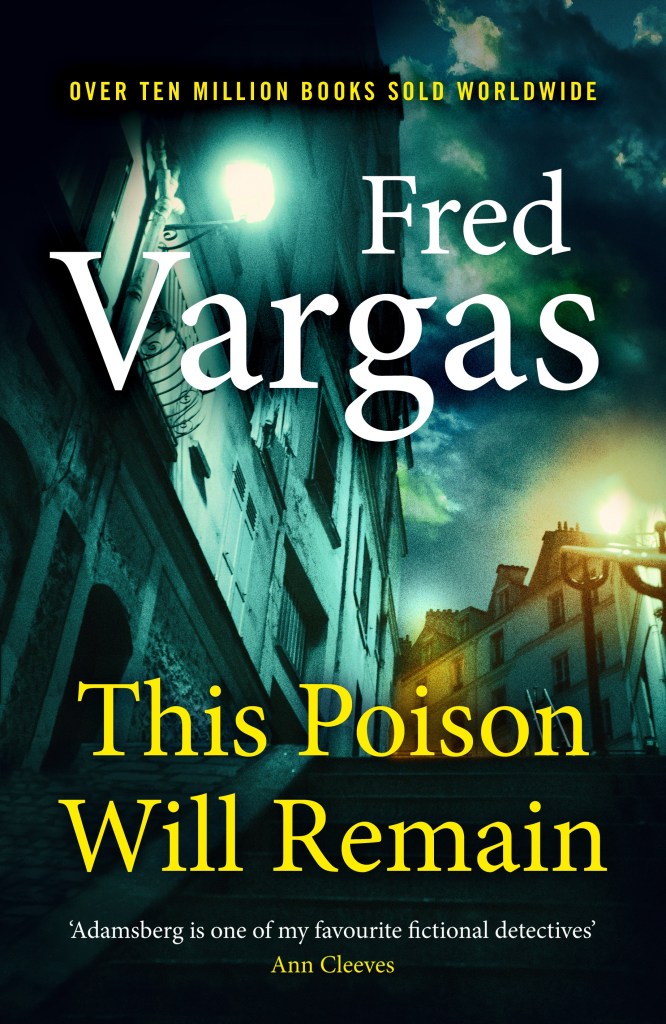
Book Review: This Poison Will Remain by Fred Vargas

Fred Vargas writes a beguiling and often unusual mystery novel. Her series featuring Commissaire Adamsberg and the Serious Crimes Bureau is immensely entertaining for the weird and wonderful storylines and oddball criminals – usually serial killers of some kind with motives beyond the everyday. The latest book – This Poison Will Remain – involves a type of murder no one believes to be anything other blood-poisoning following a spider bite. In Nimes three old men suffer septicaemia and die, but they were old, right? Could happen to anyone, right?

Jean Baptiste Adamsberg, with his nose for the uncanny, thinks otherwise. But he’s going to have a tough time convincing his team to agree with him. Particularly Commandant Danglard, his second in command and former friend. Danglard, in his impeccable English tailoring has become a formidable opponent and with his gift with words and sharp intellect, he soon has the others thinking Adamsberg has lost the plot. This is a new Danglard. In previous books we see him sipping wine on the job and bemoaning his problematic home-life.

You soon realise that this is not your usual police station. There’s Mercadet whose narcolepsy interrupts his police work daily, so he has a cushiony corner in a quiet office where he can catnap. Maternal Helene Froissy keeps a cupboardful of snacks at the ready and helps Adamsberg look after a family of blackbirds who have nested in the courtyard. Amazonian Violette Retancourt is ‘worth ten men’ and is devoted to Snowball the cat who sleeps on top of the photocopier no one uses but is always on to keep it warm. Voisenet would rather be an ichthyologist and stinks out the office with the head of a moray eel he plans to study. Veyrenc hails from the same corner of the Pyrenees as Adamsberg. With his black-and-ginger striped hair, the result of bullies trying to scalp him as a boy, he bursts into clunky Alexandrine verse at every opportunity.

It is Veyrenc whom Adamsberg first turns to for help in solving the mystery of the spider bites, secretly at first. It emerges that two of the victims lived at the same orphanage and were part of a gang who tormented the other boys, hiding recluse spiders in their clothing. In those days before readily available antibiotics, some of their victims endured terrible injuries. If someone was out for revenge, it would be fitting to kill them with spider venom from the same kind of spider, but such spiders are rare and you would need dozens to produce enough poison. And how on earth would you milk the spider venom anyway?

It seems an impossible puzzle, so it isn’t surprising Adamsberg and Veyrenc adjourn to a nearby café, called La Garbure, after the traditional cabbage soup from the Pyrenees, to discuss the case. This is something else I love about the series. Reminiscent of novels by Simenon, Fred Vargas conjures up Paris through Adamsberg’s walks by the Seine, and scenes set in cafés and restaurants. Veyrenc has a bit of thing for La Garbure’s proprietress and the two send each other glances across the room without quite catching each other’s eye.

Like the best crime fiction, the story is very much character driven, but Vargas has plenty of surprises in store for the reader to keep you turning the pages. Adamsberg has the challenge not only of solving the most perplexing of crimes, one that will take him back to the memory of a terrible event from his childhood, but he must also win back the loyalty of his team. Themes around child abuse, mental illness, isolation and the history of religious hermits give the story plenty of depth.

This Poison Will Remain is an excellent read, with a superb English translation that maintains the spirit of the author’s unique, lively and very French style. A four star read from me.

Book Review: Motherland by William Nicholson

Does anyone write about the human condition with as much heart as William Nicholson? Reading his novels always gives me the impression that he loves his characters as if they were family. He brings us their stories, but also their frailties and dreams, as if he’s been through exactly what they’re going through himself. Often set against an interesting background of political or social upheaval.

In the case of Motherland we start off in the middle of World War II. It’s 1942, and three characters meet and fall in love. Unfortunately, both Larry and Ed fall for Kitty when they meet her in Sussex. She’s an ATS driver, a job she enjoys, while Ed’s a Royal Marine commando and Larry, who’d rather be painting, is a liaison officer with Combined Ops under Mountbatten. Ed and Larry both went to the same school and are each other’s oldest friends, which makes this love triangle even harder to navigate.

Kitty chooses Ed, who is dashing and exciting, but also has a darkness to his nature, probably a problem with depression. Meanwhile Mountbatten and his team are planning a raid on Dieppe, using the commandos and the Canadian Infantry stationed nearby. Larry begs to go, even though he doesn’t have to fight, and he and Ed are caught up in one of the worst military disasters of the war. Thousands of casualties, and while Ed is made a hero, an accolade he loathes, Larry has to come to terms with his lack of bravery in the heat of battle.

The effects of Dieppe on all three, but particularly Ed and Larry, resonate through the book, as each settles into life post-war. Ed struggles to find a vocation and Kitty has to give up work, expected to devote her life to husband and child. Larry tries to make a go of painting, at the risk of disappointing his father who wants him to join the family banana importing company, which had made their fortune.

Mostly the book seems to be Larry’s story. We are with him as he witnesses the effects of the partition of India in 1947 (he briefly joins Mountbatten’s lot again), and later, the exploitation of workers in Jamaican banana enterprises. We have a window into his heart and his abiding love for Kitty, but also onto some of the big events of the 1940s. There’s a collection of supporting characters who each are well-rounded and have their own issues: Kitty’s ATS friend Louise who has never had as much luck with men as Kitty and decides to marry the owner of the estate where the troops are stationed – ineffectual but kind-hearted George. There’re the women in Larry’s life who just aren’t Kitty. Each gives us a glimpse of the narrow roles men and women played in mid 20th century society, and the problems entailed in wanting something else.

Motherland has characters that appear in other books by Nicholson, such as Ed and Kitty’s daughter Pamela who is a protagonist in Reckless, set against a backdrop of 1960s London and the Profumo Affair, while news of the Cuban Missile Crisis has everyone on edge. Another great read and evidence that Williamson loves his characters enough to give them more books. I’m happy with that. Motherland is a three-and-a-half-out-of-five read from me.

Review: The Lost Man by Jane Harper

Jane Harper writes brilliant crime fiction that brings the reader face to face with the extremes of the Australian landscape. In The Lost Man, we’re in the dry, scorching outback of Queensland, an atmospheric setting that cranks up the tension. You can’t just go for a lengthy walk – within hours you become dehydrated and ill. People who get lost don’t survive.

The story begins with the arrival of Nathan, loner of the Bright family, at the site of his brother’s dead body. His farm borders that of his family, run by his brothers, Bub and the now deceased Cameron. What was Cam doing here at the old stockman’s grave, miles from anywhere and his car nowhere in sight? They all know it’s madness to go any distance without your vehicle and its stock of water, food and petrol reserves, enough to sustain you until rescue. The family log book where everyone notes their whereabouts for the day says he would be elsewhere on the property, meeting Bub to fix a repeater mast, an appointment he never kept.

Nathan slowly pieces together what was going on in Cam’s life, moving back to the family farm with his sixteen-year-old son, Xander recently home for Christmas, and now it seems for a family funeral. We meet the characters who could reveal more: his still spritely mother, Liz, and Uncle Harry, the longtime farm help and family retainer. There’s also Cam’s wife Ilse, a former barmaid and onetime squeeze of Nathan’s with whom he finds hard to be alone. There are Cam and Ilse’s young daughters and the English backpacking couple who help out where needed.

We get Nathan’s back-story, his difficult relationship with his father-in-law, his acrimonious divorce, the reason why he keeps to himself on his farm and never comes to town. In a way, he is just as much a lost man as his brother Cam, but the death brings him back to his family and leads him to re-evaluate his life and facts he’d taken for granted. There are a raft of family secrets, including stories about Cam – was he such a great guy as everyone seems to suggest? But how does Nathan ask the difficult questions without causing more upset?

The Lost Man is a character-driven mystery that keeps you turning the pages even though there isn’t an obvious threat of a killer on the loose and the piling up of bodies you often find in this genre. The threats that add the requisite tension lie in the harsh environment and its effects on the characters, plus the slow revelation of past wrongs. Everyone seems to have something to hide but can Nathan, with all his baggage, his his taciturn manner, get to the bottom of it all?

The story is entertaining enough, but also reminds you that in a harsh environment, where old traditions die hard and men are men, women can be vulnerable and have limited choices. At the same time, the landscape has a magic of its own – the stunning ochre colours, the big open skies, full of ghosts and stories. It seems more than just a setting; almost a character in its own right. It isn’t surprising that Jane Harper’s books are so popular and win awards – she is fast becoming a master at this genre. A four out of five read from me.