Book Review: Gabriel’s Moon by William Boyd – much more than your average spy novel

I’m always keen to read anything by William Boyd – his prose is crafted, his characters complex and there is always an interesting historical setting. And story-wise, you can never tell what’s going to happen next.

With Gabriel’s Moon we are in London, at least some of the time, in the early 1960s, and our complex protagonist this time is Gabriel Dax. He’s a travel writer at that time when travel writing was really popular, and at thirty, is already very successful.

The book opens with a prologue describing the house fire that killed his mother and when, as a six-year-old, Gabriel was lucky to escape with his life. Ever since, Gabriel has struggled to sleep – with nightmares of the fire plus troubling missing elements of his memory. He has sleeping pills, and not surprisingly he drinks a lot. A doctor recommends he see a therapist and these sessions lead him to investigate just what really happened that night.

Gabriel’s recent jaunt abroad has taken him to Léopoldville, and the newly independent Republic of the Congo. He takes an opportunity to interview the new prime minister, Patrice Lumumba, who wants to set the record straight. It seems his life is in danger, and there are names he wants recorded, should he be assassinated. This is way out of Gabriel’s usual sphere as a writer, but he does what he’s asked, making taped recordings of the interview.

But Gabriel’s work hasn’t always been just about travel. His brother Sefton, being something in the Foreign Office, has on occasion asked Gabriel to make deliveries for him to the Continent. When Faith Green, a secretive woman Gabriel has clocked reading his book on the plane home, contacts him with a commission of her own, his first instinct is to refuse. Faith works for MI6 and is something of a femme fatale. But the money’s good, and the trip to Spain tempting. Before you know it, Gabriel’s involved in more and more dangerous work for Faith and in spite of his niggling doubts, seems unable to refuse.

Gabriel’s an interesting character and not always likeable. You want to give him a good shake, tell him not to drink so much and get a grip on his life. There are sadly not many people he gets close enough to call friends. His girlfriend Lorraine hasn’t a clue about what is going on in his head, while he and his brother are somewhat distant having been brought up by different relatives after the death their mother. So there’s no one there to offer a reality check. How he handles the increasingly tricky situations he gets himself into sees a new Gabriel emerge.

Undercurrents of the political situation with the USSR, the Cuban Missile Crisis, as well as social politics of the time round the story out and the period really comes to life. There are glimpses of the ordinary, such as Gabriel’s ongoing battle with a savvy mouse in his flat; the pest-eradication advice from Tyrone, his streetwise locksmith. The book reminded me a little of A Bird in Winter by Louise Doughty – another really intelligent and nuanced spy novel with a main character on their own and battling for survival. This makes both books really engaging and gripping.

Then there are the settings. As well as Congo, there’s Warsaw and Cádiz, rural England and sixties London. If you’re after a satisfying, pacy but intelligent novel, Gabriel’s Moon might just do the trick. It’s a four-star read from me.

Book Review: The Impossible Thing by Belinda Bauer -a duel timeframe mystery from the cutthroat world of egg collecting

Belinda Bauer is a crime writer from Wales who frequently turns up in the crime fiction awards lists – winning a Gold Dagger for Blacklands, as well as the Theakston Old Peculier Crime Novel of the Year for Rubbernecker. I’ve always enjoyed her books, and would find it hard to pick a favourite, but Rubbernecker was, I recall, a cracker – following the story of a young autistic man and his determination to deal, in his own way, with the death of his father. In Rubbernecker, Patrick signs up for an anatomy class, where groups have to examine a corpse to determine cause of death. It’s his mother’s idea – a way to help him get over his obsession with dying. And this is how he gets tangled up in solving a murder.

It seems guillemots nest on cliffs, clustered in such tight proximity with each other that the mother bird lays a distinctive egg that will be easy to recognise among all the others. The colours are so varied, collectors would vie to obtain the most unusual. This is now quite illegal, but a hundred years or so ago, men would dangle on ropes over cliffs every nesting season to pick out eggs that they could sell. Which is how me meet our other main character, Celie Sheppard.

Celie is so different from her dark, robust looking siblings, her father disowns her and abandons the family to manage Medland Farm themselves. Her mother leaves baby Celie in the care of Robert, the “idiot” boy who helps on the farm in return for bed and board. Celie survives rather than thrives, and the two make an odd pair, both ignored by the other Sheppards. Egg collecting is a nice little earner at neighbouring farms but at Medland Farm there’s a rocky overhang making it impossible. Until skinny little Celie tells Robbie she can fit through a crack in the rock if he’ll hold her rope.

Celie’s story is one of ambition and trust, heroes and villains, love and also tragedy – particularly for the poor bird who gives up her very saleable egg every nesting season. You’re taken into the world of egg collecting – not just the perilous procedure involved, but also the greed and one-upmanship among the traders and collectors.

Nick and Patrick are also an unusual pair, but are oddly complimentary. Patrick is very smart but lacking in social awareness – something he realises and is working on. Nick isn’t all that bright but can be chatty and friendly. As even owning a rare, collectible egg is illegal, Nick refuses to get the police involved, so the two set about tracking down the stolen egg themselves. This will put them in the path of danger, as well as highlighting the motivations of egg obsessives, natural historians, wildlife custodians, and vigilantes.

The Impossible Thing is another cracking read from Bauer. I loved it, although the animal cruelty described is not for the squeamish. Bauer balances Celie’s more poignant story with the humour of Nick’s situation, his often at cross purposes dialogue with Patrick, their hare-brained schemes. There are some madcap action scenes, and the pace picks up to finish the story with a flourish.

This is also a very original novel, not only in its source material but with its two main characters, both outsiders, but both very likeable. And this makes it interesting. I am not sure if Bauer will bring Patrick back for another adventure, but I was delighted to meet him again and enjoyed his quirky smartness. The Impossible Thing is a four-star read from me.

The Impossible Thing will be released at the end of February. I read a proof copy of the book courtesy of Netgalley in return for an honest review.

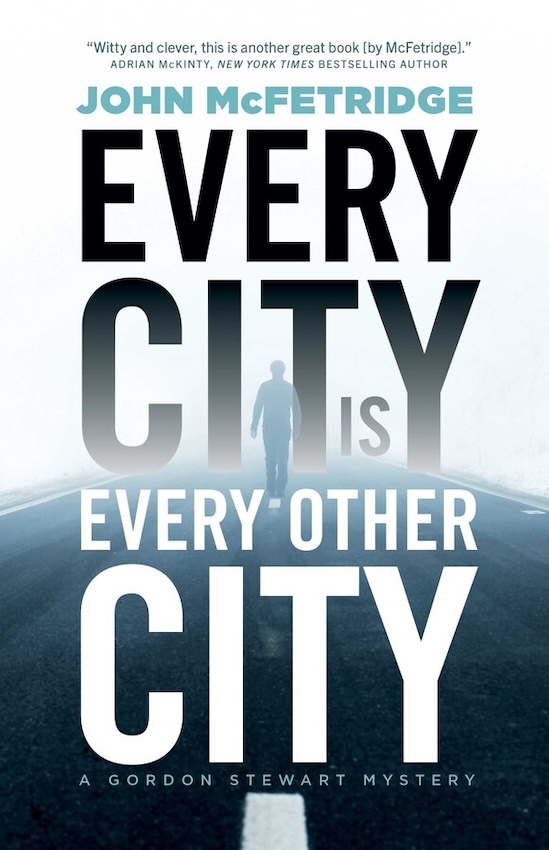
Book Review: Every City Is Every Other City by John McFetridge – a quirky Canadian update of the classic gumshoe mystery

Taking a punt on an author you’ve never heard of before can bring up some nice surprises. The title of this crime novel made me curious and I was soon happily ensconced in this e-audiobook about a part-time private investigator.

Gordon Stewart makes much of his name – you can read it either way, he says. A first name that could be a surname or vice versa. Mostly though, he’s just Gord, a location scout for the movie industry. This work means he’s got an eye for detail, and is good at sniffing things out – useful skills in a private investigator which is something he does when the movie work is quiet.

Lana, a work colleague, talks Gord into finding out what happened to her Uncle Kevin, an out-of-work electrician who has left his wife and gone off in his truck with his rifle. Finding the truck on a back road near the woods, police have written off the disappearance as suicide. He may have been depressed but Lana’s aunt is adamant Kevin’s still alive and wants to know where he is.

There’s also the story of the surveillance job Gord takes on for OBC (Old Boys Club) Security Inc – a case that has similarities to the Harvey Weinstein sexual assault case. Gord’s not keen, but Teddy at OBC can help with official records to help find Uncle Kevin so Gord feels obligated. This gets awkward when Ethel, the actress he has started seeing, discovers which side OBC is working for and decides to do some sleuthing on her own.

Every City Is Every Other City is a different kind of crime novel – maybe it’s the laid-back Canadian humour, or perhaps it’s the blend of PI sleuthing with glimpses of the less glamorous side of movie-making. Key elements of the story concern issues of the day – feminism and the Me-Too movement, for instance, as well as men’s mental health and the importance of work. McFetridge is very smart with dialogue, and his characters are nicely ordinary but interesting at the same time. The plot simmers along quietly, packing in enough tension to keep you turning the pages, with an ending that is both witty and heart-warming.

There’s also a lot of interesting detail about the entertainment industry. I love the way Gord knows just the right locations for somewhere in Ontario that can look like a New York street corner or a small town in America. Ethel’s an improv performer which comes in handy later when she’s trying to pretend she has a good reason to be somewhere she shouldn’t. Her world is also quite fascinating.

Ethel’s quite a character, the bright-spark extrovert opposite Gord’s low key personality. Both are quite appealing in their own way and their relationship adds another story thread. Even Gord’s dad is quirky in the way a man who has lost his wife a long time ago might be – fixing up his house rather than replacing anything, so that it looks mired in the 1980s, which delights Ethel.

Having characters that are fun to hang out with is always a plus, while I particularly liked the reading of this e-audiobook. This is courtesy of Tim Campbell, who takes you nicely into Gord’s head with a flat, gum-shoe kind of monotone that reminded me a little of old movies, and contrasting this well with Ethel’s more lively delivery and that of other characters. I stumbled upon this audiobook quite by accident and it made me realise I haven’t read a lot of Canadian literature in a while – something I’m keen to remedy, as I’d enjoyed it in the past. Every City Is Every Other City is a four-star read from me.

Book Review: House of Glass by Susan Fletcher – a chillingly gothic novel with an extraordinary heroine

I was so taken with Susan Fletcher’s recent novel, The Night in Question, that I thought I’d try one of her earlier books. I picked up House of Glass, a historical mystery novel which oozes creepy house atmosphere.

We start off in London at the turn of the twentieth century, where we first meet Clara as a child, unable to leave her house. She has osteogenesis imperfecta, a kind of brittle bone disease, which means the slightest stumble or fall can cause a broken bone. The doctor thinks it best if she doesn’t go outside until she has grown up – or as grown up as she ever will be.

Clara is well cared for – there are endless books to read, and her mother, Charlotte, and her stepfather love her. Charlotte is a suffragette who left India as a young woman in disgrace and has made a marriage of convenience to Patrick. At the age of eighteen, Clara is able to explore the world with care, but the early death of Charlotte leaves her devastated. She finds herself at Kew Gardens in winter, befriended by one of the gardeners, and is slowly restored to herself by learning about the plants.

The story takes us to Shadowbrook, a once stately home with impressive gardens, where Clara takes on a short-term job – to oversee the establishment of a glass house of tropical plants, delivered from Kew. The new owner of Shadowbrook, a Mr Fox, is rarely at home, so Clara is left to get on with the glass house. But there are ghostly occurrences in the house – footsteps upstairs, where none of the staff or Clara are allowed to venture; flowers that are torn to shreds in the vases; things moved around. The housekeeper talks of paintings thrown from the walls, books flung from the shelves – which explains the bareness in many of the rooms.

Clara is a young woman who has immersed herself in science and doesn’t believe in ghosts. Even so she can’t help but be curious about the Pettigrew family that once lived at Shadowbrook, the stories of wild and cruel behaviour that have made them hated in the village. But the more questions she asks, the more suspicious the locals are of Clara, with her long, pale and untamed hair, her stoop and walking stick, her strange-coloured eyes. She begins to feel as much an outsider as the mysterious Veronique Pettigrew, whose ghost supposedly haunts Shadowbrook.

I had a curious sense of being watched; throughout the garden, I felt it. It was as though I had entered a part of it – the orchard, the lime bower – at the very moment that someone else had risen and left; I felt any metal chair might retain that person’s heat. It was an unsettling notion. I chastised myself for it – it was foolishness – yet I also looked down the lines of hedges. On the croquet lawn, I turned a slow, complete circle to see it all.

House of Glass is a novel that works on many levels. It reminded me of Wilkie Collins’ The Woman in White, with its mix of suspense and mystery. There’s atmosphere by the truckload in the house and the gardens, both evocatively described. Many of the characters seem to be harbouring secrets, some of them quite devastating as the story emerges, and there are a few twists before you get to the end.

My body was discoloured, marked. I was perhaps, more bruised than I had ever been; mauve and dark red and yellow in places. I examined the bruises one by one. I tried to remember the cause of each – a branch or a door frame, my own touch – and once, I might have minded such injuries. But now I saw those bruises as proof that I was living. I was no longer watching life from a London window, my hands on the glass; I was a part of it.

And then there’s the conjuring up of England on the brink of war – it’s 1914, the summer that Clara comes to Shadowbrook – so you’re constantly aware that the futures of the young gardeners and other characters are hanging in the balance. The place of women, not only the suffragettes, but any woman wanting to make a life of her own, to live the way she wants to is a theme that is depicted in the characters of Clara, Charlotte and in the story of Veronique.

House of Glass is a terrific read for anyone who loves a good historical mystery, or enjoys an atmospheric setting, particularly the way an English country house can be almost a character in itself. The characters are interesting more than likeable, while the plot has plenty to get you rushing through the final chapters. Throw in some nicely crafted writing and there’s plenty here to enjoy – it’s a four-star read from me.

Book Review: The Long Water by Stef Penney – an enthralling Nordic mystery with dark echoes from the past

I’m always excited to see a new novel by Stef Penney. Her new novel, The Long Water, takes its name from a river in a rugged part of Norway within the Arctic Circle, where there’s a string of lakes and rivers, guarded by “mountains that rise out of the water like teeth”. It’s a remote area that once fostered mining, but with most mines now closed, the economy is now more reliant on tourism.

In the town of Fauske, senior high school students are enjoying “russ”, a kind of spring break, taking part in dares, general mayhem and partying all night before the hard work of exams begins. In the middle of this, a popular boy goes missing. Daniel was one of a group of friends who called themselves the Hellraisers and who are admired by everyone for their general coolness. A police search that goes on for days and then weeks yields not the missing boy, but a body in a mine that dates back to 1968, when the mine was closed.

The story draws you in through the eyes of several characters beginning with Svea, an elderly woman living on the outskirts of town with her dog who likes to keep to herself. Her one good friend is Odd Emil, a widower who is also Daniel’s grandfather. Svea has fallen out with her daughter, but is in contact with a granddaughter, Elin, who lives with her father, a rather conservative vicar. Now sixteen, Elin has just come out as gender fluid which at first perplexes her father, but fortunately Svea lends a sympathetic ear.

As well as being a mystery, this is also the story of Svea’s family and ongoing damage from their horrific upbringing. Svea has become strong in spite of this – the father she never knew was a German soldier stationed in Norway during the war, and her mother’s one true love. Her violent drunk of a stepfather taunted her with her doubtful parentage, but at least she had the love of her two sisters.

Elin worries that her being neurodiverse is what drove her mother away, but Svea thinks it’s more likely that her daughter has been troubled by her family’s mental health problems, in particular, an alcoholic grandmother and a fey aunt who disappeared some years ago.

The story also follows Benny, Elin’s friend who gets inadvertently caught up as a witness to events on the night of Daniel’s disappearance, while doing something he probably shouldn’t. And then there’s Daniel’s teacher, Marylen, who has a troubled home life and a secret attraction to Elin’s father. They are all interesting characters, well-drawn, who throw different lights onto the central mystery.

So there’s plenty of story threads. How the town deals with the disappearance of Daniel, as well as the discovery of a body pushes the plot along nicely. Elin and Svea can’t help but ask questions while hints of what happened decades ago make you whip through the pages. On top of which, Fauske is such an interesting place for a reader to visit – Stef Penney is brilliant at creating evocative settings – and you have the feeling that there are darker undercurrents that need to be brought to light, particularly around misogyny and prejudice.

While all the characters are easy to sympathise with, Svea is a particularly brilliant creation. She’s crusty and plain-spoken, loves her dog but has secrets too. Her story is slowly revealed, while we wonder if it isn’t too late for her to find peace with the past, reconnection with her family, even love. Stef Penney, who wrote the Costa Award winning: The Tenderness of Wolves, is always worth waiting for and her new book didn’t disappoint. The Long Water is a four and a half star read from me.

Book Review: Mr Campion’s Christmas by Mike Ripley – a fun, seasonal read with both thrills and period charm

Mike Ripley is the author of the Fitzroy Maclean Angel crime series featuring an enigmatic bandleader as its sleuth. Then about ten years ago he picked up where Margery Allingham left off and has written another twelve novels in her Albert Campion series. I feel as if I’m rather late to the party having never read any of the Campion books, which Allingham began way back in 1929, a kind of spoof, supposedly, of Dorothy Sayers’ Lord Peter Wimsey novels.

Having just read Mr Campion’s Christmas I feel I have a bit of catching up to do. The story begins with a bus journey from London, leaving the Victoria Coach Station a couple of days after Christmas. It’s 1962, a year that went down in history not only for the Cuban Missile Crisis, but also a severe season of blizzards that particularly rocked East Anglia. The coach is heading for Walsingham, a Norfolk village famous for its shrines and as such a destination for pilgrims.

Walsingham is also near an RAF airbase, so there are three genial American airman on board, as well as a small collection of odd characters: Hereward Henderson, a history buff and general bore, Miss Pounder, a reserved middle-aged woman, Reverend Breck who is planning to retire in Walsingham, and Fred De Vries, a Dutch art dealer who guards his luggage with his life. It’s a nerve-wracking journey for Graham Fisk, the driver, as snow turns to blizzard, so he’s only too happy to hand over the driving to one of the airmen. But even Oscar can’t keep the bus straight in such horrific conditions and the coach collides with one of the gate posts of a country house named Carterers.

Yes, it’s the home of Albert Campion, his wife Lady Amanda and their son Rupert, just home from his first term at a University in America. The three are hunkering down as the snow falls, along with Campion’s side-kick Magersfontein Lugg, a large man with a few rough edges. The hot meals keep coming thanks to Mrs Thursby, the housekeeper, and the family have also rescued Lloyd Thursby, Mrs Thursby’s deaf father-in-law who has a passion for watching westerns on the TV.

Suddenly the Campions are playing hosts to the stranded coach party and sleeping arrangements have to be sorted. But what starts out as Yule-tide hospitality turns into a hostage situation plus a murder, and it’s a return to the old days for Campion and Lugg who must save the day. It’s a classic kind of thriller, made entertaining and fresh by the quirky characters of the household as well as those from the coach. Most of this group seem to be harbouring a secret, just to make things complicated.

Of course the telephone loses connection so there’s no chance of rescue, and the Campions must rescue themselves, although help comes from an unexpected quarter. Lady Amanda is a modern woman, with a career in the aeronautical industry, and also gets to show her mettle. Just as all seems lost, Campion devises an oddball plan that is very entertaining as well as reasonably nail-biting. Campion hides his skill at handling tricky situations behind a facade of batty eccentricity, that’s a little P G Wodehouse, while his brain is in overdrive looking for windows of opportunity. There are codewords and his number one weapon, the size and heft of Lugg, is eventually deployed.

Bubbling through it all is a steady stream of wit, humorous incidents and smart writing that makes this update of an old favourite nicely readable for a modern audience. But you’re still happily in 1962 and the classic crime writing of this era – the perfect light, diverting escapade for Christmas. Mr Campion’s Christmas is a four-star read from me.

Book Review: 33 Place Brugman by Alice Austin – an engrossing read set in WWII Brussells

Some stories are so much about the setting that it is like a main character. This is the case for 33 Place Brugman, an apartment building in Brussels whose residents are adjusting to life during World War II. As we know, German forces invaded Belgium in 1940 and began an occupation that would last another four years. In this novel, we are treated to a glimpse of normal life before that, and how that changed with the Occupation. The fear and the pressure to conform, to dob people in or risk your life, or else to take courage and resist – to say nothing of food shortages and loss of work.

On the fourth floor of Number 33 are two families: Francois Sauvin, an architect and his daughter Charlotte, and their neighbours the Raphaëls. Leo Raphaël is an art dealer who lives with his wife Sophia, and their children, Esther and Julian. Losing his wife in childbirth, has left Francois to raise his daughter alone, but he’s been lucky to have support from the Raphaëls, particularly Sophia, who has her nanny help out with Charlotte’s care so that Francois can work and sleep.

The children all grow up together, and the two families dine together regularly. So when the Raphaëls disappear one night, without word to anybody, it’s a bolt from the blue. They are a Jewish family, and with stories about Nazi atrocities and the likelihood of another war, the Raphaëls have been lucky to get out when they could.

The Raphaëls leave in the middle of the night, and they leave everything behind.
The sofas and chairs and beds and lamps and heavy carpets and the dining table. The films we made are in a box together with the projector, a set of oil paints, and a blank canvas. On it is a note that reads, For Charlotte. I gasp, the air coming in tight and sharp. I might have thought I was dreaming, but for that note. When I see it, I know the Raphaëls are truly gone.
In their wake, rumours swirl through the building. The Raphaëls haven’t left everything. They took their silver. And the paintings? The paintings simply disappear.

The novel follows the first years of the war and how it affects both the Raphaëls and those that remain at Number 33 – not just Francois and Charlotte, but also Masha, the Russian emigré who lives in the attic, making a living as a seamstress. There’s an elderly widowed Colonel with his dog Zipper, and nosy and unlikeable Miss Hobert – both live below the Sauvins. Next floor down are the DeBaerres whose son Dirk is an old school friend of Julian’s. Each has a part to play in the story as each has to examine their conscience and decide what is the right thing to do.

And this is what the story is so good at. It throws unheard of challenges at its characters, who are complex enough for their decisions to be difficult ones. To keep in the good books of your oppressor, to look out for your neighbour, or to fight back? How to feed your family and to keep them safe.

The novel is also a love story. Firstly, there’s Charlotte, who meets Philippe at art school, where she’s talented and able to see the world in a different way, being quite colourblind. But then there’s Julian, who has always loved Charlotte, which worries his mother. The story also brings in the work of the French Resistance in Paris, through the nefarious Harry, a friend of the Colonel, as well as the war in the air, with Julian signing up for the RAF. This gives the novel plenty of strands, and adds some excitement to balance out the quietly tense periods of the plot, as pressure slowly builds.

For me, 33 Place Brugman was an engaging novel and I was soon swept up in the lives of Charlotte, Julian and their families. It’s quite nail-biting at times, when the reader knows more about the danger around the corner than the characters. The story is also threaded with philosophy, particularly that of Wittgenstein, who is discussed quite a lot – but not knowing a lot about him, I found these references somewhat beguiling. The writing is beautiful though; the characters come to life on the page, as do the settings.

I would have loved to learn what happens to the characters by the end of the war, as the story finishes even before D-Day. An epilogue, maybe? But overall I really enjoyed this original view of the war, and its splendidly evoked setting – so it’s four-stars from me. 33 Place Brugman is to be published on 11 March, 2025 . This advance copy was provided by Netgalley in return for an honest review.

Book Review: In the Blink of an Eye by Jo Callaghan – a police pairing that breaks the mould

I always like to check out the Theakston’s Old Peculier Crime Novel of the Year awards – the shortlists are full of my favourite mystery authors (Elly Griffiths, Ruth Ware, Abir Mukherjee, and that’s just for starters). This year’s winner was Jo Callaghan’s debut novel, In the Blink of an Eye, which breaks new ground in that there’s a new police officer on the team, and it’s AI. The premise of this novel was just too good to ignore.

DCS Kat Frank has been away from the Warwickshire police on bereavement leave, and her husband’s death is still a bit raw. Her son, Cam, who has just completed his A Levels, has been having therapy, his anxiety over losing a second parent who has a dangerous job never far from his thoughts. So Kat has requested a safe option for her return to work, something less on the frontline. Her boss and mentor Chief Constable McLeish has a surprise in store. He’s signed Kat up to run a missing person’s cold case team that also will be trialling AIDEs (Artificially Intelligent Detecting Entities).

Kat is not happy. She’s an intuitive cop who follows her gut. You can’t solve cases with an algorithm, she declares. Meanwhile the scientist who has designed the AIDE, Professor Okonedo, with her own axe to grind, is sceptical of Kat’s skills and of the police in general. Reluctantly Kat agrees to the trial, taking on ambitious DI Rayan Hassan and shrinking violet, yet empathetic, DS Debbie Browne. Okonedo introduces AIDE Lock, a bracelet-type band that you can talk to like Siri, and which can whip up facts, statistics and probabilities in seconds. In holographic form, it’s remarkably like a person.

With hundreds of cold cases to chose from, Lock determines that recently missing young males will be more easily found. But Lock and Kat disagree over which. Kat’s preferred case is Tyrone Walters, a high-achieving young black man from a deprived area. Lock prefers Will Robinson, a young white male not much older from a wealthy home. According to Locke, statistics suggest the Robinson case would be easier to solve because he’s white. Kat is appalled as this racial bias and has a feeling that Tyrone has been a victim of foul play..

Ultimately, Hassan suggests the trial review both cases, and Professor Okonedo assures Kat that Lock can “perform the functions of many officers in just a fraction of the time”. This makes Kat only bristle more, but she reluctantly agrees. If only the team realised that what starts out as a test, a case chosen by statistics versus one chosen by gut feeling, will converge into a single case that is still active.

Picking up her briefcase, Kat paused at the door. She needed to leave her new team with something more motivational than her obvious irritation. ‘Remember, less than one per cent of missing people turn up dead, so we still have a good chance of finding both boys alive.’

‘Just to clarify, that figure represents one per cent of all the missing,’ said Lock’s voice from her wrist. ‘Only four per cent of adults are still missing one week after being reported, which is the category that Tyrone and Will fall within. So, in actual fact, there is a twenty-five percent chance that both boys are already dead.’

This really was an edge of the seat read, as woven into the narrative are scenes from the point of view of someone who has been kidnapped, drugged and immobilised. The clock is ticking and we can only hope that Kat and Lock will sort out their differences enough to solve the crime and save the missing lads. While Kat is learning how to manage Lock and use its obvious skills – downloading data, scanning social media for clues, extrapolating info, etc. – Lock is learning too. And it needs to, particularly with reading body language and developing social skills.

This makes the book really interesting as it takes time before Kat and Lock gel enough to be useful together. For a lot of the time they’re the angry cop and the irritatingly rational cop. Slowly, Kat’s team start to come into their own: Hassan in spite of his confident manner has a softer side and stuff going on at home, while Browne has a big problem to deal with, but fortunately Kat has enough patience to bring her out. Although mostly Kat is on edge, drinks too much and tends to fly off the handle.

It will be interesting to see how Kat and her officers, as well as Lock, evolve over the course of this series – there’s already a second book, Leave No Trace, plus a third to be published in April next year. Quite the feast. Whatever your thoughts on AI, In the Blink of an Eye illuminates it in real-world scenarios. Jo Callaghan has done a lot of research on the subject and how she imagines AI in a policing environment is fascinating. It’s a four-star read from me, and I can’t wait for the TV series. It would be a cracker.

Book Review: The Night Whistler by Greg Woodland – a new cop in a small town that’s simmering with secrets

Readers of these posts will know that Aussie Noir is one of my favourite sub-genres. Having recently read Greg Woodland’s debut crime novel, I am pleased to have discovered what looks like a promising new series. The Night Whistler has all that readers have come to enjoy about Aussie Noir: an evocative, rural Australian setting; small town secrets; and a cop that’s up against it. Set in the 1960s, the story evocatively conjures up the era – the music, the social order plus the edgy restlessness of a long, hot summer.

Mick Goodenough (pronounced like “no-good” backwards, as opposed to “good enough”) has been sent to Moorabool, a smug little town that’s something of a culture shock. A former Sydney detective, he’s been busted down to the rank of Probationary Constable after a case went horribly wrong. Falling foul of his superiors and with a drinking problem that has cost him his marriage, Mick has hit rock bottom but, fortunately, it seems, you can’t keep a good cop down.

The narrative alternates between Mick’s story and that of twelve-year-old Hal, similarly a new kid in town, along with little brother Evan. The two boys are investigating a creek near their house when they come across the body of a mutilated dog. The boys are understandably upset, but go on to give the animal something of a burial, little knowing that the dog is one of a string of such killings that the police won’t take seriously. That is until Mick Goodenough recognises the traits of a perpetrator that will likely take a more serious turn. When the dead dog turns out to be Mick’s, it only spurs him on.

While there’s a killer just getting up steam, Mick is having to deal with arrogant Sergeant Bradley who is wary of Mick’s city cop ways, and lords it over his team. This includes a fellow Probationary Constable who sucks up to Bradley and world-weary Senior Constable Bligh, who becomes an unexpected ally. Meanwhile Mick is desperate to see his teenage daughter again, if only his ex-wife will agree to send her down on the train.

Hal’s father is the bright new spark at Prime Foods, which is why the family have moved to Moorabool. He’s got a fancy new car and wandering eyes. At the Prime Foods Christmas Picnic, we see a microcosm of the town, the braying and overbearing Mayor Dianne Curio, and her bombastic husband, as well as the racism carelessly handed out to Jenna, a young Aboriginal woman who is friendly to Hal and his mother.

Finding the dead dog sets Hal on a mission to uncover the killer – he’s been reading Sherlock Holmes. He gets a hand from young Allie, an Aboriginal girl who teases him relentlessly but shows him how to fish for yabbies in the creek. The two make a great pairing, but obviously they are soon going to be out of their depth. Worse still, Hal’s mother begins getting nuisance calls from someone whistling “Are you lonesome tonight” and making threats. Sergeant Bradley ignores her call for help, even when Mick suggests this isn’t just a snowdropper.

Greg Woodland quickly creates a simmering sense of menace as the story builds towards a gripping ending. But there’s also plenty of banter between Hal and his brother and with Ally, between the kids and their parents and other adults that adds some humour and light relief. Then there’s all the pressure on Mick: the pressure not to probe too much in a town where it pays not to ask too many questions.

For a debut novel, The Night Whistler is expertly constructed, the characters well drawn and interesting, while bringing the setting, both time and place, to life. But we shouldn’t be surprised. Greg Woodward is an experienced screenwriter with a bunch of award-winning films under his belt. The second book featuring Hal and Mick, The Carnival Is Over, is already on my ever-growing list of must-reads. The Night Whistler, excellently narrated by Nic English in audiobook format, is a four-star read from me.

Elektra by Jennifer Saint – a retelling of the Sophocles tragedy for a modern audience

These retellings of stories from Ancient Greek classics can be oddly compelling. The latest to hit my bedside table is Jennifer Saint’s Elektra, a new version of the tragedy by Sophocles. If you haven’t met her before, the eponymous heroine is the youngest daughter of Agamemnon and Clytemnestra. You’ll remember Agamemnon as the leader of the Greek fleet that waged war on Troy – the thousand ships that sought revenge on Paris for making off with Helen – the world’s most beautiful woman, and also Agamemnon’s sister-in-law.

The story starts off with Helen choosing her husband. All the suitors have gathered at the court of her father, the king of Sparta, where she chooses the adoring Menelaus, a second son who will let her stay in Sparta to help rule her father’s kingdom. At the same choosing party is Helen’s sister Clytemnestra. She is impressed by the two brothers from the House of Atreus, particularly the powerful energy emanating from Menelaus’s brother, Agamemnon. After the marriage of Helen, the brothers set sail for the home they have lost to the uncle who’d murdered their father, and with the Spartan fleet behind them, enact vengeance.

It is this house that Clytemnestra marries into, and discovers the terrible curse on the House of Atreaus, one that just won’t leave them alone. It involves murder of innocents, fratricide and revenge – an on-going intergenerational battle for the throne. Things may have settled down after Agamemnon took back his kingdom – if only Paris hadn’t stolen Helen and spirited her away to Troy. You know how it goes.

Jennifer Saint tells the story from the point of view of three women: Clytemnestra, her daughter Elektra and Cassandra, a daughter of Trojan King Priam. Clytemnestra witnesses her husband sacrifice their eldest daughter Iphigenia so that the gods will grant him a wind to take his fleet to Troy. In her grief, she vows to kill Agamemnon on his return, but that’s another ten years away, and her grim decision takes over her life.

Elektra is a child when her father sails off to vanquish the Trojans, and misses him terribly. She is fierce, loyal and ignored by her mother. Clytemnestra’s intentions will set in motion a vengeance of her own. In Cassandra we have the story from the Trojan point of view. Badly treated by Apollo, Cassandra is cursed with a gift to predict the future, but to have her warnings disbelieved. Everyone therefore thinks she is mad – even when she predicts the fall of Troy and sees what’s hidden in the Trojan horse. Taken as a war prize by Agamemnon himself, her story will connect with that of Clytemnestra.

It surprises me just how readable and compelling this novel is given the content. Jennifer Saint does a brilliant job of envisaging the war, the plotting and scheming, the cruel indifference of the gods. One terrible deed just seems to lead to the next, and the characters have few redeeming features. So much bitterness and fury. All three women are trying to make a stand in some way, to determine their future, to make changes – difficult in a world run by power-hungry men and unreliable gods. Humming in the background is the question: if we leave one evil deed unpunished, do we not show contempt for the victim, for human kind and also for the gods?

The ending is brutal, but allows for a small glimmer of hope that the curse has finally come to an end – but who knows? Perhaps that’s another story. Elektra is another excellent addition to the genre, well-researched, intense and atmospheric. A terrific read for anyone who wants to immerse themselves in classical legends – four-stars from me.