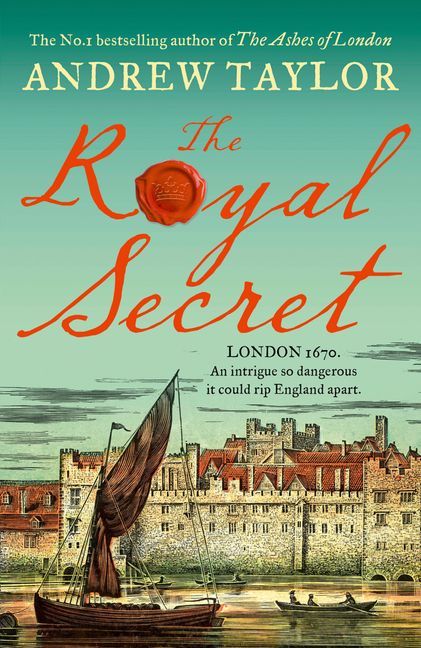
Book Review: The Royal Secret by Andrew Taylor

The Marwood and Lovett series is such a joy for anyone who loves a good mystery, with a historical setting that takes you there. Taylor’s series brings alive the nitty gritty of everyday life plus the machinations of the powerful at court. Set during the reign of Charles II, The Royal Secret has government agent James Marwood investigate the death of a former colleague, a Mr Abbott. He comes across the man in his cups and full of regret on his way from a gambling house.

When Abbott dies suddenly, it is hard not the think about the opening scene of the novel, where Abbott’s stepdaughter and a young maid plot his death by witchcraft. But the twenty-first century reader knows that the man’s death will be a lot more complicated than that. Another incident sees Marwood getting in Cat Lovett’s bad books when he takes her to the theatre and ogles the leading actress. The two have been friends and associates through several hair-raising adventures and now meet regularly for outings. Dating? I think not.

Cat has inherited her husband’s architecture business and at the theatre, meets her client, Mr Fanshaw, along with a Dutchman, Mr Van Riebeeck, a family connection of Fanshaw’s. Cat is charmed by Van Riebeeck, while Marwood takes an instant dislike to the man. The scene also introduces us to the world of the Dutch in England at the time and the political difficulties posed by rivalry between the Netherlands and France. This rivalry will come closer to home when Cat earns a commission to design a poultry-house for the King’s sister who lives at the French court. So many threads of historical interest.

The plot ramps up with plenty of action – James Marwood seems to attract trouble, as his suspicions around Van Riebeeck grow along with jealousy over Cat’s growing friendship with the man. There’s the usual tension of Cat and Marlow’s see-sawing relationship and Marwood is often in trouble with his own servants, which adds a degree of lightness.

While we get to see kings and their courts close up, their finery and excesses, Taylor doesn’t stint when it comes to describing the grubbiness of ordinary life in the 1600s. Characters puke, piss and evacuate their bowels in fairly graphic ways, not surprisingly when there are growing suspicions of poisonings. He throws in some other quirky details, such as the interest in collecting by the wealthy. Fanshaw, an avid collector, adds a disconsolate and elderly lion to his household, caged in the garden to impress visitors.

It’s a brilliant read, well-researched, pacy and as for the characters, I can’t get enough of Cat and Marwood – they are so lively and interesting. Sometimes you want to bang their heads together. But in a world where it is important to find favour in the right places, not just to succeed but to survive, they are refreshingly themselves and more inquisitive than is good for them. I can’t wait for the next book in the series. This one’s a four and a half out of five from me.
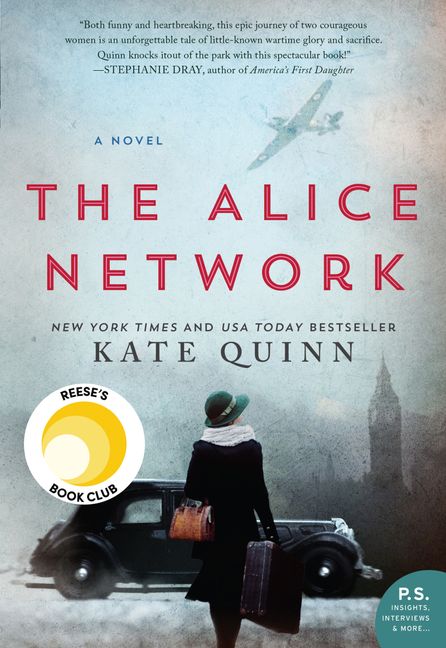
Book Review: The Alice Network by Kate Quinn

There have been quite a few novels telling the story of World War II female British agents dropped into France, and their resistance fighter counterparts, and they often make good reading. It was a time for women getting to do some gutsy jobs, involving danger and cunning – not the usual ‘keep the home fires burning’ roles they were often accustomed to. But what about the earlier war? Kate Quinn puts us in the picture with one particular network run by Alice Dubois (real name Louise de Bettignies) in German occupied France during the First World War.

Although The Alice Network is partly written through the eyes of a fictitious character – Evelyn Gardiner, a British spy (code name Marguerite Le Francois) – Dubois and her network of spies are also incorporated into the story. We first meet Eve years later as an ageing drunk with deformed hands, a bad temper and a tendency to wave her Luger around, firing off a round when startled.

It’s an evening in 1947 when nineteen-year-old New Yorker, Charlie St. Clair, hammers on Eve’s door demanding to be let in. It’s pouring with rain, and Charlie has escaped her mother during a visit to Europe for a completely different purpose. Charlie is determined to track down a long lost French cousin, Rose, angry that no one has found out what happened to Rose in the recent war. Without a death certificate or witness statement, she still hopes Rose is alive. Eve, working at a bureau that helped locate refugees, had corresponded with Charlie’s father about Rose giving no reason for hope.

That’s not the only problem for Charlie – she’s three month’s pregnant and was supposed to be going to a clinic for an abortion. But Charlie needs to track down Rose before it’s too late and take control of her own life. Eve is set to turn Charlie out into the street, but a new lead sparks her curiosity. Before long they form an unlikely alliance, heading to France with Eve’s Scottish hired help, Finn Kilgore, in his ageing Lagonda. Finn also has his own war story, which eventually emerges, but the narrative is mostly Eve’s and Charlie’s, flipping between WWI and 1947 to fill us in on the story of the Alice Network, and Charlie’s journey of discovery.

This is a nicely paced novel. The story of Eve’s war is a grim one, unfolding to reveal how women spies picked up gems of information about troop movements and planned attacks. Eve, with her stutter, looks naive and youthful, but as a waitress in the only decent restaurant in Lille, is an ideal spy with her ease in both French and German. There’s lots of tension here and the sudden switches to Charlie’s story give a bit of light relief. Although her’s is a sad story too, there’s a bit more fun in the way the three travellers interact and develop a grudging respect for each other. Things simmer between them until the past finally catches up with the present and everything comes to a dramatic finish.

I enjoyed the novel immensely as an escapist read, but was also really interested to learn more about the spy-ring run by Alice Dubois and the fate of those who were captured. Remembering that this is a time before women had the vote in Britain, it’s remarkable how these female agents were allowed to take on dangerous missions behind enemy lines. The execution of Edith Cavell, a nurse shot for aiding the escape of Allied soldiers, is a stark reminder that this wasn’t a game.

The characters of our three main players are both interesting and engaging, and the cliff-hanger chapter endings keep you racing through the story. It’s not surprising this novel has been extremely popular and well-recommended, and many will be eager to read Quinn’s new book: The Rose Code. The Alice Network is a four out of five read from me.

Book Review: The Midnight Library by Matt Haig

Matt Haig writes the sort of books that get picked up for movies starring Benedict Cumberbatch (How to Stop Time is one, though still in development). The Midnight Library is the first I’ve read, but looking at his back catalogue, I can see the potential for screen adaptations in the stories he comes up with. They look original, life affirming, sometimes romantic and with a bit of philosophy thrown in. There’s that category, Speculative Fiction which might put you off if you’re not into sci-fi or fantasy. But on the other hand, this could be the Spec-Fic for you.

The Midnight Library is the story of Nora, once a promising young swimmer who, if her dad’d had his way, would have gone on to Olympic glory. She could have been a rock star too, if she hadn’t pulled out of her brother’s band, causing a rift between them that has continued to this day. Her life could have included a career in glaciology, helping save the planet with her studies on Arctic sea ice, or an academic career in philosophy. But somehow, at 35, Nora has hit rock bottom, losing her music store job, missing family and far-away friends and living in a grim flat in Bedford..

When her cat dies suddenly, Nora feels she is so worthless she tries to kill herself, but wakes up in the Midnight Library instead. Here, the librarian is Mrs Elm, a kindly figure Nora remembers from school, who shows Nora the Book of Regrets, and gives her the chance to start again, picking alternative life paths until she finds the one she wants to live. Each segment shows Nora in a new life story, but being dropped into a different life at the age of 35 and having to figure out what she has to do adds some interesting tension. Who are these people, she wonders, and what do I next?

The Midnight Library plays with the idea that if we could live our life again, what would we decide to do differently. Would we be happier? More fulfilled? It is peppered with very quotable quotations – Nora didn’t study philosophy at uni for nothing – and as such the book seems to be full of wisdom. When you’ve got to the end, you might find yourself thinking about your own life and its crossroads and turning points. The ultimate in personalised Spec-Fic, perhaps.

As Thoreau wrote, ‘It’s not what you look at that matters, it’s what you see.’ 

It’s a fun read though – like Nora, you don’t easily pick what will happen next – and there’s a smattering of humour. Though you realise fairly early on that there’s a moral to the novel, not your usual fictional resolution. I was at a writer’s conference recently when the presenter on novel structure reacted adversely to the suggestion that a novel should have a moral. But this one does and somehow avoids being too icky – though some might disagree.

I wouldn’t like to read a book like The Midnight Library too often. It’s a bit gimmicky and too many stories with philosophical meanderings would lessen the effect. However, sometimes a book like this is just the ticket and could be a tonic if you’re feeling stuck in a rut, or to spark a lively book group discussion. I can’t quite bring myself to give the novel a four, so it’s a three-and-a-half read from me.

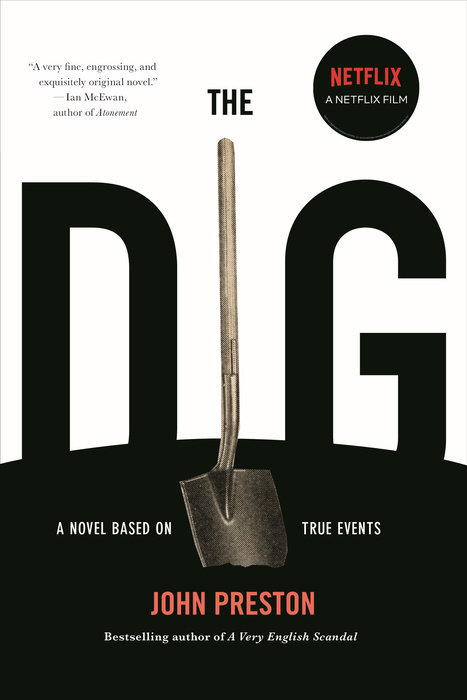
Book Review: The Dig by John Preston

This could be the greatest story you’ve never heard of – well, it was for me until the Neflix movie version came out earlier this year. It had a terrific cast including Carey Mulligan and Ralph Fiennes playing Mrs Pretty, owner of Sutton Hoo, and the man (Basil Brown) she hires to investigate the ancient burial mounds on her Suffolk property. The film had much going for it, including costuming that had me longing for the comfort of classic tailoring.

When I came across the book by John Preston – first published in 2007 – I was happy to revisit the story which is just so interesting. Not only did Sutton Hoo offer up a hoard of fantastic Anglo Saxon treasures: a stunning metal helmet, bowls, amulets and jewellery – a quick trip to google will show you – but it was also encased in a ninety foot ship. Of course the ship’s timber had long since rotted to nothing, so how Basil, and the archaeologists who followed, sensitively excavate the site to reveal it is a wonder.

When Basil discovers a coin the site is soon shown to date from around the seventh century AD – so not a Viking hoard, as first thought, but Anglo Saxon. Suddenly people’s opinions of the what were termed the Dark Ages were challenged. The departure of the Romans from Britain didn’t seem to herald a time of barbarism, barren of any artistic sophistication after all, if the stunning artefacts were anything to go by.

And while the reimagining of all this is enthralling enough, the characters are engaging too. We follow several viewpoints, beginning with Edith Pretty, a frail widow in her late fifties who wants to excavate the mounds before her health fails or there’s a German invasion – this is the summer of 1939. She has a young son, who’s at a loose end having lost his governess, so he chums up with Basil. We’re also in the mind of Basil who’s not an academic, but knows his soil. When the British Museum gets involved, he and Mrs Pretty are sidelined.

This creates plenty of tension and intellectual snobbery which brings in some terrific scenes and personality clashes. Also on the dig is newly married Peggy Piggott (apparently a relative of the author’s) who is helping her university professor husband. Already cracks are appearing in their marriage, and things get complicated when Edith’s young cousin, Rory, turns up on his bike with his photographic equipment.

While the film gives you the visuals to imagine the excavation site, the book adds lots of interesting detail – although the author has taken a few factual liberties, as he explains, ‘for dramatic effect’. I would recommend both for anyone who loves history and archaeology, or a cracking good story. Incidentally, John Preston is also the author of A Very English Scandal – another book on my wish list. The Dig gets a comfortable four out five from me.

Book Review: Anxious People by Fredrik Backman

I’d heard so many good things about Anxious People that it’s been on my Must Read list for a while. And yet a book about an attempted bank heist which turns into a hostage drama isn’t my usual cup of tea. But this is no crazy Bruce Willis and thugs with sub-machine guns story. It’s about ordinary people, strangers who get caught up in an interesting situation and kind of get to know each other.

As the title would suggest, they’ve got problems. The bank robber, following a broken marriage is also suddenly unemployed. No income means no means to pay the rent and that means no home for the kids. The bank won’t lend the robber money either. The story is also about Jack and Jim – the two police officers called to the scene of a hostage situation at an apartment hosting an open home. It’s New Year’s Eve, not an ideal time for an open home, but the door’s open, so that’s where the bank robber escapes to. We learn Jack’s story – how he mightn’t have joined the police, alongside his father, Jim (a bumbling but kindly officer), if he hadn’t witnessed a suicide on a bridge.

The suicide’s story is similar to the bank robber’s. How the banks lost the victim’s savings and assets, which left him with nothing and a family to support. Jack tries to stop him, and fails. The next day visiting the bridge he stops a young girl from jumping too. The girl is later revealed as a character in the story, unbeknownst to Jack, as is the bank manager who couldn’t help the first victim. Jack’s experience as a fifteen year old drives him to want to help people, though these days he mostly just seems to help his father.

Meanwhile the story of how the bank robber escaped and the backstories of the hostages are explored as the book progresses. There is plenty of humour and philosophical meanderings. Thoughts on what makes a happy marriage, a happy life are mulled over by the bank robber and the hostages as they all start getting to know each other. There’s a ton of quotable moments – if you want a snapshot just check out those listed on GoodReads.

“They say that a person’s personality is the sum of their experiences. But that isn’t true, at least not entirely, because if our past was all that defined us, we’d never be able to put up with ourselves. We need to be allowed to convince ourselves that we’re more than the mistakes we made yesterday. That we are all of our next choices, too, all of our tomorrows.” 

The hostage drama turns into quite a nice little get-together over pizza. Fortunately for all concerned there’s a massive traffic jam on the highway out of Stockholm and the designated police negotiator takes a long time to arrive. So everything’s left to Jack and Jim, and the hostages themselves, to work out a solution.

Anxious People is a quirky, feel-good read with plenty of twists, secrets revealed and interesting connections. The story jumps between character to character, dips back in time and allows the hostages to tell their stories and come up with answers. I haven’t read Backman’s previous books (A Man Called Ove, My Grandmother Asks Me to Tell You She’s Sorry are two titles that spring to mind), but now I’m keen to read more. This one’s a four out of five read from me.

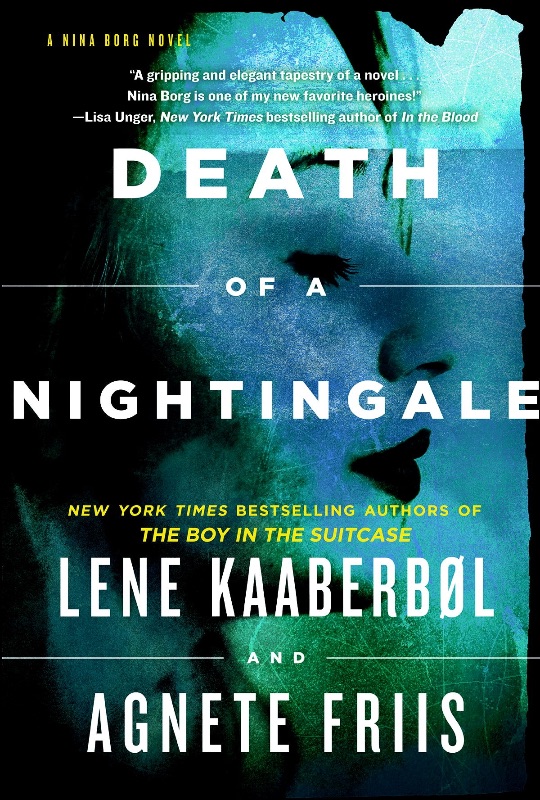
Book Review: Death of a Nightingale by Lane Kaaberbol and Agnete Friis

This novel is the third in the Nina Borg series which began with The Boy in the Suitcase. It’s also the only one I have read. Oh, no, nags the little voice in my head – you should read them all in order! Stilling the little voice, I was soon engrossed in this engaging example of Danish noir.

Nina Borg is a nurse who has worked in some dangerous places in her role with the Red Cross. Now she’s working at a Copenhagen refugee camp, where she feels driven to save those who have fled some horrific situations in their countries of birth. Her tendency to disregard her own personal safety has meant that now she’s cut off from her husband and children and living in a dreary flat. There’s a large digital clock on the wall which triggers thoughts about what her children might be doing at any time in the day.

Nina is one of those characters you want to shout at. She’s always going it alone. ‘Call the police!’ you want to scream. ‘Get some help.’ You can see how her commitment to wanting to help people drives her. But being a maverick sleuth can be lonely. Sometimes she brings home a Swedish doctor colleague for the night, who’s also a bit lonely, but this only makes her seem even more solitary. Already, she’s an interesting main character before we even get to the story.

Flip to Natasha – a runaway from Ukraine, wanted by police at home in connection with the death of her husband, and now in Copenhagen for the death of her fiancé who is a bit of a thug with an eye for her young daughter. It’s not surprising Natasha lashed out. But somehow now he’s dead. Natasha is desperate and being on the run in a Danish winter notches up the tension. Nina is concerned because Natasha’s daughter, Rina, is very sick and isn’t doing well away from her mother. Will Natasha risk everything to see her daughter? The authorities are alert to her possible return, but somebody else is too – somebody who might wish her dead.

There’s a police officer on the case who teams up with Nina when Rina’s safety is compromised. The story also switches back to 1930’s USSR where two young girls live in a village, battling hunger and the difficulty of being a good Soviet citizen. The book captures the period following the great famine when families struggled to feed their children, and hoarding food was an offence that would see you off to the gulags, or worse.

So Death of a Nightingale has plenty of threads in a complex storyline, peopled with a large cast of characters and some interesting twists. How the grim backstory has left its mark on Natasha and her countrymen keeps the reader guessing, and isn’t made clear until the end. But before we get remotely close to that revelation, there’s plenty of action and dicing with death.

I’m glad I picked this one up, even if it is number three in a series of four. The characters are vividly drawn and the story keeps you on your toes. The scenes in Soviet Russia make for sobering reading and remind you how terrible state-led indoctrination can be with repercussions that last a lifetime. I did find the final scenes a little rushed and the complications around the point where the past catches up to the present could have been clearer. Yes, I shall probably check in with Nina Borg again, but I’m not in any hurry. A three-and-a-half out four read from me.

Book Review: Still Life by Sarah Winman

Sarah Winman’s new book begins in 1944 Italy, as English troops are engaged in the push back agains the Germans. We’ve got a meeting between two unlikely friends: Evelyn Skinner a sixty-something art historian sojourning in Tuscany with fellow lesbian Margaret; and a young soldier, Ulysses Temper. Temps, as his mates call him, chances upon Evelyn and introduces her to his erudite Captain Darnley and the three discover a painting which has a big effect on the young soldier.

Oh, drop the Miss, for God’s sake, said Evelyn, sitting down next to him. My name’s Evelyn. And yours?

Ulysses.

Ulysses! How wonderful! And is there a Penelope waiting for your return?

Nah. Just a Peggy. And I doubt she’s waiting, and he turned the ignition and the jeep pulled away.

Temps is from London’s East End, the son of a globe-maker, a fitting occupation for a man named Ulysses. He paints delicate versions of the Earth on carefully prepared spheres, but his experiences in Florence will stay with him long after his return. A chance interception of an attempted suicide will bring him back here, but not before we’ve been introduced to his fellow Eastenders who make up a kind of family, and the 1940s spin into the 1950s.

Winman creates some wonderful characters here, all of them centred on the Stoat and Parrot – the pub owned by Col, a cantankerous publican with permanent dyspepsia. Col runs through girlfriends in alphabetical order, blaming the Shakespeare-spouting parrot for the desertion of his wife. But he’s got a disabled daughter to raise, a naive innocent. Fortunately Peggy’s on hand, taking the girl under her wing along with old-timer Cress who talks to a tree and keeps an eye out for everyone.

Peggy is Ulysses’s wife – a hasty marriage brought on by the start of war, but his time away has Peggy form an attachment to American soldier, Eddie, and left her with a daughter, Alys. When Eddie fails to return, Peggy belts out her blues in song at the Stoat and Parrot, accompanied by Pete, when he’s not in a show. The reader gets enough of the gritty post-war London with it’s slow rebuild and pea-soup fogs to want better for this odd family of characters. It comes in the form of a legacy which has Ulysses, Cress and young Alys (who Ulysses loves like his own daughter) move to Florence accompanied by Claude, the parrot.

From here, the story weaves through the decades, and Ulysses makes new friends and learns to love the Italian lifestyle. He chucks out his demob suit for a sharp Italian look and Cress learns to cook pasta. Our friends from the Stoat and Parrot will drift here for visits and longer stays, watching the big world events play out – the moon landings, student demonstrations, assassinations of Martin Luther King and JFK – as the world recreates itself after the recent wars.

Still Life is a feast for the senses. The food alone in this book is worth reading it for – I pulled out an Italian cookbook destined for a second-hand fair, determined to revisit some of these classic dishes. As well as the food and wine we have sweltering summers, scented gardens, wonderful art (and poetry), the music of the day, romantic attachments of all kinds, shown with sensitivity and warmth.

I loved the characters, but particularly Ulysses, who unlike his namesake, is sensitive, charming and caring, quietly missing Peggy who he can’t seem to forget. Still Life is a lively book full of lifelike people who learn to live and love again in a wonderful new place (there’s also a quirky lack of punctuation when it comes to dialogue, which took a bit of getting used to). It’s also a hymn to Florence, and if you’ve been there before, Still Life will bring it all back for you. A book that charms on many levels, it’s a four out of five read from me.

Book Review: The Van Apfel Girls Are Gone by Felicity McLean

Felicity McLean’s debut novel novel has been described as The Virgin Suicides meets Picnic at Hanging Rock. Set in small town Australia, the book is told in two time frames, and begins when Tikka Molloy returns home to reconnect with her sister Laura who isn’t well. She can’t stop thinking, had they did the right thing twenty years ago when their friends, the three Van Apfel sisters vanished. She looks back on that sweltering summer when she was eleven and the events that led up to their disappearance.

Tikka is a great child narrator – she reminds me a little bit of Scout from To Kill a Mockingbird, if we’re thinking of book comparisons here. She’s smart and imaginative and comes from a loving family. At the corner of their street live the Van Apfels and Tikka and Laura spend a lot of time there as the family has a pool. The Van Apfels attend a fundamentalist church – their dad, though outwardly genial, is particularly strict and this causes tension with his wayward thirteen-year-old daughter Cordelia.

There’s a lot of Tikka trying to make sense of her world and understand what’s going on with the grown-ups, and the tension that seems to lurk at the Van Apfels. There’s a new teacher, Mr Avery, who has a mysterious past that may have included a stint in prison – as rumour has it. So along with the simmering heat there is plenty of simmering tension as the school plans its big, Showstopper concert at an outdoor amphitheatre, for which Tikka has written her own skit and where events build to a climax.

In true Aussie Noir style, the landscape plays a big part in this novel. The mangroves around a brackish estuary create a sinister backdrop (Tikka complains of an unpleasant smell); the empty landscape beyond; the heat bouncing off the tarmac. It all adds to the mood and tension of the book. And there is a hint of the unreliable narrator about Tikka. How accurate are her memories from childhood? Even now as an adult she still can’t help looking for Cordelia (Cordie) at railway stations, at busy intersections, her blonde head just disappearing around corners, failing to stop when called. The Van Apfel girls may have disappeared that summer, but a part of Tikka seems to have been lost as well.

The Van Apfel Girls Are Gone is an impressive debut, a character driven mystery that is also quite the page-turner. There is plenty of humour with the way McLean re-imagines childhood, the rivalry between sisters and between classmates, the rumours and the secrets, the superiority of the older kids. This balances out the sadness of what happens and the feeling of lost innocence which runs through the story. Not a long book, McLean’s novel is well worth picking up, and heralds a promising new author to look out for. A four out of five read from me.

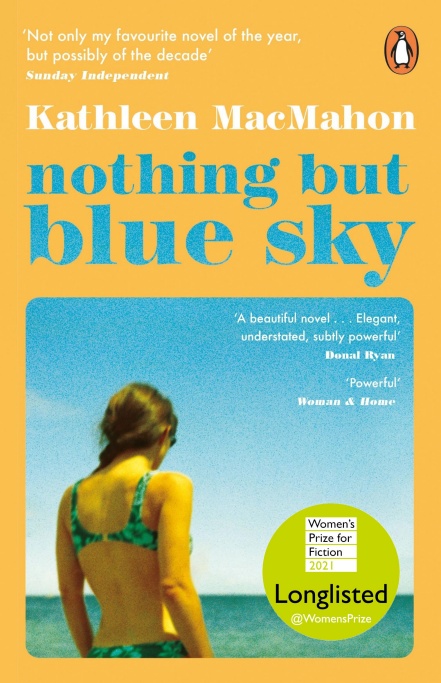
Book Review: Nothing But Blue Sky by Kathleen MacMahon

When winter starts to bite, there’s nothing like a book cover showing a summery scene to make you want to pick it up. Kathleen MacMahon’s latest book, Nothing But Blue Sky describes a succession of summer holidays spent abroad, mostly on the sunny Costa Brava. 

David Dowling is recently bereaved – his wife, Mary Rose, killed in a plane crash while she was on her way to a wedding. Ever since they were newly married, the couple have holidayed at the same Spanish seaside town, visiting the same restaurant over the years, the same bar for their pre-dinner aperitif. They’ve people watched, making up stories in particular about a glamorous French family.

In many ways, this is the story of a marriage. David is a cynical foreign correspondent, who doubts his capacity for happiness. His parents seemed to live in a loveless marriage, his father bullying his mother, just as his older brother bullied David. When David meets Mary Rose, he is swept up into the world of his girlfriend’s family, a home full of joy and conversation and people who actually seem to like each other. David discovers another way to live, but can’t quite shake off his inner doubts, his bad cop to Mary Rose’s good cop routine.

When Mary Rose dies, David’s grief is all-consuming. He revisits the events of his marriage – Mary Rose’s goodness and optimism, their childlessness, the way they just seemed to gel, their disagreements. The book weaves their story together in chapters that read a little like a succession of short stories highlighting different aspects of their relationship.

A summer holiday with friends, soon after the air crash, is a miserable affair for David, so he bravely takes himself off to Aiguaclara one more time, and the possibility of starting again takes shape. 

MacMahon draws you slowly into the novel, and in David has created a brilliant character study. How do you deal with feelings, when you’ve spent a lot of your life suppressing them? David is a difficult character but oddly likeable, and you want him to learn a little empathy and trust. This is such a sensitive portrayal about love and loss, about happiness and grief, nuanced and yet also very entertaining. 

The book reminded me a little of novels I’ve read by Anne Enright as well as Andrea Levy. I can’t wait to read more by MacMahon. Nothing But Blue Sky earns a four and a half out of five from me.
Book Review: Home Stretch by Graham Norton

I listened to Home Stretch as an audiobook, and this is a terrific option in this case as the book is read by the author. Graham Norton has a warm and vivid reading style – he has the kind of voice that sounds friendly and the humour never seems all that far away, even when the plot takes a serious turn. Which it does quite often.

The story concerns young Connor, who is caught up with a bunch of local teenagers on the eve of a wedding, tagging along on a trip to the beach. He’s the son of a publican in one of those tiny Irish coastal towns where everybody knows everybody and there’s no hiding any secrets, or so we might suppose. When the car crashes and three are killed, including the bride and groom, another girl left fighting for her life, Connor carries the shame of being the driver responsible.

After the court case, Connor is sent to Liverpool to work for a cousin’s building business and sets out to forget his family, his town and all that has gone on before. But Connor has another secret – he is gay – something he has never been able to mention to his family; this is 1987 after all. When fate conspires to send Connor to London and later to the US, it seems like he can never go home.

The story weaves between Connor’s and that of his sister, Ellen, rescued from shame by Connor’s fellow crash survivor, Martin, the doctor’s son. Martin seems to be the white knight, dazzling Ellen with thoughts of new beginnings. Things don’t quite turn out for Ellen as she may have hoped, and eventually the past will come back and secrets will emerge. Can Connor ever make his way home again and find acceptance in his family?

The story switches between viewpoints and jumps through the decades to the time of the referendum that voted for legalising gay marriage in Ireland. Even Connor’s dad put up a ‘vote yes’ poster in the pub, so the book mirrors changes in society as well as several dawning realisations among the main characters. I felt this was perhaps a more personal story from this author, and it is easy to imagine Norton weaving in some of his own experiences and insight about the gay scene and the shifts in public perception over time.

My only reservation was that sometimes we seem to be fairly galloping through the years and I could happily have stayed awhile longer here and there. But at least this keeps the reader hooked on the story, wondering if Connor will ever make it home to face the past. The book is told with very real feeling and any parent will relate to the fear of never seeing their child again. Norton has such a deep empathy for his characters, even the ones we are not supposed to like are not painted entirely black – there is understanding for them as well.

I loved the dialogue which is very real and lively – Norton having a keen ear for the way people express their personalities in speech. And then there’s the humour, just twinkling away in the background, caught in the banter of characters’ interactions, the way they perceive themselves, the foolishness of youth, the misunderstandings. Home Stretch is a heartfelt and entertaining read, and I thoroughly recommend the audiobook version and Graham Norton’s splendid performance. A three and a half out of five read from me.